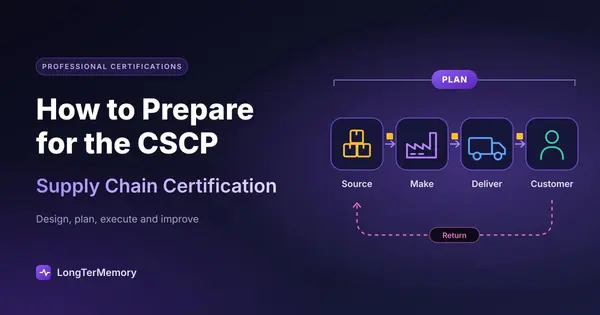
How to Prepare for the CSCP Supply Chain Certification
A practical guide to passing the APICS CSCP exam, covering what it tests, how to study efficiently, and the best resources for certification success.
Table of Contents
- What the CSCP Tests Across Supply Chain Strategy and Operations
- Study Resources and Recommended Preparation for CSCP Certification
- Recommended Study Timeline
- Practice Question Strategy and Study Timeline for CSCP Exam Readiness
- The Review-First Method
- Simulating Exam Conditions
- Using Spaced Repetition for CSCP Terminology and Concepts
- The Bottom Line
The APICS Certified Supply Chain Professional (CSCP) credential is one of the most respected certifications in operations and logistics. It signals that you understand end-to-end supply chain management, from supplier relations to delivery to the customer. But respect comes with difficulty. The CSCP exam is broad, detailed, and demands both conceptual understanding and application under pressure.
If you are preparing for the CSCP, you need more than a textbook and good intentions. You need a structured plan that respects the exam’s scope and uses your study time efficiently. This guide covers what the CSCP actually tests, how to approach each content area, and the study strategies that produce passing scores.
What the CSCP Tests Across Supply Chain Strategy and Operations
The CSCP exam covers three main modules: Supply Chain Design, Supply Chain Planning and Execution, and Supply Chain Improvements and Best Practices. These sound generic, but the exam gets specific fast. You need to understand frameworks, apply them to scenarios, and calculate basic metrics.
| Module | Key Topics | What the Exam Asks |
|---|---|---|
| Supply Chain Design | Strategy alignment, network design, sustainability, risk management | Which design fits a given business scenario? How to mitigate specific risks? |
| Planning and Execution | Demand planning, inventory management, procurement, logistics, customer service | Calculating safety stock, selecting planning methods, optimizing logistics routes |
| Improvements and Best Practices | Lean, Six Sigma, technology, measurement, compliance | Identifying waste, selecting KPIs, applying continuous improvement tools |
The exam is 150 multiple-choice questions, and you have 3.5 hours. Many questions are scenario-based, meaning you need to read a short business case and select the best supply chain response. Pure memorization is not enough. You need to think like a supply chain manager.
Study Resources and Recommended Preparation for CSCP Certification
The official APICS Learning System is the gold standard, but it is not the only resource you need. Think of it as your foundation, not your entire house.
Here is a resource stack that works:
- APICS CSCP Learning System. This is the official material and it mirrors the exam content outline closely. Use it as your primary text.
- CSCP Exam Content Manual (ECM). APICS publishes this free outline of exactly what is testable. Cross-reference every topic you study against the ECM to avoid wasted effort.
- Practice questions from multiple sources. The Learning System includes practice questions, but you need more volume. Third-party question banks expose you to different wording and trickier scenarios.
- Flashcards for terminology and formulas. The CSCP has a dense vocabulary. Spaced repetition is the most efficient way to lock in terms like ATP (Available to Promise), VMI (Vendor Managed Inventory), and TCO (Total Cost of Ownership).
Recommended Study Timeline
| Timeline | Weekly Hours | Focus |
|---|---|---|
| 12 weeks out | 8 to 10 | Read through all modules, build flashcards |
| 8 weeks out | 10 to 12 | Deep dive into weak areas, start practice questions |
| 4 weeks out | 12 to 15 | Intensive practice tests, review wrong answers |
| 1 week out | 6 to 8 | Light review, final practice exam, rest before test day |
Most successful candidates study for 100 to 150 total hours. If you have supply chain work experience, you can aim for the lower end. If the material is new to you, budget for the higher end.
Practice Question Strategy and Study Timeline for CSCP Exam Readiness
Practice questions are where the learning happens. Reading the material is necessary but passive. Answering questions under pressure forces you to apply what you know and exposes gaps you did not know you had.
The Review-First Method
When you miss a practice question, do not just read the correct answer and move on. Use this five-step review:
- Why is the correct answer right? Explain it in your own words.
- Why did you choose your wrong answer? Identify the specific misconception or careless mistake.
- What concept does this question test? Map it back to the module and topic.
- What would a similar question look like? Write a variation to test the same concept.
- Add it to your review schedule. Use spaced repetition to revisit this concept in 3 days, 1 week, and 2 weeks.
This method turns every wrong answer into a learning event. Students who do deep error analysis improve faster than students who simply log their score.
Simulating Exam Conditions
Two weeks before the exam, start taking full-length practice tests under realistic conditions:
- 3.5 hours straight, no extended breaks.
- No phone, no notes, no interruptions.
- Same time of day as your scheduled exam.
The CSCP is as much an endurance test as a knowledge test. Sitting and thinking critically for 3.5 hours is a skill you need to practice.
Using Spaced Repetition for CSCP Terminology and Concepts
The CSCP exam rewards precise knowledge of terminology, formulas, and frameworks. LongTerMemory can help by turning your notes and the APICS Learning System into active recall flashcards automatically. Instead of re-reading chapters, you review targeted cards that surface exactly what you are at risk of forgetting. For a certification with this much vocabulary, that efficiency matters.
The Bottom Line
The CSCP is challenging but absolutely passable with disciplined preparation. Respect the breadth of the content. Build a structured study plan. Prioritize practice questions and deep error analysis. And give yourself enough time, 12 to 16 weeks is the sweet spot for most candidates.
Supply chain management is a field that rewards systems thinking. Approach your CSCP prep the same way: design your study system, execute it consistently, and measure your progress. The certification is the proof that you already think like a supply chain professional.