How to Use Mnemonics to Remember Complex Information
Learn the main types of mnemonics, how to create custom memory devices for any subject, and how to review them so they stick long-term.
Your brain is not designed to remember random facts. It is designed to remember stories, images, patterns, and things that feel meaningful. That is why you can recall the plot of a movie you saw once ten years ago, but you cannot remember the name of that enzyme you read about yesterday. Mnemonics work because they hijack this natural tendency. They turn abstract, arbitrary information into concrete, memorable forms that your brain actually wants to keep.
The problem most people have with mnemonics is not that they do not work. It is that people use them lazily. They memorize a single acronym and think they have mastered the technique. In reality, mnemonics are a toolkit. Different jobs require different tools. This guide covers the main types, when to use each, how to build custom mnemonics for your specific material, and how to review them so you do not forget the mnemonic itself.
The Main Types of Mnemonics and When to Use Each
Mnemonics fall into several categories, each suited to different kinds of information. Knowing which type to use is half the battle.
| Type | How It Works | Best For | Example |
|---|---|---|---|
| Acronyms | First letters form a word | Ordered lists, steps, categories | PEMDAS for math order of operations |
| Acrostics | First letters form a sentence | Longer ordered lists | ”My Very Educated Mother Just Served Us Noodles” for planets |
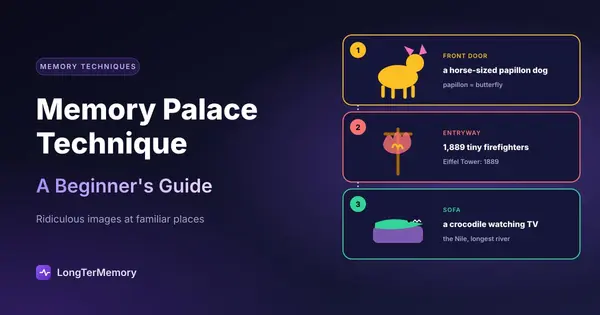
| Method of Loci | Place items along a familiar route | Large unordered sets, speeches | Imagining grocery items placed in rooms of your house |
| Keyword Method | Link foreign or technical word to a familiar sound-alike | Vocabulary, terminology | Spanish “carta” (letter) sounds like “cart,” imagine a letter in a cart |
| Peg System | Associate numbers with rhyming objects, then hang items on them | Numbered lists | 1 is bun, 2 is shoe, then associate list items with buns and shoes |
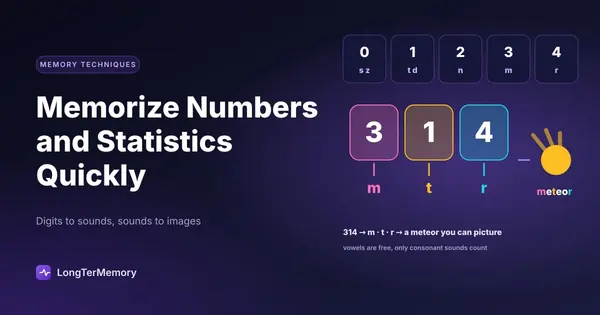
| Chunking | Group digits or facts into meaningful units | Numbers, codes, long sequences | Remembering 14921776 as 1492 and 1776 |
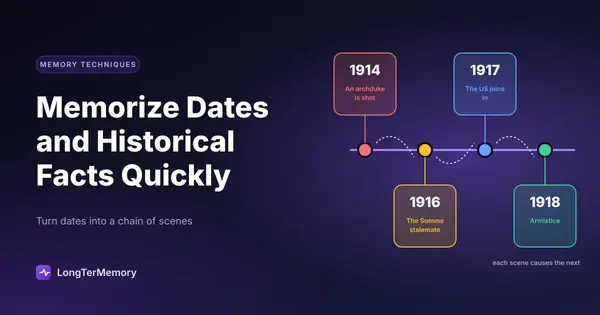
| Visual imagery | Create vivid, exaggerated mental pictures | Abstract concepts, pairs | Imagining a giant mitochondria lifting weights for “powerhouse of the cell” |
For short ordered lists, acronyms and acrostics are unbeatable. For large amounts of unordered material, the method of loci is the gold standard. For language vocabulary, the keyword method is research-backed and highly effective. For numbers, chunking is almost automatic once you practice it.
Creating Custom Mnemonics for Your Specific Study Content
Pre-made mnemonics are fine, but custom mnemonics are far more memorable. When you build your own, you engage in deeper processing, which itself strengthens memory. The process of inventing the mnemonic is almost as valuable as the mnemonic itself.
Here is a simple framework for building custom mnemonics:
- Identify what needs to be remembered. Be specific. Is it a list? A sequence? A definition? A pairing?
- Extract the key elements. Strip away everything non-essential. What are the core words, numbers, or concepts?
- Find anchors. What do these elements sound like? What do they look like? What personal memory do they trigger?
- Build a bridge. Connect the anchor to the target information with a vivid image, sentence, or story. The weirder and more emotional, the better.
- Test it. Try to recall the target from the mnemonic alone. If it does not work, rebuild it.
Example: Custom Mnemonic for Biochemistry
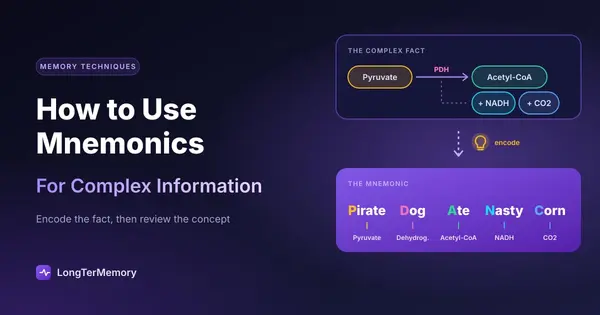
Suppose you need to remember that pyruvate dehydrogenase converts pyruvate into acetyl-CoA, producing NADH and CO2 in the process. A generic mnemonic might be “Pirate Dog Ate Nasty Corn.” A custom mnemonic built with vivid imagery might be: imagine a pyramid (pyruvate) being de-helmeted by a dog (dehydrogenase), who then gives an ace card to a coach (acetyl-CoA), while a naughty (NADH) crow (CO2) flies overhead. The absurdity makes it stick.
How to Review Mnemonics So You Do Not Forget the Mnemonic Itself
The biggest failure mode of mnemonics is forgetting the mnemonic. You stare at the exam question, remember that there was a sentence about a dog, but cannot reconstruct what the dog stood for. This happens when you review the mnemonic without reviewing the target information.
Here is the correct review sequence:
- Prompt with the real question first. What does pyruvate dehydrogenase produce? Try to answer from memory.
- If stuck, use the mnemonic as a retrieval aid. Picture the dog, the ace card, the crow.
- After retrieving the answer, review the full concept. Do not stop at the mnemonic. Rehearse the actual biochemical pathway.
- Space your reviews. Use a spaced repetition system to revisit the card at increasing intervals. The mnemonic should fade into the background over time as the real knowledge becomes direct.
The goal of a mnemonic is to be a scaffold, not a permanent crutch. Over multiple spaced reviews, you should find that you no longer need the mnemonic to recall the fact. The direct memory has formed underneath it.
Mnemonics and LongTerMemory
If you are building custom mnemonics for dense subjects like medicine, law, or engineering, you will end up with dozens or hundreds of them. Managing them in notebooks or scattered digital files becomes chaotic. LongTerMemory helps by letting you turn each mnemonic into a flashcard with the target prompt on one side and your vivid image or sentence on the other. The built-in spaced repetition schedule ensures you review each mnemonic at the optimal interval, so the scaffold stays strong until the direct memory takes over.
The Bottom Line
Mnemonics are not a gimmick. They are a cognitive tool grounded in how human memory actually works. The key is choosing the right type for the information, building custom mnemonics that are vivid and personal, and reviewing them correctly so they serve as a bridge to real understanding rather than a fragile substitute for it.
Start with one topic where you are struggling to memorize raw facts. Build one custom mnemonic using the framework above. Test it tomorrow, then in three days, then in a week. Watch how much easier recall becomes. Then build another. The skill compounds.