How to Memorize Dates and Historical Facts Quickly
Master history memorization with proven techniques like the Major System, narrative chaining, and visual storytelling to ace exams and retain facts.
Table of Contents
- Why Dates Are So Hard to Remember
- The Major System: Turning Numbers Into Words
- Putting It Into Practice
- Why the Major System Works
- Turning Dates Into Memorable Stories
- Example: The Timeline of World War I
- Linking Historical Events Into Narrative Chains
- How to Build a Narrative Chain
- Example: The Fall of the Roman Empire → The Middle Ages
- The Timeline Visualization Method
- Setting Up Your Mental Timeline
- Why Spatial Memory Is So Powerful
- Practical Strategies for History Exams
- Strategy 1: The Anchor Dates Method
- Strategy 2: The "5 W's" Flashcard
- Strategy 3: Compare and Contrast
- Common Mistakes in History Memorization
- Mistake 1: Memorizing Dates Without Context
- Mistake 2: Trying to Memorize Everything Chronologically
- Mistake 3: Ignoring Causation
- Mistake 4: Studying Without Testing
- A Weekly Study Plan for History
- The Bottom Line
History has a memorization problem. Not because the subject is boring , it’s actually full of incredible stories, wild characters, and moments that changed everything. The problem is that history comes loaded with dates, names, sequences, and specific facts that your brain treats as arbitrary information and promptly forgets.
When did the French Revolution start? Was the Battle of Hastings in 1066 or 1076? Did the Renaissance come before or after the Protestant Reformation? These feel like the kind of things you should just “know,” but dates and isolated facts are notoriously difficult to remember because they lack the kind of inherent meaning that makes information stick naturally.
The good news is that people have been solving this exact problem for centuries. Memory champions regularly memorize strings of hundreds of random numbers using techniques that work just as well for historical dates. And linking facts into narrative chains makes them dramatically more durable than isolated flashcard entries.
Let’s break down the methods that actually work.
Why Dates Are So Hard to Remember
Before we get to solutions, it helps to understand why dates are such a pain in the first place.
Your brain is designed to remember things that are meaningful, emotional, spatial, and connected to existing knowledge. Dates are none of these things. The number 1789 has no inherent emotional weight. It doesn’t trigger an image. It doesn’t connect to your personal experience. It’s just four digits.
Compare that to the actual event: angry Parisians storming a medieval fortress-prison, guards being overwhelmed, the beginning of a revolution that toppled a monarchy. That story has drama, emotion, visual detail, and clear cause-and-effect. Your brain eats that up.
The trick to memorizing dates isn’t to stare harder at numbers. It’s to convert numbers into the kind of information your brain naturally retains , images, stories, and spatial locations. That’s what the techniques below do.
The Major System: Turning Numbers Into Words
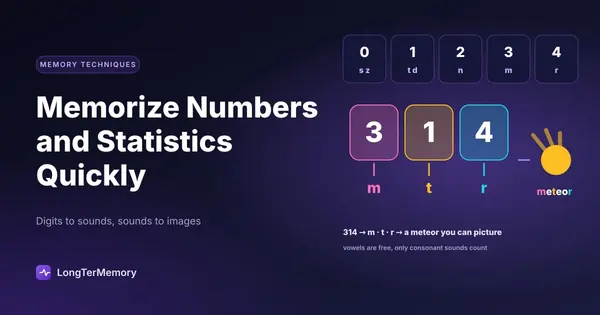
The Major System is the most powerful general-purpose technique for memorizing numbers, and it’s been used by memory practitioners since the 17th century. It works by assigning a consonant sound to each digit, allowing you to convert any number into a word or phrase.
Here’s the code:
| Digit | Consonant Sounds | Memory Aid |
|---|---|---|
| 0 | s, z, soft c | zero |
| 1 | t, d, th | t has one downstroke |
| 2 | n | n has two downstrokes |
| 3 | m | m has three downstrokes |
| 4 | r | four ends in r |
| 5 | l | L is the Roman numeral for 50 |
| 6 | j, sh, ch, soft g | J looks like a mirror-6 |
| 7 | k, hard c, hard g, q | K looks like two 7s |
| 8 | f, v | cursive f looks like 8 |
| 9 | p, b | p is a mirror-image 9 |
Vowels (a, e, i, o, u) and the letters w, h, and y are ignored , they’re “free” and can be inserted anywhere to form words.
Putting It Into Practice
Let’s encode the year 1789 (French Revolution):
- 1 = t/d
- 7 = k/g
- 8 = f/v
- 9 = p/b
Possible words: t-k-f-p → “duck” (1-7) + “fib” (8-9) → “duck fib”
Now create an image: Picture a duck telling a fib (a lie) to the king of France, and the king gets so angry he starts a revolution. Absurd? Yes. Memorable? Absolutely.
Or try: 1066 (Battle of Hastings)
- 1 = t/d
- 0 = s/z
- 6 = sh/ch/j
- 6 = sh/ch/j
“tissue” + “judge” → Picture a Norman warrior using a tissue while a judge rules that England now has a new king. The weirdness makes it stick.
Why the Major System Works
The system works because it transforms abstract numbers into concrete, imageable words. And once you have a word, you can create a vivid mental image that connects the date to the event. Your brain is terrible at remembering “1789” but excellent at remembering a duck telling lies to the French king.
The initial investment in learning the digit-to-sound code takes about an hour. After that, you can encode any date in seconds. It’s one of the highest-return memorization investments you can make.
Turning Dates Into Memorable Stories
Even without the Major System, you can make dates stick by building stories around them. The key ingredients of a memorable story are:
- Visual specificity , don’t think “a battle happened,” think “armored knights charging across a muddy field”
- Emotional content , fear, excitement, absurdity, humor
- Cause and effect , why did this happen? What happened next?
- Personal connection , can you relate this to something in your own life?
Example: The Timeline of World War I
Instead of memorizing isolated dates, build a narrative chain:
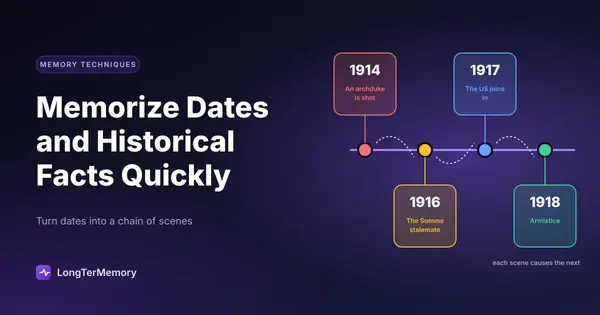
1914: An archduke gets shot in Sarajevo. Picture the moment , the car, the crowd, the chaos. The number 14 in the Major System gives you “tire” (t=1, r=4). Imagine the archduke’s car getting a flat tire , that’s why they stopped, and that’s when the assassin struck.
1916: The Battle of the Somme , one of the bloodiest battles in history. 16 gives you “dish” (d=1, sh=6). Picture soldiers sharing a last dish of food before the battle. The contrast between the simple meal and what’s coming creates emotional weight.
1917: The United States enters the war. 17 gives you “dog” (d=1, g=7). Picture Uncle Sam walking a dog into the battlefield , absurd and unforgettable.
1918: The war ends. 18 gives you “dove” (d=1, v=8). Picture a dove landing on a cannon, and everyone stops fighting. A dove of peace , the image basically writes itself.
Now you have a sequence: tire → dish → dog → dove. Run through that sequence a few times, and you’ve got the major dates of WWI locked in with vivid, emotionally charged images.
Linking Historical Events Into Narrative Chains
Individual facts are forgettable. Connected facts form stories, and stories are almost impossible to forget. The narrative chaining technique links events into a cause-and-effect sequence that your brain processes like a movie rather than a list.
How to Build a Narrative Chain
- Start with the big picture. What’s the main storyline? (e.g., “How did feudalism in Europe give way to nation-states?”)
- Identify 5-7 key events in the storyline, in chronological order.
- For each event, find the cause and the consequence. What led to this? What did it lead to?
- Link each event to the next with a clear “and because of that…” connector.
Example: The Fall of the Roman Empire → The Middle Ages
- The Roman Empire overextends its borders and can’t defend them all →
- Germanic tribes push in from the north, overwhelming weakened borders →
- Central authority collapses, and local strongmen fill the power vacuum →
- These strongmen become feudal lords, trading protection for labor →
- The Catholic Church becomes the only institution spanning all of Europe →
- Monasteries preserve knowledge and literacy through the Dark Ages →
- Eventually, trade revives, cities grow, and the Renaissance begins
Each link in this chain explains the next one. You’re not memorizing seven separate facts , you’re memorizing one story with seven chapters. And stories, as anyone who’s ever binge-watched a TV series knows, are incredibly easy to remember.
The Timeline Visualization Method
Your brain has powerful spatial memory , you can probably walk through your childhood home in your mind right now, remembering where every room is. The timeline visualization method exploits this by placing historical events along a physical path in your mental space.
Setting Up Your Mental Timeline
- Choose a familiar route , your walk to work, your house from front door to backyard, your school hallway.
- Assign each century or decade to a specific location along the route. For example:
- Front door = 1700s
- Living room = 1750s
- Kitchen = 1800s
- Hallway = 1850s
- Bedroom = 1900s
- Place events as vivid scenes in each location. The French Revolution (1789) happens in your living room , picture revolutionaries overturning your couch as a barricade. The American Civil War (1860s) happens in your hallway , picture soldiers marching down it.
Why Spatial Memory Is So Powerful
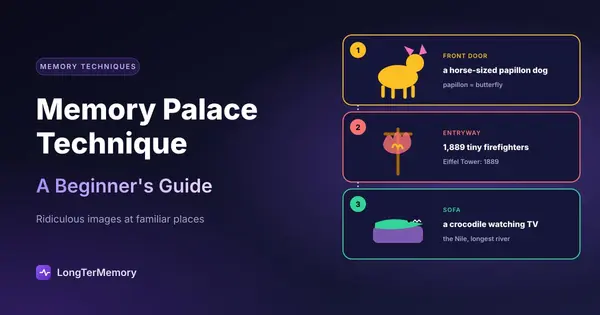
This technique, sometimes called the memory palace or method of loci, has been used since ancient Greece. It works because spatial and visual memory are processed by the hippocampus , the brain region most involved in memory formation. By encoding historical events as spatial experiences, you’re using the most powerful memory system your brain has.
Students who use this method often report being able to “walk through” historical timelines in their minds during exams, visiting each location and retrieving the events stored there. It feels less like remembering and more like looking at something that’s right there in front of you.
Practical Strategies for History Exams
Strategy 1: The Anchor Dates Method
You don’t need to memorize every date. Instead, memorize 5-10 anchor dates , major events that divide history into clear periods , and then locate everything else relative to those anchors.
Essential anchors for Western history:
| Date | Event | What It Divides |
|---|---|---|
| 476 | Fall of Rome | Ancient → Medieval |
| 1066 | Battle of Hastings | Early → High Middle Ages |
| 1453 | Fall of Constantinople | Medieval → Early Modern |
| 1492 | Columbus reaches Americas | Old World → Age of Exploration |
| 1776 | American Independence | Colonial → Revolutionary era |
| 1789 | French Revolution | Ancien Régime → Modern politics |
| 1914 | World War I begins | 19th century order → Modern era |
| 1945 | World War II ends | War → Cold War era |
| 1989 | Berlin Wall falls | Cold War → Post-Cold War |
With these nine dates firmly memorized, you can place almost any other event by asking “was this before or after [anchor]?” That relative positioning is often enough for exam questions, and it’s much more manageable than memorizing hundreds of individual dates.
Strategy 2: The “5 W’s” Flashcard
For each historical event you need to know, create a flashcard that covers:
- Who was involved?
- What happened?
- When did it happen?
- Where did it happen?
- Why did it happen (and what were the consequences)?
The front of the card asks one of these questions. The back gives the complete answer including all five W’s. This way, you can test yourself from multiple angles on the same event, which creates more retrieval pathways and stronger memories.
Strategy 3: Compare and Contrast
One of the best ways to cement historical facts is to compare two related events. How was the French Revolution similar to and different from the American Revolution? How did WWI differ from WWII in causes, conduct, and consequences?
Comparison forces you to process each event more deeply than simple memorization does. You have to think about what features each event has, which ones overlap, and which ones don’t. This deep processing creates robust, interconnected memories that are far harder to forget than isolated facts.
Common Mistakes in History Memorization
Mistake 1: Memorizing Dates Without Context
Knowing that something happened in 1453 is useless if you don’t know what it was, why it mattered, and what it led to. Always memorize the significance alongside the date. The date is just a label , the significance is the actual knowledge.
Mistake 2: Trying to Memorize Everything Chronologically
Not all historical knowledge needs to be in strict chronological order. Sometimes thematic organization is more effective. Group events by theme (revolutions, wars, technological changes, social movements) rather than forcing everything into one giant timeline.
Mistake 3: Ignoring Causation
“This happened, then this happened, then this happened” is a list. “This happened because of this, which led to this” is a story. Lists are forgettable. Stories are memorable. Always look for the causal links between events.
Mistake 4: Studying Without Testing
Reading your history textbook three times will make you feel like you know the material. Closing the book and trying to reproduce a timeline from memory will show you whether you actually do. Test yourself relentlessly. The struggle of retrieval is where history memorization actually happens.
A Weekly Study Plan for History
Here’s a practical schedule for a student preparing for a history exam:
Monday-Tuesday: Read new material and build narrative chains. Focus on understanding causes and consequences, not memorizing dates yet.
Wednesday: Convert key dates to Major System images. Create 5W flashcards for important events. Practice the narrative chains from memory.
Thursday: Place events on your mental timeline. Do a blank-page recall of the week’s material , close everything and write down every event, date, and connection you remember.
Friday: Review flashcards using spaced repetition. Do practice questions or past exam papers without notes.
Weekend: Light review plus one compare-and-contrast exercise. Let your brain consolidate.
If you have hundreds of dates and events to keep straight, LongTerMemory can build the deck for you. Upload your history notes or textbook chapters and it generates question and answer flashcards, then schedules them with spaced repetition so dates stay connected to the events they belong to.
The Bottom Line
History isn’t a list of dates to be memorized through brute force. It’s a network of stories, causes, and consequences that your brain is naturally equipped to remember , if you present the information in the right way.
Turn numbers into images with the Major System. Link events into narrative chains that flow like stories. Place timelines in spatial locations that you can mentally walk through. And always, always prioritize understanding why something happened over memorizing when it happened.
The dates will follow the stories. They always do.