How to Memorize Numbers and Statistics Quickly
Master memorization of numbers, dates, and statistics using the Major System, Dominic System, story anchoring, and concept-linking strategies for exams.
Table of Contents
- Why Numbers Are Hard (and What to Do About It)
- The Major System: Converting Digits to Words
- The Dominic System: People and Actions
- Turning Statistics Into Memorable Story Fragments
- The Formula: Who Did What to How Many
- Extreme Examples as Anchors
- Anchoring Numbers to Concepts for Exam Recall
- The Why Behind the Number
- The Benchmark Method
- Building a Number Memorization Practice
- Step 1: Inventory Your Numbers
- Step 2: Sort by Type
- Step 3: Create Number Flashcards
- Step 4: Practice Reconstruction
- Handling Statistical Ranges and Approximate Numbers
- The Bottom Line
Numbers are brutal to memorize. Unlike concepts, stories, or even definitions, numbers don’t come with built-in meaning. The year 1776 is just four digits. The statistic “73% retention rate” is just a number and a phrase. Your brain, which is magnificently designed to remember faces, places, narratives, and emotions, is genuinely not wired to store arbitrary number sequences reliably.
And yet , exams are full of them. Dates in history. Percentages in social science. Threshold values in medicine. Statistical findings in psychology. Exact figures in law and accounting. If you can’t memorize numbers, entire categories of exam question become a liability.
The good news is that the same way words have meaning and stories have hooks, numbers can be given both , through encoding systems that convert digits into something your memory can actually work with. Here’s the complete toolkit.
Why Numbers Are Hard (and What to Do About It)
The fundamental problem with numbers is that they’re arbitrary and non-distinctive. The number 73 has no inherent relationship to the number 72. A date like 1848 has no internal logic that distinguishes it from 1849. When you try to memorize a list of statistics, each number blends into the others because they all exist in the same bland numerical space.
Compare that to remembering faces, which your brain tracks with extraordinary precision across decades. Or remembering the plot of a movie you saw once. The difference is meaningfulness and distinctiveness , two properties that numbers naturally lack and that you have to deliberately create.
The techniques below work by translating numbers into objects, people, or words , things that are both meaningful (they have associations) and distinctive (each one is clearly different from the others).
The Major System: Converting Digits to Words
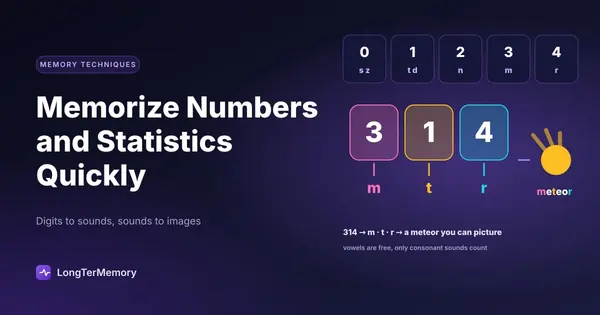
The Major System is the foundational number-to-word encoding system, and it’s worth learning even if you only use it occasionally. The system assigns a consonant sound to each digit:
| Digit | Consonant sound | Memory aid |
|---|---|---|
| 0 | s, z | Zero |
| 1 | t, d | t has 1 downstroke |
| 2 | n | n has 2 downstrokes |
| 3 | m | m has 3 downstrokes |
| 4 | r | four |
| 5 | l | L = Roman numeral 50 |
| 6 | j, sh, g | G curves like a 6 |
| 7 | k, hard c | K looks like two 7s |
| 8 | f, v | f in cursive loops like 8 |
| 9 | p, b | p is a rotated 9 |
Vowels (a, e, i, o, u), w, h, and y are ignored , they fill in gaps between consonants to form real words.
Example: The number 1492 (Columbus reaching America) = t/d , r , 9 would be “p/b” , n = t-r-p-n → “trip” + “an” = “tripe on” or better: “aDRePt” … let’s try: 1=t, 4=r, 9=b/p, 2=n → “tarpan” (a wild horse). Picture a wild horse discovering America. Strange enough to remember.
A simpler example: The number 73 (often cited as a retention percentage) = 7=k, 3=m → “comb” or “cam”. Picture a comb on a percentage sign.
Once you have a word for a number, you create a visual scene linking that word to the content the number belongs to. The scene doesn’t need to make logical sense , it needs to be vivid and unusual enough that it doesn’t blend with other scenes.
The Dominic System: People and Actions
The Dominic System, developed by memory champion Dominic O’Brien, is an alternative to the Major System that some people find more intuitive. Instead of assigning consonant sounds to digits, it assigns people and actions to two-digit pairs.
You convert each digit to a letter:
- 0 = O, 1 = A, 2 = B, 3 = C, 4 = D, 5 = E, 6 = S, 7 = G, 8 = H, 9 = N
Each two-digit pair (00-99) becomes an initials pair that maps to a memorable person. For example:
- 01 = AO = Arnold (name starting with A) + something (name starting with O): perhaps “Arnold Schwarzenegger Opens his mouth”
- 52 = EB = Einstein Builds (his famous equation)
- 73 = GC = George Clooney Cooks
The beauty of the Dominic System is that people are extremely memorable , our brains evolved to track individuals. And actions are equally vivid. A two-digit number becomes a mini-scene: George Clooney cooking in front of a statistical chart. When you need to recall 73%, you mentally revisit that scene.
For a student, you don’t need to set up the full 100-person system for it to be useful. Assign people to your most frequently needed numbers: key dates, important percentages, threshold values for your subject. Even 15-20 people covering your most-needed numbers will dramatically reduce the mental load.
Turning Statistics Into Memorable Story Fragments
For research statistics , the kind that appear constantly in psychology, medicine, economics, and social science exams , pure encoding systems can feel like overkill for a single percentage. A lighter approach: embed the statistic in a mini story or scenario that your brain treats as a narrative.
Narratives are among the most naturally memorable formats for human memory. As research consistently shows, information embedded in a meaningful story context is retained far better than the same information presented in isolation , a finding confirmed across 75+ studies and more than 33,000 participants.
The Formula: Who Did What to How Many
Good statistical stories follow this pattern: who conducted the study, what they found, and how many (what percentage, what number).
Raw fact: “Ebbinghaus found that people forget 60% of new information within 24 hours.”
Story version: Picture Ebbinghaus , the German memory researcher with the magnificent beard , sitting in his lab as 60 balloons float away out of his window. Each balloon has a piece of information written on it. He watches them go, helplessly, as the clock reads “24 hours.”
Now the 60% has an image (balloons floating away) and a person (Ebbinghaus) and a timeframe (24 hours shown on a clock). The story encodes three facts simultaneously and each element cues the others.
Extreme Examples as Anchors
For surprising statistics , which many exam statistics are , the extremity of the number is itself a hook. When you learn that over 50% of people cannot correctly interpret a confidence interval (a well-documented finding in statistics education), the surprising wrongness of that fact gives it emotional charge. High emotional content equals better memory.
When you encounter an extreme or surprising statistic:
- React to it emotionally , let yourself be surprised or disturbed
- Create a visual scene of the extreme
- Connect it to a cause or explanation you already know
The combination of emotional charge + visual + explanation creates a memory trace that’s hard to dislodge.
Anchoring Numbers to Concepts for Exam Recall
The deepest form of number memorization isn’t about encoding systems at all , it’s about understanding why the number is what it is, so that you can reconstruct it from reasoning if your direct memory fails.
The Why Behind the Number
For every statistic or threshold value you need to memorize, ask: why is it that number?
- Why is the standard significance threshold in science 0.05? (By convention, Fisher chose it in the 1920s as a reasonable balance between false positives and false negatives , not mathematically derived, just a practical choice.)
- Why does the forgetting curve show ~40% retention at 24 hours? (Because the hippocampus has limited short-term capacity and begins clearing unreviewed information rapidly.)
- Why is 120/80 the standard blood pressure? (These are statistical norms derived from large population studies, representing the median healthy range.)
Understanding the “why” behind a number gives you two things: a conceptual anchor (the number belongs to a reasoned system, not arbitrary space) and a reconstruction path (if you forget the exact number, you can sometimes reason your way back to it from the explanation).
The Benchmark Method
Numbers are easiest to remember when anchored to benchmarks you already know. If you need to remember “87% of students who use spaced repetition outperform those who don’t,” anchor it to something familiar: 87% is roughly 9 in 10. Is it closer to 9 in 10 or 8 in 10? It’s between them , closer to 9 in 10. That relative positioning is often enough to reconstruct the approximate figure under exam pressure.
For a subject-specific set of numbers, create a mental number line specific to that topic:
Blood pressure benchmarks:
- 80/50 = dangerously low
- 120/80 = optimal
- 130/85 = elevated
- 140/90 = Stage 1 hypertension
- 160/100 = Stage 2 hypertension
Once you have these benchmarks memorized as a coherent system, adding new numbers to the system is much easier , you just locate them relative to what you already know.
Building a Number Memorization Practice
Here’s a practical system for managing the numbers you need to memorize for a specific course or exam:
Step 1: Inventory Your Numbers
Go through all your course material and make a list of every number, date, percentage, or statistic you might need to know. Most students are surprised by how many there are , and how few they’ve actively studied.
Step 2: Sort by Type
| Category | Memory Strategy |
|---|---|
| Dates and years | Major System images |
| Percentages and stats | Story fragments |
| Threshold values | Benchmark method |
| Named constants (Avogadro’s number, speed of light) | Anchor to real-world scale + mnemonic |
| Sequences of numbers | Method of loci or chaining |
Step 3: Create Number Flashcards
For each important number, create a flashcard with:
- Front: The concept (“At what percentage does Ebbinghaus show initial forgetting in 24 hours?”)
- Back: The number + the story or image you created (“60% , 60 balloons floating out of Ebbinghaus’s window”)
Review these with active recall, not passive recognition.
Step 4: Practice Reconstruction
Once a week, go through your number list and try to reconstruct each number from scratch , not from your mnemonic, but from conceptual understanding. For anything you can reconstruct conceptually, the mnemonic is insurance. For anything you can’t reconstruct conceptually, the mnemonic is load-bearing , make sure it’s strong.
Handling Statistical Ranges and Approximate Numbers
Not every number needs to be exact. For many exam purposes, a defensible approximation is sufficient:
- “Approximately 60%” is often acceptable when the exact figure is 58% or 62%
- “About one-third” conveys 30-36% ranges accurately
- “Roughly doubling” works for 90-110% increases
When you’re pressed for time or when exact figures aren’t typically tested, focus on the order of magnitude and rough bracket: is it roughly one-fifth, one-third, one-half, two-thirds, or three-quarters? Getting this right gets you through most conceptual exam questions even if the decimal precision escapes you.
If you need to retain lots of figures across a course, LongTerMemory can help. Upload your notes or readings and it generates flashcards that pair each number with its context, then schedules them with spaced repetition so the statistics stay anchored to the concepts they describe.
The Bottom Line
Numbers are inherently unmemorable because they’re abstract and non-distinctive. The solution isn’t to stare at them harder , it’s to transform them into something memorable: words through the Major System, people and actions through the Dominic System, stories and scenes through narrative embedding, or conceptual anchors through understanding the “why.”
Encode them vividly. Anchor them to concepts you understand. Practice reconstructing them without the mnemonic. Numbers that you’ve approached this way stop being the terrifying wild cards of an exam and become just another category of knowledge , strange-looking on the surface, but just as memorable as everything else once you know how to handle them.