How Interleaved Practice Supercharges Active Learning
Discover how interleaved practice boosts active learning, strengthens memory, and helps you retain more than blocked studying ever could.
Table of Contents
- What Is Interleaved Practice, Really?
- Blocked vs. interleaved practice: the research comparison
- Why interleaving feels harder but produces better results
- How to build an interleaved study schedule for any subject
- Step 1: Identify your problem types or topics
- Step 2: Create a mixed practice set
- Step 3: Use a rotation or randomization method
- Step 4: Review mistakes across topics
- Common Mistakes That Undermine Interleaving
- Making Interleaving Part of Your Active Learning Toolkit
- How LongTerMemory Makes Interleaving Automatic
- The Bottom Line
Most people study the wrong way without even realizing it. They finish a chapter, do five problems just like the examples, move to the next chapter, and repeat. Everything feels smooth, everything makes sense, and then the exam arrives and the brain goes blank.
That smoothness is the problem. Blocked practice, where you drill one topic at a time, creates an illusion of competence. The real world, and most real exams, do not hand you problems labeled by chapter. You have to figure out which tool to use, and that is exactly the skill blocked practice fails to build.
Interleaved practice solves this. Instead of studying topic A, then topic B, then topic C in neat blocks, you mix them together. One moment you are solving a geometry problem, the next a statistics question, the next an algebra puzzle. Your brain has to constantly decide what kind of problem it is facing and which strategy applies. That extra decision, that little moment of confusion, is where the deep learning happens.
What Is Interleaved Practice, Really?
At its core, interleaved practice means mixing different skills, topics, or problem types during a single study session. It is the opposite of blocked practice, where you focus on one thing until it feels easy and only then move on.
Imagine you are learning to play guitar. Blocked practice would look like playing the G chord for twenty minutes, then the C chord for twenty minutes, then the D chord for twenty minutes. Interleaved practice would look like playing G, C, D, G, D, C in quick succession, forcing your fingers to switch shapes on demand.
The same logic applies to almost any subject. In math, you mix algebra, geometry, and probability problems. In medicine, you mix cardiology, neurology, and respiratory cases. In languages, you mix vocabulary, grammar, and listening comprehension in the same session. The common thread is deliberate variety.
Researchers sometimes call this mixed practice studying, but the idea is identical. You are not studying harder. You are studying smarter by making your brain work a little harder in the right way.
Blocked vs. interleaved practice: the research comparison
The research is remarkably consistent. When students use interleaved practice, they perform better on delayed tests, transfer problems to new contexts more easily, and retain skills longer than students who use blocked practice.
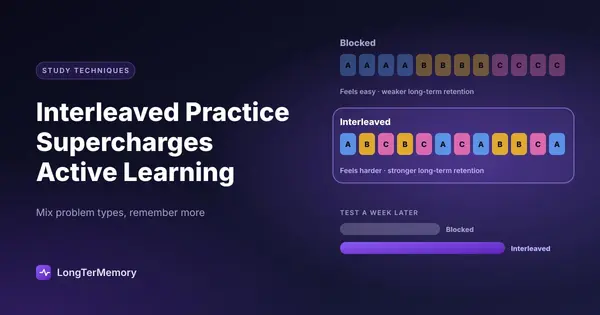
One of the most cited studies comes from Douglas Rohrer and colleagues, who looked at how students learned math problem types. Students in the blocked group completed all problems of one type before moving to the next. Students in the interleaved group had the same problems shuffled together. During practice, the blocked group felt like they were doing better. Their scores were higher in the moment. But on the final test a week later, the interleaved group dramatically outperformed them.
Here is what that contrast looks like in practice:
| Feature | Blocked Practice | Interleaved Practice |
|---|---|---|
| Session feel | Easy, fast, comfortable | Harder, slower, more effortful |
| Immediate performance | High | Lower during practice |
| Long-term retention | Weaker | Stronger |
| Skill discrimination | Poor, cues are always the same | Strong, you learn when to use what |
| Transfer to new problems | Limited | Much better |
| Confidence | Inflated early, crashes on tests | More realistic, survives testing |
That table captures the central paradox. The method that feels worse while you are doing it is the method that produces better results later. The blocked group was essentially cheating themselves with familiarity. They recognized problem types because the type never changed. They never had to do the hard work of identification.
A similar pattern shows up in sports. Baseball players who practice hitting random pitch types improve more than players who see the same pitch type over and over. The same thing happens with surgeons learning different procedures, pilots practicing emergency scenarios, and musicians switching between pieces. Mixed practice studying is not a school trick. It is a general principle of how expertise develops.
Why interleaving feels harder but produces better results
The reason is simple but not obvious. Interleaving forces your brain to do three useful things at once: retrieve the right strategy, suppress competing strategies, and compare similar problem types.
First, when every problem looks different from the last, you cannot rely on momentum. You have to look at the problem and ask, “What is this?” That question, that brief moment of uncertainty, is a tiny retrieval event. You are pulling the relevant concept out of memory and matching it to the current task. Each successful match strengthens the memory trace.
Second, interleaving builds what psychologists call discriminative contrast. When you study two similar topics in blocks, they can blur together. When you alternate between them, their differences become sharper. You learn not just how to solve a problem, but which kind of problem you are solving.
Third, and this is the subtle one, interleaving creates desirable difficulty. Some struggle is good for learning. Not overwhelming struggle, but the kind that makes you pause, think, and work through uncertainty. Blocked practice avoids that struggle. Interleaved practice leans into it.
Here is the cognitive science in plain language:
- Retrieval practice happens every time you have to remember which method applies.
- Spacing happens naturally because you return to each topic after a short gap.
- Discrimination happens because similar topics are compared side by side.
- Effort signals to your brain that this material is worth encoding deeply.
The discomfort you feel during interleaved practice is not a sign that you are doing badly. It is a sign that you are doing something that actually changes your brain.
How to build an interleaved study schedule for any subject
The good news is that you do not need a complicated system. You just need to stop sorting your study time by topic and start deliberately mixing things up. Here is a simple framework that works for almost any subject.
Step 1: Identify your problem types or topics
Break your material into chunks that are small enough to switch between. In math, that might be factoring, solving equations, and graphing. In biology, it might be cell structure, genetics, and evolution. In language learning, it might be vocabulary, verb conjugations, and listening comprehension.
The chunks should be related enough that mixing them creates meaningful discrimination, but distinct enough that you have to choose between strategies.
Step 2: Create a mixed practice set
Gather a set of practice questions or prompts from across your chunks. A good starting ratio is roughly equal time across topics, but you can weight topics by difficulty. If calculus is harder for you than trigonometry, give it a bit more presence.
For example, a thirty-minute math session might look like this:
- Solve a quadratic equation.
- Find the derivative of a polynomial.
- Calculate the area under a curve.
- Solve another quadratic equation, but with a twist.
- Find the derivative of an exponential function.
- Interpret a graph without calculating every point.
Notice how the sequence bounces around. You are not finishing all quadratics before moving to calculus. You are keeping your brain in a state of mild uncertainty, which is exactly where learning happens.
Step 3: Use a rotation or randomization method
You do not need true randomness, but you do need unpredictability. One simple approach is a card deck. Write each problem type on an index card, shuffle the deck, and draw the next card whenever you finish a problem. This works well for subjects with clearly different question types.
Another approach is time-based rotation. Spend five minutes on topic A, five on topic B, five on topic C, then repeat. This keeps the session varied without requiring you to design a custom sequence every time.
For subjects that are more conceptual, try thematic rotation. In history, alternate between causes, effects, and primary source analysis. In literature, alternate between character study, theme analysis, and close reading of passages.
Step 4: Review mistakes across topics
When you make a mistake, do not just fix it and move on within the same topic. Note the error type and come back to it later in the session, mixed in with other topics. This forces you to retrieve the correction in a varied context, which makes it stick better.
A practical weekly template might look like this:
| Day | Interleaved Session Focus |
|---|---|
| Monday | Mix topic A and topic B problems |
| Tuesday | Mix topic B and topic C problems |
| Wednesday | Mix all three topics together |
| Thursday | Focus on weak areas, still interleaved |
| Friday | Mixed review of the whole week |
| Saturday | Light mixed practice or rest |
| Sunday | Plan next week and preview upcoming material |
This template keeps variety at the center of your routine. Even your “focused” days should mix problem types rather than drilling one thing into the ground.
Common Mistakes That Undermine Interleaving
People often try interleaving, feel the discomfort, and conclude it is not working. Usually, one of a few mistakes is to blame.
The first mistake is mixing topics that are too different. If you alternate between Spanish vocabulary and organic chemistry, you are not building discriminative contrast. You are just multitasking. The topics should be related enough that your brain has to decide between similar strategies.
The second mistake is giving up too early. Interleaving will feel harder than blocked practice. That is expected. If you switch back to blocked practice because it feels better, you are returning to the method that creates the fluency illusion.
The third mistake is neglecting feedback. Interleaving only works if you know whether your answer was right. If you solve a mixed set and never check your work, you may reinforce incorrect strategies. Always review answers, ideally soon after each attempt.
The fourth mistake is overcomplicating the schedule. You do not need a perfect randomizer or a color-coded spreadsheet. A simple shuffled list of problems is enough. Start small, get used to the discomfort, and build from there.
Making Interleaving Part of Your Active Learning Toolkit
Interleaved practice is powerful on its own, but it becomes even more effective when combined with other evidence-based techniques. Pair it with retrieval practice by testing yourself instead of re-reading. Pair it with spaced repetition by returning to topics across days and weeks instead of cramming. Pair it with self-explanation by asking why a particular strategy fits a particular problem.
The goal is not to make studying harder for the sake of difficulty. The goal is to make study sessions match the demands of real performance. In an exam, you do not get a warning label telling you which chapter each question comes from. In a job, you do not get to choose which problem lands on your desk. Active learning means preparing for reality, not just for the feeling of understanding.
How LongTerMemory Makes Interleaving Automatic
If all of this sounds like a lot of manual scheduling, that is because it can be. Deciding what to study, when to study it, and how to mix topics without dropping anything is genuine cognitive overhead. The good news is that the right tool can handle most of it for you.
That is where LongTerMemory comes in. LongTerMemory is built around the same learning science principles that make interleaving effective. It turns your notes, PDFs, and study materials into automatic flashcards, then schedules them using spaced repetition so you revisit each concept at the optimal moment.
Instead of manually shuffling topics, you can let LongTerMemory mix your material for you. It brings back older concepts just as you are about to forget them, which naturally creates the varied, spaced, retrieval-focused practice that interleaving is famous for. You get the benefits of mixed practice studying without the scheduling headache.
If you want to move beyond the highlight-and-re-read routine and build a study system that actually sticks, LongTerMemory is worth exploring. You can sign up at longtermemory.com and start turning your study material into a personalized, interleaved review schedule today.
The Bottom Line
Interleaved practice is one of the most underrated tools in learning. It does not feel as good as blocked practice in the moment, but that is precisely why it works. By mixing topics, forcing retrieval, and building discriminative contrast, you train your brain to handle the unpredictable demands of real tests and real life.
Start small. Pick two related topics you are studying. Create a short mixed practice set. Alternate between them for one session. Notice the extra effort, and recognize it for what it is: the feeling of actual learning.
The best study techniques rarely feel easy. They feel effective. And once you experience what interleaving can do for your retention, you will never want to study one topic at a time again.