How Interleaving Practice Improves Test Performance
Discover why mixing topics in your study sessions, instead of blocking them, dramatically improves retention and test scores.
Table of Contents
- What Is Interleaving Practice?
- The Research Behind Interleaving
- Why Interleaving Works: The Science
- Discrimination Learning
- Enhanced Retrieval Practice
- How to Implement Interleaving in Your Study Sessions
- Shuffle Your Flashcard Decks
- Create Mixed Problem Sets
- Alternate Topics Within Study Blocks
- Build Category-Mixed Review Sessions
- When Interleaving Works Best
- Handling the Discomfort
- Combining Interleaving With Spaced Repetition
- A Practical Example: How to Study for a Professional Exam Using Interleaving
- The Bottom Line
Here’s something that might sound counterintuitive: the study method that feels the most productive is often the least effective, and the one that feels the most uncomfortable tends to produce dramatically better results on test day.
That distinction is at the heart of interleaving practice, and once you understand what it is and why it works, you’ll never look at your study sessions the same way again.
What Is Interleaving Practice?
Most students study using a method called blocked practice: work through one topic completely before moving on to the next. You finish all your calculus problems, then shift to statistics. You master Chapter 5 before opening Chapter 6. You study flashcards for one subject until you feel confident, then move to another deck.
Blocked practice feels logical. It feels organized. It feels like mastery is being achieved one piece at a time.
Interleaving works differently. Instead of completing one topic before moving to the next, you deliberately mix topics within the same study session. You do a few calculus problems, then some statistics, then back to calculus, then differential equations, all in the same session. You alternate between biology concepts rather than exhausting one chapter before opening the next.
That mixing is what interleaving means. And research shows it produces significantly better test performance than blocked practice, even though, and this is the crucial part, it feels worse while you’re doing it.
The Research Behind Interleaving
The evidence for interleaving is robust and consistent across different types of learning.
One of the most cited studies comes from Kornell and Bjork (2008), who had students study paintings by different artists. One group studied all the paintings by each artist in sequence (blocked). Another group studied the paintings in a mixed order (interleaved). Afterward, both groups were tested on their ability to identify which paintings belonged to which artist.
The interleaved group significantly outperformed the blocked group on the identification test. But here’s what makes the finding particularly striking: the students who learned via interleaving consistently believed they had learned less than the blocked group, even as they scored higher on the test.
That gap between perceived learning and actual learning is called the interleaving illusion, and it explains why so many students default to blocked practice. It feels like you’re learning more efficiently when you focus on one thing at a time. But you’re not.
A 2010 study by Taylor and Rohrer tested interleaving with math problems. Students who studied mixed problem types scored 43% higher on a follow-up test one day later compared to students who had studied in blocked sets. The problems were identical. The only difference was the order in which they were presented.
That 43% gap represents real exam performance. Real grades. Real professional exam outcomes. The method matters enormously.
Why Interleaving Works: The Science
There are two main mechanisms that explain why interleaving is more effective than blocked practice.
Discrimination Learning
When you study one type of problem or concept in a block, your brain gets into a rhythm. You’re essentially just applying the same approach over and over. You’re not building the skill of recognizing which strategy to use, only the skill of executing a single strategy once you’ve already identified it.
In real exams, questions come mixed. You don’t know in advance whether the next question will require the Pythagorean theorem or the quadratic formula, or whether it’s testing indemnity principles or subrogation. The discrimination problem, figuring out which tool applies to which situation, is itself a critical skill, and blocked practice never develops it.
Interleaving forces your brain to solve the discrimination problem every time you switch topics. That extra work is harder, but it’s also what makes knowledge stick.
Enhanced Retrieval Practice
When you study topic A, then B, then return to A, you’re retrieving information about A from memory rather than just refreshing it while it’s still warm in your working memory. That retrieval effort is a form of active recall, and it’s one of the most powerful memory consolidation techniques in learning science.
Blocked practice keeps information in working memory by never letting it fade enough to require genuine retrieval. Interleaving creates brief forgetting windows that force actual retrieval, which strengthens the underlying memory trace far more than refreshing something that was just studied moments ago.
How to Implement Interleaving in Your Study Sessions
Knowing the theory is one thing. Applying it is another. Here’s how to build interleaving into your actual study practice.
Shuffle Your Flashcard Decks
This is the simplest and most accessible entry point. If you’re using flashcards to prepare for an exam, stop organizing them by chapter or topic. Shuffle the full deck and work through it in random order.
Most digital flashcard systems, including LongTerMemory, handle this automatically. The platform generates Q&A pairs from your materials and schedules them across your review sessions, naturally mixing questions from different topics based on what you need most. This produces interleaved review without requiring you to manually shuffle or organize anything.
Create Mixed Problem Sets
For subjects involving problem-solving, math, science, accounting, statistics, don’t do 20 problems of the same type in a row. After every four or five problems, switch to a different type. Then switch again.
If you’re using a textbook, the end-of-chapter problem sets already group problems by type. To interleave, pull a few problems from each of several chapter sets and mix them together on your own problem sheet.
Alternate Topics Within Study Blocks
If you’re working through multiple subjects in a single session, alternate between them every 20 to 30 minutes rather than fully finishing one before starting another.
A 90-minute session might look like this: 25 minutes on organic chemistry, 25 minutes on biology, 25 minutes back to organic chemistry, 15 minutes of organic chemistry practice questions. Compare this to 90 minutes on organic chemistry only, and then 90 minutes the next day on biology. The interleaved session produces better retention across both subjects.
Build Category-Mixed Review Sessions
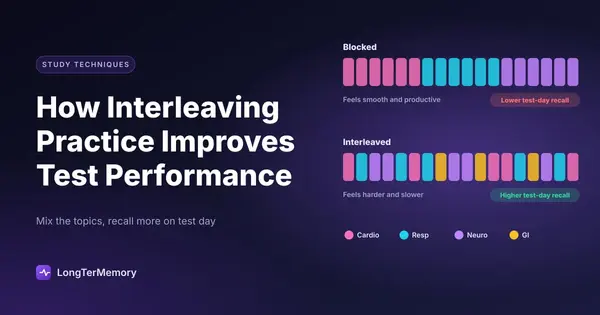
For content-heavy subjects like history, law, or medical licensing exams, create review sessions that deliberately cross topic boundaries. Instead of reviewing all cardiovascular questions, then all respiratory questions, mix questions from different body systems in a single session.
| Blocked Approach | Interleaved Approach |
|---|---|
| 30 cardiology questions | 10 cardiology, 10 respiratory, 10 neurology |
| 30 respiratory questions | 10 neurology, 10 cardiology, 10 gastrointestinal |
| 30 neurology questions | 10 respiratory, 10 gastrointestinal, 10 cardiology |
| Feels smooth and productive | Feels harder and slower |
| Lower test day recall | Higher test day recall |
When Interleaving Works Best
Interleaving is most powerful in specific situations.
When you need to discriminate between related concepts: If your exam tests multiple similar things (different types of insurance policies, different statistical tests, different legal doctrines), interleaving is essential. Studying each in a block creates the illusion that you know when to apply each, but only interleaving develops that skill for real.
For problem-solving subjects: Math, physics, chemistry, accounting, and economics all involve recognizing which procedure applies to a given problem. This is a discrimination task. Interleaving is the most direct way to train it.
For mixed-format exams: If your exam mixes topics within each section rather than grouping them by chapter, your practice should mirror that structure. A mixed-format exam rewards the kind of flexible, context-sensitive retrieval that interleaving builds.
During review phases: Interleaving is particularly effective when reviewing material you’ve already encountered, rather than when you’re encountering a topic for the very first time. When you’re completely new to a subject, some initial blocked practice can help you build a foundation. Once you have the basics, shift to interleaving.
Handling the Discomfort
The biggest barrier to interleaving isn’t knowledge. It’s the feeling.
When you practice interleaving for the first time, it feels chaotic. It feels like you’re not progressing. Every switch between topics means starting slightly cold, and that initial sluggishness when you return to a topic can feel like evidence that you’re not learning it well.
That feeling is wrong. That sluggishness is the retrieval effort doing its work. The moment you struggle to remember something you studied 20 minutes ago is the moment your brain is building a stronger memory trace.
Research shows that students who interleave consistently underestimate their performance. After interleaved study, people feel like they learned less, even when tests show they retained more. This mismatch is important to understand before you try interleaving, because if you don’t know to expect it, the discomfort will push you back to blocked practice prematurely.
The discomfort of interleaving is not a signal to stop. It’s a signal that your study session is working.
Combining Interleaving With Spaced Repetition
Interleaving and spaced repetition are the two most powerful evidence-based study techniques, and they work even better together.
Spaced repetition determines when you review material, based on forgetting curves and how well you know each item. Interleaving determines how you mix topics within a single session. They address different dimensions of effective studying.
When you use a spaced repetition system that handles scheduling automatically (as LongTerMemory does), the interleaving happens naturally. The system schedules your next review for each piece of information at the optimal interval, mixing items from different topics based on what’s due, not on any artificial grouping by chapter or subject. You get both benefits at once without having to manually orchestrate either.
A Practical Example: How to Study for a Professional Exam Using Interleaving
Let’s say you’re preparing for an exam that covers three domains: domain A (theory), domain B (application), and domain C (regulations). You have three weeks until the exam.
Instead of spending week one on domain A, week two on domain B, and week three on domain C (a classic blocked approach), you could structure your preparation like this:
- Each daily session: 45 minutes total, rotating through short segments on all three domains rather than focusing on one per session
- Practice question sets: pulled from a mixed bank of questions across all three domains, not organized by domain
- Weekly review: a full mixed practice test covering all domains, not separate domain-specific quizzes
This approach feels harder. It produces more errors during practice. It requires more mental effort.
And it produces significantly higher scores on the actual exam.
The Bottom Line
Interleaving practice is one of the most consistently supported findings in educational psychology. It improves test performance, builds the discrimination skills that exams actually require, and develops the kind of flexible, context-aware retrieval that blocked practice never trains.
It feels harder. That’s the point.
If your study sessions feel smooth and comfortable, that’s often a sign you’re staying inside a comfort zone that won’t serve you when the exam questions start mixing topics. Embrace the difficulty. Mix your topics. Let the discomfort do its work.
The results on test day will make sense of every moment of it.