How to Interpret Your Score Report After a Professional Exam
Your exam score report contains more information than a pass or fail. Here's how to read it, understand domain scores, and use the data to improve.
Table of Contents
- The Basics: What a Score Report Usually Contains
- Total Score vs. Scaled Score: What's the Difference?
- Understanding Domain Scores
- How to Weight Your Retake Study by Domain
- What Scores Don't Tell You
- Reading Performance Descriptors vs. Numerical Scores
- How to Use Your Score Report After Passing
- What to Do When You Fail
- Specific Score Report Formats You May Encounter
- PMP (Project Management Professional)
- CompTIA Certifications
- AWS Certified Exams
- CPA Exam (USA)
You’ve just come out of a professional certification exam. Maybe you passed, maybe you didn’t. Either way, there’s a document sitting in your inbox or your testing portal that most people glance at for thirty seconds and then close: the score report.
That’s a mistake.
Whether you passed or failed, your score report contains specific, actionable information about your performance. Knowing how to read it, what its numbers actually mean, and how to use the data it gives you is the difference between a candidate who improves systematically and one who just studies harder and hopes for a better outcome next time.
This guide walks you through exactly how to interpret professional exam score reports, domain by domain.
The Basics: What a Score Report Usually Contains
Not all score reports are identical, but most professional certification exams provide some variation of the following:
- Your total score (often as a scaled score, sometimes as a percentage)
- The passing score (the minimum required to pass)
- Domain or section scores (how you performed in each content area)
- Performance indicators (descriptors like “below proficient,” “proficient,” or “above proficient” for each domain)
- Candidate information (your name, exam date, registration number)
The specific format depends on the certification body. A PMP exam score report looks different from a CompTIA Security+ report, which looks different from a CPA exam score report. But the logic is similar: you get a total result and some breakdown by content area.
Understanding what each element tells you (and what it doesn’t) is what turns a score report from a pass/fail notification into a genuine study tool.
Total Score vs. Scaled Score: What’s the Difference?
Many professional exams don’t report your raw score (how many questions you got right). They report a scaled score instead.
A scaled score is a mathematically adjusted number that accounts for variations in exam difficulty across different test versions. Because not every version of a certification exam has exactly the same difficulty level, raw scores can’t be directly compared between candidates who took different versions. Scaling normalizes the scores so that the same scaled score means the same level of competency, regardless of which version you sat.
This is why a passing score on many exams isn’t simply “70% correct.” On the PMP exam, for example, the scoring is categorical (Below Target, Target, Above Target), not numerical. On the AWS certifications, passing scores typically sit at 720 on a 100-1000 scale, but that doesn’t mean you answered 72% of questions correctly. On the CFA exam, the minimum passing score varies by exam administration and isn’t published as a specific number.
The key point: a scaled score of 750 doesn’t mean you got 75% right. It means your performance, after statistical adjustment for exam difficulty, puts you at that position on a standardized scale. Always read the score report in the context of what the certification body explains about its scoring methodology.
Understanding Domain Scores
This is where the real value of your score report lives. Domain scores break down your performance by the major content areas covered on the exam.
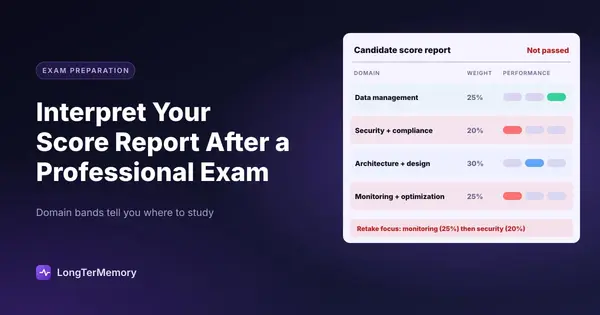
Here’s an example of what a domain breakdown might look like for a fictional certification:
| Domain | Weight | Your Performance |
|---|---|---|
| Data Management | 25% | Above Proficient |
| Security and Compliance | 20% | Below Proficient |
| Architecture and Design | 30% | Proficient |
| Monitoring and Optimization | 25% | Below Proficient |
This tells you much more than a total score does. Even if you passed, this breakdown shows you that Security and Compliance and Monitoring and Optimization are weak areas. If this certification requires renewal or if you’re building toward an advanced certification in the same domain, those weaknesses matter.
If you failed, the domain breakdown is your study roadmap. Don’t go back and re-study everything from scratch. Go back and focus most of your time on domains where you were “Below Proficient” or equivalent.
How to Weight Your Retake Study by Domain
The math here is important and most candidates miss it.
A domain that represents 30% of the exam and where you scored “Below Proficient” deserves dramatically more of your retake study time than a domain that represents 10% of the exam where you scored “Proficient.”
When building a retake study plan, multiply your weakness by domain weight. A major weakness in a high-weight domain is far more impactful on your score than a moderate weakness in a low-weight domain. Prioritize accordingly.
A rough allocation model:
- Below Proficient in a high-weight domain (25%+): spend 40-50% of your retake prep time here
- Below Proficient in a medium-weight domain (15-25%): spend 20-30% of your retake prep time here
- Proficient in any domain: light review, 10-15% of your time
- Above Proficient in any domain: minimal or no review needed
This kind of targeted preparation is far more efficient than going back to the beginning and working through everything at the same pace.
What Scores Don’t Tell You
Score reports are useful, but they have real limitations you should understand.
They don’t tell you which specific questions you got wrong. For security and fairness reasons, exam providers don’t reveal individual question performance. You know you underperformed in a domain, but you don’t know exactly which concepts within that domain caused the problem.
Domain categories are broad. A domain like “Security and Compliance” might include dozens of subtopics. “Below Proficient” in that domain means something within that broad category tripped you up, but doesn’t identify what.
The same domain score can hide different problems. Two candidates who both score “Below Proficient” in the same domain might be weak on completely different concepts within that domain.
This means your score report gives you a direction, not a complete map. You still need to do diagnostic work to figure out exactly what within a domain to address. The best tool for this is practice exams: take a full-length practice test, review every wrong answer, and tag each question by the subtopic within its domain. That gives you granular data the official score report cannot.
Reading Performance Descriptors vs. Numerical Scores
Different certification bodies communicate performance differently. Some give you numbers. Some give you descriptors. Both have their uses.
Numerical scores tell you precisely where you fell relative to the passing threshold. If you scored 680 on an exam with a passing score of 720, you know exactly how far you were from passing. You also know you weren’t catastrophically far off, which affects how much additional preparation you need.
Categorical descriptors (like Above Target / Target / Below Target, or Proficient / Near Proficient / Below Proficient) give you relative positioning without hard numbers. These are less precise but often more intuitive for planning purposes. “Below Target in three domains” translates directly into a prioritized study agenda.
When your report gives both, use both. A passing score with multiple “Below Proficient” domains might be a narrow pass. A failing score with only one “Below Proficient” domain might mean you were very close. These distinctions change how you approach your next study cycle.
How to Use Your Score Report After Passing
Passing is great, but a lot of the value of your score report gets ignored by candidates who passed because they figure the exam is over and there’s nothing left to do.
Here’s why that’s short-sighted:
Renewal is coming. Most professional certifications require periodic renewal, whether through continuing education credits or a retake. Your weak domains from the initial exam are worth addressing now, while the content is fresh, rather than scrambling before renewal.
Advanced certifications build on foundations. If you passed an associate-level certification and plan to pursue the professional or expert level eventually, the weak domains from your associate exam will likely appear again in harder form at the next level. Addressing them now compresses your preparation timeline later.
Job performance matters. Certifications are credentials, but the domains you scored below proficient in are also areas where your practical competency may be weaker. That matters in actual work contexts, not just exam contexts.
Take ten minutes after passing to note your lowest-performing domains. Add them to a running list of areas to continue developing. That’s the kind of learning orientation that makes certifications genuinely valuable rather than just framed wall art.
What to Do When You Fail
First, take a breath. Failing a certification exam is common, especially for rigorous professional credentials. Many exams have first-attempt pass rates of 50-60%, meaning a failed first attempt is statistically normal, not exceptional.
Once you have your score report in hand, follow this process:
Step 1: Identify your weakest domains by weight. Cross-reference your domain scores with the exam blueprint to see which failures hurt you most relative to the exam’s total composition.
Step 2: Estimate how close you were to passing. If your score report includes numerical data, calculate the gap between your score and the passing score. A small gap means you need a targeted fix. A large gap means a more comprehensive review is warranted.
Step 3: Build a focused retake plan. Don’t start from the beginning. Build a study schedule weighted toward your weak domains, with a realistic timeline that gives you time for both content review and practice exams.
Step 4: Change your practice approach. If you failed, something in your preparation didn’t work. Maybe you relied too much on passive review. Maybe you didn’t do enough practice questions under timed conditions. Maybe you underestimated a particular domain. Identify what went wrong in your process, not just what went wrong in your content knowledge.
Step 5: Check your retake policy. Most certification bodies have waiting periods between attempts and limits on total retakes. Know these before you register again.
Once your score report shows where you are weak, the next step is targeted review. LongTerMemory can generate question and answer flashcards from the study materials for those specific domains and schedule them with spaced repetition, so your retake preparation focuses on what actually cost you points.
Specific Score Report Formats You May Encounter
PMP (Project Management Professional)
The PMP exam no longer provides a numerical score. Instead, it categorizes performance in each of three domains (People, Process, Business Environment) as Above Target, Target, Below Target, or Needs Improvement. A pass means you met PMI’s overall performance threshold across domains.
CompTIA Certifications
CompTIA exams use a scaled score from 100 to 900 with a fixed passing score (usually 750 for most exams). You get a numerical total and domain-level performance indicators. These reports are relatively straightforward to interpret.
AWS Certified Exams
AWS exams report a scaled score from 100 to 1000. Passing thresholds vary by certification. You get a report with domain-level performance shown as percentages. The domain percentages reflect how your performance in each area contributed to your overall score.
CPA Exam (USA)
The CPA exam sections each have different passing scores and complex scoring structures that combine multiple choice and task-based simulation performance. The score report includes a numerical score but domain-level feedback is limited compared to some other certifications.
Your score report is not just a pass or fail notification. It’s a diagnostic document. Every time you sit a professional exam, you get data about where your preparation was strong and where it fell short. The candidates who improve fastest are the ones who read that data carefully, let it drive their next study plan, and treat each exam, pass or fail, as information rather than just outcome.
Read your report. Use the data. Adjust your approach. That’s the mindset that gets certifications done.