How to Prepare for the ITIL 4 Foundation Exam
Preparing for the ITIL 4 Foundation exam? This guide covers what to study, the best resources, and a practice question strategy to help you pass.
Table of Contents
- What ITIL 4 Foundation Tests
- The ITIL 4 Vocabulary Problem
- Key Concepts to Know Deeply
- The Seven Guiding Principles
- The Service Value System and Service Value Chain
- The Four Dimensions of Service Management
- The 34 Practices
- Recommended Study Resources and Prep Time
- Official AXELOS/PeopleCert Content
- Third-Party Study Materials
- How Long You Need to Study
- Practice Question Strategy for ITIL 4 Foundation
- Start Practice Questions Early
- How to Use Practice Questions Effectively
- Target Score on Practice Papers
- The Week Before the Exam
- On Exam Day
If you work in IT service management or are moving into that space, the ITIL 4 Foundation certification is one of the most recognized credentials you can hold. It signals that you understand how modern IT services are delivered, managed, and improved, and it is a prerequisite for more advanced ITIL qualifications that unlock significant career opportunities.
The Foundation exam is not brutally difficult, but it does require genuine understanding of a specific framework with its own vocabulary, models, and guiding principles. You cannot wing it. People who walk in expecting a basic IT exam and have not studied the actual ITIL material do not pass. The good news is that with the right preparation approach, most candidates can be ready in three to four weeks of consistent study.
Here is everything you need to know to prepare effectively.
What ITIL 4 Foundation Tests
The ITIL 4 Foundation exam has 40 multiple-choice questions, and you need to answer at least 26 correctly (65%) to pass. You have 60 minutes to complete it. It is a closed-book exam, so everything you need must be in your head on exam day.
The exam is developed and administered by PeaxExams (formerly AXELOS/PeopleCert), and it tests your understanding of the ITIL 4 framework including:
- The key concepts of IT service management (service, value, organization, outcome, output, cost, risk, utility, warranty)
- The ITIL Service Value System (SVS) and its components
- The Service Value Chain (SVC) and its six activities
- The four dimensions of service management
- The seven guiding principles of ITIL 4
- Thirty-four ITIL management practices, at varying levels of depth
- The concept of the ITIL service value chain and how its activities interconnect
The 40 questions are distributed across these topics according to a published blueprint, with the guiding principles and the service value system getting relatively heavier weighting than peripheral practices.
The ITIL 4 Vocabulary Problem
One thing that catches candidates off guard is the vocabulary. ITIL uses terms that have specific meanings in the framework that do not always match their everyday usage. “Output” and “outcome” are famously distinct concepts in ITIL. “Service” has a precise definition. “Utility” and “warranty” mean specific things that combine to define value.
On the Foundation exam, questions are often testing whether you understand the correct ITIL definition of a term, not just whether you have a general idea of what the concept is about. This means vocabulary study is not optional. It is core exam content.
Key Concepts to Know Deeply
While everything in the ITIL 4 Foundation syllabus can technically appear on the exam, some areas are worth more of your preparation time than others.
The Seven Guiding Principles
The seven guiding principles are the most frequently tested area in the Foundation exam. You need to know all seven, understand what each one means in practice, and be able to recognize which principle applies in a given scenario.
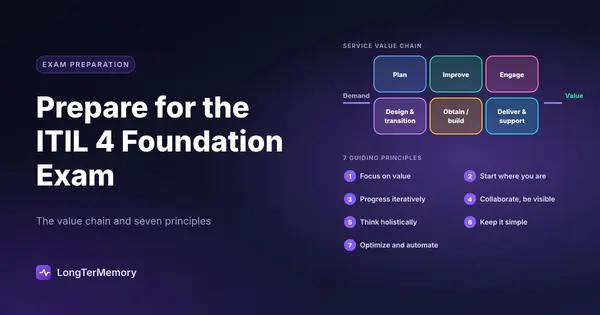
The seven principles are:
- Focus on value
- Start where you are
- Progress iteratively with feedback
- Collaborate and promote visibility
- Think and work holistically
- Keep it simple and practical
- Optimize and automate
For exam purposes, do not just memorize the names. Understand the intent behind each one. Many questions will describe a scenario, a situation a service team is facing, and ask which guiding principle most applies. If you only know the names, you will struggle with scenario-based questions.
The Service Value System and Service Value Chain
The Service Value System (SVS) is the central model in ITIL 4. It describes everything that contributes to creating value through IT services. Its components are:
- Guiding principles
- Governance
- Service value chain
- Practices
- Continual improvement
Within the SVS, the Service Value Chain (SVC) describes six interconnected activities that transform inputs into outputs:
- Plan
- Improve
- Engage
- Design and transition
- Obtain/build
- Deliver and support
You need to be able to describe each activity, understand how they connect, and recognize which activity is relevant in different service scenarios. Exam questions often present a situation and ask which value chain activity is being performed.
The Four Dimensions of Service Management
ITIL 4 describes four dimensions that must all be considered to deliver effective services:
- Organizations and people
- Information and technology
- Partners and suppliers
- Value streams and processes
Questions about the four dimensions often focus on understanding what belongs in each dimension and why a holistic view across all four is necessary for effective service delivery.
The 34 Practices
This is where candidates sometimes get overwhelmed. ITIL 4 describes 34 management practices, and the Foundation syllabus expects varying levels of familiarity with them. The good news is that you are not expected to know all 34 in deep detail at Foundation level.
The practices are grouped into:
- General management practices (14 practices): including continual improvement, risk management, knowledge management
- Service management practices (17 practices): including incident management, change enablement, service desk, problem management
- Technical management practices (3 practices): including deployment management and infrastructure and platform management
For Foundation level, the exam expects you to be able to describe the purpose of every practice and recall key details for the highest-priority ones. Focus extra attention on: incident management, problem management, change enablement, service desk, service level management, and continual improvement. These appear in exam questions more frequently than others.
Recommended Study Resources and Prep Time
Official AXELOS/PeopleCert Content
The official ITIL 4 Foundation study guide published by AXELOS is the authoritative reference for everything on the exam. It is comprehensive and can be dense in places, but it is the source from which exam questions are drawn. If you are planning to use only one resource, this is the one.
That said, the official guide is not always the most engaging first read. Many candidates find it more effective to start with a more accessible secondary resource and then return to the official guide to fill gaps and verify details.
Third-Party Study Materials
Several third-party providers have produced excellent ITIL 4 Foundation study materials:
- IT Governance publishes a concise study guide that covers the syllabus efficiently
- AXELOS’s own eLearning platform provides structured online learning
- Udemy courses from instructors with actual ITSM experience (look for courses with recent reviews and a high completion rate)
- YouTube has free walkthrough videos for every major ITIL 4 concept, which are useful for understanding concepts that are hard to grasp from text alone
How Long You Need to Study
Candidates with no previous ITIL exposure typically need 20 to 30 hours of study time to be well-prepared for the Foundation exam. This is roughly three weeks of consistent study at an hour per day, or two weeks at an hour and a half.
Candidates with prior ITIL v3 knowledge or significant ITSM experience often need less time, typically 15 to 20 hours, because they already understand the underlying concepts and are primarily learning the ITIL 4 terminology and updates.
If you are completely new to IT service management in general, budget 30 hours to be safe. Use 20 hours for content learning and 10 hours for practice questions and review.
| Background | Recommended Hours |
|---|---|
| New to ITSM and ITIL | 30+ hours |
| Some ITSM experience, new to ITIL | 20-25 hours |
| Previous ITIL v3 certification | 15-20 hours |
Practice Question Strategy for ITIL 4 Foundation
Practice questions are essential for ITIL Foundation preparation, not as a memory test but as a way to understand how the exam thinks. The question style on ITIL Foundation is distinctive: questions are often scenario-based, requiring you to apply concepts rather than just recall them, and there are frequently two or three plausible-sounding answers that require careful reading to distinguish.
Start Practice Questions Early
Do not wait until you have finished all your content study before attempting practice questions. Start doing practice questions after covering your first major topic area, the guiding principles or the SVS. This early exposure accomplishes two things: it shows you what level of understanding the exam actually requires, which calibrates your content study, and it reinforces what you have learned through retrieval practice.
How to Use Practice Questions Effectively
When you get a question wrong, do not just note the correct answer and move on. Understand why the correct answer is correct and why the other options are wrong. ITIL Foundation questions often hinge on subtle distinctions, for example between what the guiding principle “Start where you are” emphasizes versus what “Progress iteratively with feedback” emphasizes. If you just memorize answers without understanding the reasoning, you will be caught by the next question that presents the same concept in a different framing.
Aim to work through at least 100 to 150 practice questions before your exam. Most question banks include between 100 and 200 questions, and some provide official sample papers.
Official sample papers from PeopleCert are the most representative of actual exam difficulty and question style. If you can access them, prioritize these over third-party question banks, though both are valuable.
Target Score on Practice Papers
When you are consistently scoring above 80% on practice papers, you are well-positioned for the real exam. The passing score is 65% (26 out of 40 questions), so an 80% practice score gives you a comfortable buffer that accounts for exam-day nerves and any questions you find unexpectedly difficult.
If you are scoring below 70% on practice papers, identify which topic areas are causing the most incorrect answers and go back to the study material for targeted review. Track your weak areas by topic, not just by total score.
The Week Before the Exam
The week before your exam should shift the balance from learning new content to reinforcing what you already know.
Days 7-4 before exam: Continue working through practice questions. Review any topic areas where you are still weak. Re-read the official descriptions of the guiding principles and practice purposes you are unsure about.
Days 3-2 before exam: Do a full practice paper under timed exam conditions (60 minutes, no notes, no interruptions). Review every question, right and wrong. Identify any remaining weak spots.
Day 1 before exam (the night before): Light review only. Go through your flashcards or summary notes for the guiding principles, the service value chain activities, and any definitions you have found tricky. Do not attempt new material. Sleep well.
Creating flashcards for ITIL 4 vocabulary and concepts is particularly effective because so much of what you need is definition-based or principle-based. Tools like LongTerMemory can help you convert your study notes and practice material into spaced repetition flashcards automatically, keeping the key ITIL 4 concepts fresh as you approach exam day without requiring hours of manual card creation.
On Exam Day
Read every question carefully. ITIL Foundation questions frequently use precise language, and the difference between “most” and “always” can change the correct answer. Scenario-based questions often have one answer that is technically true in a general sense but is not the best answer within the ITIL framework specifically. Always ask yourself: what would ITIL say here, not just what is generically sensible.
If a question is genuinely unclear, use process of elimination. ITIL Foundation typically has one clearly wrong answer and one clearly better answer among the options, with the remaining two being plausible but imprecise. Eliminate the clearly wrong one first, then the weaker plausible one, and you usually end up with a correct answer even when you are uncertain.
You have 60 minutes for 40 questions, which is 90 seconds per question on average. Keep an eye on time but do not rush. Most candidates finish with time to spare.
The ITIL 4 Foundation certification is a credential worth having, and the exam is genuinely passable with focused preparation. Three to four weeks of consistent study, a solid understanding of the vocabulary and key models, and consistent practice question work will get you there.