How to Memorize Foreign Language Vocabulary Overnight
Use science-backed pre-sleep review, spaced repetition, and context techniques to memorize foreign language vocabulary overnight and make it stick.
Table of Contents
- What Happens to Language in Your Brain While You Sleep
- The Pre-Sleep Vocabulary Review Method
- Step 1: Create the right list
- Step 2: Active encoding before sleep
- Step 3: Sleep review , literally
- The Keyword Method: Building Hooks That Last
- Context Sentences: Why Isolated Words Don't Work
- Spaced Repetition Apps: The Best Overnight Tool You're Underusing
- What to Do If You Keep Forgetting the Same Words
- Morning Review: Don't Skip This
- Realistic Expectations: What "Overnight" Actually Means
- Quick Reference: Your Overnight Vocabulary Protocol
You’ve got a vocabulary test tomorrow. You’ve got a list of 40 words in a language you’re still getting comfortable with. It’s already evening. Can you actually learn those words by morning , and keep them?
The short answer is yes, but with an important condition: the techniques you use in those evening hours will make all the difference between vocabulary that vanishes before you sit down for the test and vocabulary that stays with you for months.
Here’s everything you need to know about memorizing foreign language vocabulary overnight, backed by what we actually know about how memory works during sleep.
What Happens to Language in Your Brain While You Sleep
Before the techniques, let’s spend a minute on the mechanism , because understanding why pre-sleep review works will help you use it more intentionally.
While you’re awake, your brain takes in new information and holds it in a kind of short-term buffer. During sleep , specifically during the slow-wave and REM stages , your brain replays recently learned material and transfers it from the hippocampus (short-term storage) into long-term cortical networks.
This process is called memory consolidation, and it’s not passive. Your sleeping brain is actively strengthening some neural connections and weakening others. The material you reviewed last before sleep gets a priority pass into this consolidation process , there’s less interference from subsequent information, which means it gets encoded more deeply.
In practical terms: what you study right before sleep consolidates better than what you studied earlier in the day. This is why language learners who do a vocabulary review session 20-30 minutes before bed consistently outperform those who cram the same material during the afternoon.
The Pre-Sleep Vocabulary Review Method
Here’s the structure that maximizes overnight consolidation:
Step 1: Create the right list
Don’t try to learn 100 words in one night. 20-30 words is the sweet spot for a high-quality overnight session. If you have more words than that, prioritize by frequency, importance, or test weighting.
For each word, you need three things:
- The word in the target language
- Its meaning (preferably with a context sentence, not just a translation)
- A hook , something that connects the word to something you already know (more on this below)
Step 2: Active encoding before sleep
30-40 minutes before you want to sleep, sit down with your vocabulary list and work through it actively:
- Say each word out loud in both languages
- Read the context sentence
- Close your notes and try to recall the word from just the meaning , this is the retrieval trigger
- Write out any words you couldn’t recall
Don’t just read the list top-to-bottom multiple times. That’s passive exposure, and it creates the fluency illusion , where words feel familiar without being retrievable. Force yourself to recall actively.
Step 3: Sleep review , literally
This sounds odd, but it works: do a final quick pass through just the words you struggled with as you’re getting into bed. Not a full study session , just a brief exposure to the problem words. Then sleep.
Your brain will do the rest.
The Keyword Method: Building Hooks That Last
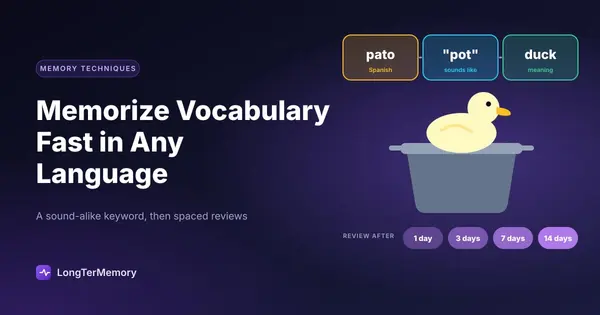
The single most powerful technique for fast vocabulary memorization in any language is the keyword method (also called the mnemonic link system for language). It works by linking the sound of a foreign word to a vivid mental image.
Here’s how it works:
- Take a foreign word, e.g. the Spanish word mariposa (butterfly)
- Find a part of the word that sounds like an English word , mari-POSA sounds a bit like “Mary” + “pose”
- Create a vivid mental image that connects the sound-alike to the meaning: Mary is posing like a butterfly, wings spread
- That image becomes your retrieval hook
The more absurd, emotional, or vivid the image, the better it sticks. Your brain is wired to remember things that are surprising, funny, or weird , tap into that.
Some examples:
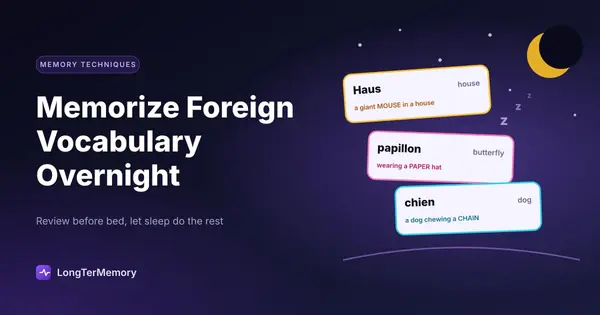
| Foreign Word | Language | Meaning | Keyword Hook |
|---|---|---|---|
| Haus | German | House | A giant MOUSE living in a house |
| papillon | French | Butterfly | A butterfly wearing a PAPER hat |
| chien | French | Dog | A dog eating a CHAIN |
| árbol | Spanish | Tree | An ARCHER shooting an arrow at a tree |
| libro | Italian/Spanish | Book | A LIBRARY full of books |
The keyword method consistently outperforms rote repetition in research studies. It’s especially effective for languages where the words share little phonetic overlap with English , like Japanese, Arabic, or Hungarian , because it creates a bridge through sound.
Context Sentences: Why Isolated Words Don’t Work
Here’s something that language researchers have known for decades: isolated word lists are an inefficient way to learn vocabulary. Words exist in context , they have collocations, register, and usage patterns that only become clear in sentences.
When you learn a word through a context sentence, you get:
- The meaning
- How it’s used grammatically
- What other words it naturally appears with
- A mini-story that makes it more memorable
Compare these two:
- conquistar = to conquer
- El explorador quería conquistar nuevos territorios. (The explorer wanted to conquer new territories.)
The second one is harder to forget. It’s not just a word, it’s a scene.
When building your overnight vocabulary list, find or write one context sentence per word , ideally a sentence that uses the word in a way that’s vivid, personally relevant, or slightly memorable. Your brain treats meaningful material completely differently from isolated tokens.
Spaced Repetition Apps: The Best Overnight Tool You’re Underusing
If you have vocabulary you need to retain beyond just tomorrow’s test , if you’re building language skills for real , then spaced repetition is your most powerful ally for pre-sleep review.
Apps like Anki, LongTerm Memory, or Clozemaster use an algorithm to show you words at exactly the interval your brain needs to review them before forgetting. The result is that you spend zero time on words you already know well, and maximum time on the words on the edge of your forgetting curve.
Here’s how to use them for overnight sessions:
- Add your vocabulary list with context sentences
- Review all “due” cards 30-40 minutes before sleep
- Mark words you missed as “hard” or “again” , these will come back sooner
- Close the app and sleep
The following morning, do a quick review before anything else , even before coffee if possible. This morning review is sometimes called the “consolidation booster” because it locks in what your brain worked on overnight, while the memory is fresh but not yet fully consolidated into long-term storage.
What to Do If You Keep Forgetting the Same Words
Some words just don’t stick, no matter how many times you review them. This is normal , and it’s a signal that your current encoding strategy isn’t working for that particular word.
When a word keeps slipping away, do two things:
First, change your hook. The keyword image you created isn’t vivid or bizarre enough. Make it weirder. Make it funnier. Add motion, emotion, or absurdity. If “Mary posing” didn’t stick for mariposa, try a more extreme image , Mary dressed as a giant butterfly, flapping her arms in slow motion.
Second, use the word actively. Write a sentence using it. Say it in a sentence out loud. Use it in your inner monologue when you’re brushing your teeth. The more pathways you create to a word , sound, visual, semantic, motor , the more retrieval routes your brain has.
Words that feel impossible to retain aren’t impossible , they’re just under-encoded. Add more dimensions.
Morning Review: Don’t Skip This
After your overnight session, how you handle the morning matters.
About 5-10 minutes after waking up , while your brain is still in a slightly drowsy state and consolidation processes are wrapping up , do a quiet recall test:
- Without looking at any list, try to produce as many overnight words as you can, in the target language, from their meanings
- Write them down or say them out loud
- Then check against your list
This morning retrieval practice is powerful for two reasons:
- It tests what actually consolidated overnight vs. what just felt familiar before sleep
- It actively strengthens the freshly consolidated memories while they’re still “warm” and flexible
Students who add this 10-minute morning review to their overnight sessions consistently report better retention at test time , not because they reviewed more, but because they closed the consolidation loop properly.
Realistic Expectations: What “Overnight” Actually Means
To be clear: one overnight session won’t give you permanent vocabulary mastery. What it will do is dramatically improve your recall for the next 1-7 days , which is perfect for an upcoming test.
For vocabulary to become truly long-term , part of your active language knowledge , you need spaced reviews over weeks and months. The overnight method is excellent for short-term performance, and it’s the right starting point for a longer spaced repetition schedule.
Think of it this way: overnight learning gets words into memory. Spaced repetition over time keeps them there.
If you combine good pre-sleep sessions with consistent spaced reviews in the days and weeks that follow, vocabulary that you crammed the night before a test can end up becoming vocabulary you remember for years.
Quick Reference: Your Overnight Vocabulary Protocol
Here’s the full workflow in one place:
| Time | Action |
|---|---|
| Evening (1+ hour before sleep) | Build your list (20-30 words, with context sentences and keyword hooks) |
| 30-40 min before sleep | Active encoding: read, recall, write struggling words |
| Right before sleep | Quick pass through the words you missed |
| Morning after waking | 10-min recall test without looking at the list |
| Later that day | Review the words you missed in the morning test |
| 3 days later | Quick spaced review session |
Follow this cycle and the words you “crammed overnight” become words you actually own.
Learning a new language? LongTerm Memory can automatically turn your vocabulary lists and language notes into spaced repetition sessions , so you get the benefits of optimized review timing without having to manage a manual schedule.