How to Learn Accounting From Scratch: A Self-Taught Beginner's Guide
A complete guide to learning accounting independently, with the right resources, study methods, and spaced repetition strategies for real retention.
Table of Contents
- Why Learn Accounting Without a Classroom?
- Start Here: The Four Pillars of Basic Accounting
- The Accounting Equation
- The Double-Entry System
- The Three Core Financial Statements
- Accrual vs. Cash Basis Accounting
- The Resources Worth Your Time
- Free Foundations
- Textbooks for Serious Study
- Online Courses
- How to Actually Study Accounting (Not Just Read About It)
- Work Every Problem Twice
- Use Flashcards for Rules and Definitions
- Build a Running Glossary
- Test Yourself With Complete Financial Statements
- Planning Your Study Schedule
- A Realistic Timeline for Foundational Accounting
- Build Review Into Your Schedule From Day One
- What to Do When You Hit a Wall
- Building Toward Certification
Accounting has a reputation for being intimidating. Numbers everywhere. Debits, credits, balance sheets, income statements, something called a trial balance, and enough acronyms to make your head spin before you’ve even opened a textbook.
But here’s the thing: accounting is actually one of the most learnable subjects out there, because it has genuine internal logic. Once you understand the core principles, everything else is application of those principles. The problem most self-taught learners have isn’t that accounting is too hard. It’s that they start in the wrong place, or they use the wrong method, or they memorize rules without understanding why those rules exist.
This guide is for anyone who wants to learn accounting independently, whether you’re brushing up for a career switch, preparing for a certification exam, building financial literacy for your own business, or just trying to finally understand what your accountant is talking about.
Why Learn Accounting Without a Classroom?
The obvious answer is flexibility. You learn on your schedule, at your pace, and you invest money in resources rather than tuition. But there’s a less obvious benefit: self-directed learners who survive the process tend to understand accounting more deeply than classroom students who are carried through it by structured deadlines.
This sounds counterintuitive. Surely structure helps? It does, in the short term. The problem is that classroom accounting often teaches to the test. You learn enough to pass the next quiz, then you move on before the material has actually consolidated. Self-directed learners who build their own schedule can afford to stay on a topic until it genuinely makes sense, which changes the entire experience.
The catch, of course, is that you have to provide your own accountability and your own feedback mechanisms. We’ll come back to how to do both.
Start Here: The Four Pillars of Basic Accounting
Before you pick up a textbook, a course, or anything else, it helps to know what you’re actually trying to understand at the foundational level. Accounting rests on four core ideas that everything else builds from.
The Accounting Equation
The most fundamental thing in all of accounting:
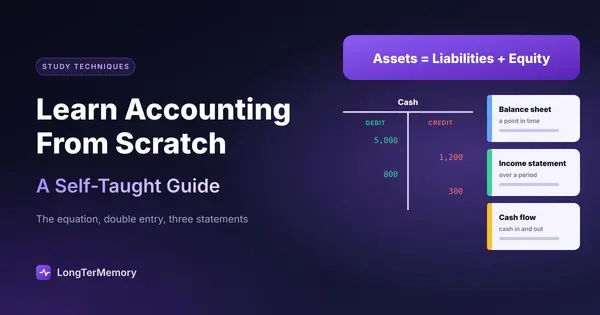
Assets = Liabilities + Equity
Everything in double-entry bookkeeping is a consequence of this equation. Every transaction is recorded in a way that keeps this equation balanced. If you genuinely understand what assets, liabilities, and equity are, and why this equation must always hold, you have the conceptual foundation for everything else.
Don’t rush past this. Many learners treat it as an obvious definition and move on. Spend real time with it. What counts as an asset? What makes something a liability rather than an expense? Why does equity sit on the same side as liabilities?
The Double-Entry System
Every transaction affects at least two accounts. When you buy office supplies with cash, your supplies account goes up (you have more supplies) and your cash account goes down (you have less cash). The total in the equation stays balanced because both sides change by the same amount.
Debits and credits are just a formal language for describing these changes. Debits increase some accounts and decrease others, depending on the account type. The same goes for credits. This trips up almost every beginner because the everyday meanings of “debit” and “credit” (good thing / bad thing, money in / money out) have nothing to do with their accounting meanings.
The fix is to learn account types first, and what happens to each type under a debit or credit, before you try to record any transactions.
The Three Core Financial Statements
Once you understand how transactions are recorded, the goal is to understand how they roll up into the three reports that tell you what a business is worth and how it’s doing:
| Statement | What It Shows |
|---|---|
| Balance Sheet | Assets, liabilities, and equity at a single point in time |
| Income Statement | Revenue and expenses over a period of time |
| Cash Flow Statement | How cash moved in and out over a period |
These three documents tell three different stories about the same business, and they’re connected to each other in specific ways. Understanding those connections is a significant milestone in your accounting education.
Accrual vs. Cash Basis Accounting
One of the early conceptual hurdles: two different methods for deciding when to record revenue and expenses. Cash basis records things when money actually changes hands. Accrual basis records revenue when it’s earned and expenses when they’re incurred, regardless of when cash moves.
Most serious accounting, and everything you’d study for a certification, uses accrual basis. Cash basis is simpler but gives a less accurate picture of a business’s financial health. Knowing why this is true is more important than memorizing the definition.
The Resources Worth Your Time
The internet has made accounting resources abundant, but quality varies wildly. Here’s what actually works for self-directed learners.
Free Foundations
Khan Academy’s Accounting and Finance course is the best place to start if you’ve never touched accounting before. The videos are short, clear, and genuinely build from first principles. Sal Khan’s pedagogical instinct is excellent for this subject. Work through the whole accounting section before moving to anything more advanced.
AccountingCoach.com is an underrated gem. The free content covers almost everything you need for foundational accounting, with clear explanations and plenty of examples. It also has a paid tier with quizzes and assessments that are worth considering once you’re past the basics.
Textbooks for Serious Study
If you’re preparing for a professional exam or just want to go deep, a textbook gives you systematic coverage that online courses rarely match.
“Accounting Made Simple” by Mike Piper is genuinely as simple as it claims, and that’s not an insult. For someone starting from zero, this is often the right first book: short, clear, and free of the bloat that makes introductory textbooks overwhelming.
Once you’ve got the basics, “Intermediate Accounting” by Kieso, Weygandt, and Warfield is the standard reference used in university programs and most CPA exam prep. It’s dense and expensive, but comprehensive.
Online Courses
Coursera’s Introduction to Financial Accounting from Wharton is free to audit and covers the material rigorously with real-world examples. It’s structured around a 15-week university course pace, but you can compress or extend that however you like.
For CPA exam prep specifically, Becker CPA Review is the industry standard, though it’s expensive. Surgent CPA Review is a strong alternative that uses adaptive technology to focus your study time on your personal weak areas.
How to Actually Study Accounting (Not Just Read About It)
This is where most self-learners go wrong. They read a chapter, feel like they understand it, and move on. Then the exam or real-world application reveals that they understood it while reading it, but couldn’t actually do it independently.
Accounting is a skill, not just a body of knowledge. You have to do problems.
Work Every Problem Twice
When you work through a practice problem in accounting, the goal isn’t just to get the right answer. It’s to understand every step of why the right answer is right. Work the problem once without looking at the solution. Compare your answer. Then, critically, work through the solution method step by step, even if your answer was correct, to confirm that your reasoning was sound.
If you got the right answer with wrong reasoning, you got lucky once. You won’t be lucky consistently under exam conditions.
Use Flashcards for Rules and Definitions
The parts of accounting that require pure memorization, account types, debit/credit rules, specific recognition criteria under standards like GAAP or IFRS, respond well to spaced repetition flashcards.
Build a flashcard for every accounting rule or definition you need to know cold. Then drill those cards using a spaced repetition system like Anki. The combination of flashcard drilling and practice problem work covers both the declarative knowledge (what the rule is) and the procedural knowledge (how to apply it).
LongTerMemory.com can accelerate this process for certification prep: upload your study materials, and the platform auto-generates question-answer pairs for spaced repetition review, saving you the time of building flashcard decks from scratch.
Build a Running Glossary
Accounting has a lot of jargon, and terms overlap and connect in important ways. Keep a running document (or a set of linked notes if you use Obsidian or a similar tool) where you define every new term in your own words, note how it connects to terms you already know, and record an example of it in context.
The act of writing definitions in your own words is one of the most effective learning techniques available. It forces you to confront vague understanding and clarifies exactly where your mental model breaks down.
Test Yourself With Complete Financial Statements
Once you’re past the basics, the single most valuable practice exercise is building complete financial statements from scratch using a set of transactions. Start with 20 or 30 transactions, classify them correctly, record them, and produce a balance sheet and income statement that reconcile.
This end-to-end exercise integrates everything: account classification, debit/credit logic, the relationship between the income statement and equity, the flow into the balance sheet. If you can do this cleanly with unfamiliar transactions, you actually know accounting.
Planning Your Study Schedule
Self-directed learning lives or dies by the schedule. Without a clear plan, most people either try to do too much at once, burn out, and quit, or they study inconsistently and never build momentum.
A Realistic Timeline for Foundational Accounting
For a complete beginner aiming at solid foundational knowledge (not a professional certification), a realistic timeline looks something like this:
| Phase | Duration | Focus |
|---|---|---|
| Core concepts | 2-3 weeks | Accounting equation, debits/credits, account types |
| Journal entries | 2-3 weeks | Recording transactions, the general journal |
| Financial statements | 2-3 weeks | Building and interpreting all three statements |
| Adjusting entries | 1-2 weeks | Prepaid expenses, accruals, depreciation |
| Practice integration | 2-3 weeks | Complete accounting cycles from scratch |
That’s roughly 10 to 14 weeks of study, at an hour or two per day. For professional certifications, you’re looking at a longer runway depending on the exam.
Build Review Into Your Schedule From Day One
The mistake most learners make is treating each topic as something to finish and move past. You study journal entries, feel like you’ve got it, and shift your attention entirely to financial statements. Three weeks later, when you need journal entries again, they’ve partially faded.
Spaced repetition solves this. Use your flashcard system to keep earlier material active while you push into new content. Spend 20% of each study session reviewing older material before diving into new topics. You’ll feel like you’re going slower, but you’ll retain far more, and the new topics will make more sense because the foundations are solid.
What to Do When You Hit a Wall
Everyone learning accounting hits a wall at some point. Usually it’s one of a few specific topics: debits and credits in the early stages, accrual accounting, or depreciation methods. These are the spots where intuition breaks down and the formal rules feel arbitrary.
When this happens, the worst thing you can do is push through the confusion by reading more. Read a different explanation. Watch a video. Work a simple example with concrete numbers. Explain the concept out loud to yourself or anyone willing to listen. The Feynman technique (explaining a concept as if teaching it to a beginner) is especially powerful for accounting because it forces you to work out whether you can actually use the rule or just recognize it.
One useful exercise: trace a single transaction all the way through the accounting system. Pick something simple, like purchasing equipment with cash. How does it hit the journal? Which accounts change? How does it affect the balance sheet? What happens when you depreciate it over time, and how does that hit the income statement? Tracing one thing end-to-end often unsticks understanding that reading definitions couldn’t.
Building Toward Certification
If your goal is a professional accounting certification, the self-taught path is absolutely viable but requires more structure.
The CPA exam (in the US) is a four-part exam requiring deep knowledge across financial accounting, auditing, regulation, and business concepts. Most candidates spend 12 to 18 months of serious preparation. The foundational knowledge in this guide is a prerequisite, not a substitute, for specialized CPA review materials.
For more accessible credentials, the Quickbooks certification, AIPB Certified Bookkeeper, or NACPB Accounting Certificate are achievable with foundational knowledge and some additional targeted prep, and they carry real value in the job market.
Whatever your target, identify the specific exam content outline early. Everything in this guide is relevant, but knowing exactly what the exam tests lets you prioritize your study time correctly rather than spending equal time on things that matter a lot and things that barely appear.
Accounting rewards patient, systematic learners who are willing to do the work rather than just read about it. If you combine a solid resource with consistent practice problems, a spaced repetition system for rules and definitions, and the discipline to actually build financial statements from scratch rather than just read about them, you’ll find that accounting is far more accessible than its reputation suggests.
The logic is there, waiting to click.