How to Learn Chinese Characters With Spaced Repetition
Learn Chinese characters faster with spaced repetition. Proven techniques for mastering Mandarin writing, tones, and long-term vocabulary retention.
Table of Contents
- Why spaced repetition is uniquely effective for character-based writing systems
- Why characters are different from alphabetic vocabulary
- The research on spaced repetition and character retention
- Flashcard design for Chinese characters: tone, meaning, and stroke order
- The four card types you actually need
- Why tone deserves its own attention
- Stroke order: necessary at first, optional later
- Adding example words and collocations
- Sequencing character learning for HSK levels or general fluency
- Frequency-based sequencing for faster functional literacy
- The radical foundation strategy
- Setting a sustainable daily pace
- Integrating characters with listening, speaking, and grammar
- Tools and apps that actually work for Chinese SRS
- The bottom line
If you’ve ever opened a Mandarin textbook, stared at a page full of characters that all look like slightly different stick-figure puzzles, and quietly wondered how anyone on earth learns this language, you’re in good company. Chinese characters are intimidating. Unlike alphabetic languages where you can sound out a word once you know the letters, every Chinese character is a unique visual symbol that carries its own meaning, its own pronunciation, and often multiple readings depending on context.
The traditional approach, writing characters out hundreds of times in a notebook, works for some people. For most of us, it’s slow, boring, and produces surprisingly poor long-term retention. You can write a character fifty times on Tuesday and completely forget it by Friday.
The alternative isn’t studying harder. It’s studying smarter, and spaced repetition is the smartest system available for the specific challenge of character-based writing. When you pair the right SRS approach with well-designed flashcards and a logical learning sequence, Chinese stops feeling like an impossible wall and starts feeling like a puzzle you can actually solve, one piece at a time.
Why spaced repetition is uniquely effective for character-based writing systems
Spaced repetition is uniquely effective for Chinese because it solves the volume problem. Mandarin requires mastery of roughly 2,000 to 3,000 characters for basic literacy, and each one is a distinct visual symbol with multiple attributes attached. Without a system to manage reviews, the forgetting curve demolishes your progress almost immediately.
Hermann Ebbinghaus first mapped the forgetting curve back in the 1880s, and his findings apply brutally to character learning. Within 24 hours of encountering a new character, you will forget roughly 50% to 70% of what you learned if you don’t review it. Within a week, that number climbs to 80% or higher. This is catastrophic when you’re trying to build a mental library of thousands of unique symbols.
Spaced repetition interrupts this decay by scheduling reviews at mathematically optimal intervals. The algorithm shows you a character right before you’re about to forget it, which forces a difficult retrieval that physically strengthens the neural pathway. Over time, the intervals stretch from one day to three days to a week to a month, and eventually to years. The result is genuine long-term retention with the minimum possible number of reviews.
Why characters are different from alphabetic vocabulary
Learning a Spanish or French word is mostly about linking a sound to a meaning. The letters are already familiar. Chinese is different in three specific ways that make spaced repetition not just helpful, but practically essential:
- Visual complexity: Characters range from simple one-stroke symbols to elaborate forms with over 20 strokes. Your brain has to encode a precise visual pattern, not just a sequence of familiar letters.
- Phonological opacity: Unlike alphabetic words, characters give you almost no pronunciation clues. You cannot sound out a character you’ve never seen. You either know it or you don’t.
- Semantic density: Many characters carry multiple meanings, multiple pronunciations, and function differently when combined with other characters. The word for “tomorrow” is literally “bright day,” which combines two characters you need to know individually.
These three factors multiply the memory load. A single Chinese character demands more cognitive resources to encode than a typical alphabetic word. That makes efficient review scheduling even more critical, because inefficient review means even more time spent on an already demanding task.
The research on spaced repetition and character retention
Studies on Japanese kanji, which share the same character system, provide useful benchmarks. Research consistently shows that learners using spaced repetition retain characters at rates 40% to 60% higher than learners using massed practice, like writing characters repeatedly in a single session. One study found that students who reviewed kanji on an SRS schedule made 2.3 times fewer errors on a delayed post-test compared to students who used traditional handwriting repetition.
The numbers are clear: spaced repetition doesn’t just save time, it produces measurably better memory for exactly the kind of visual-semantic information that Chinese characters represent.
Flashcard design for Chinese characters: tone, meaning, and stroke order
The best Chinese flashcards isolate one retrieval target per card, showing the character on the front and testing either pronunciation, tone, meaning, or stroke order on the back. Cards that ask you to recall everything at once create cognitive overload and produce worse retention than focused, single-target cards.
Most beginners make the mistake of building one giant card that asks for the character, the pinyin, the tone, and the meaning all at once. This feels efficient because you’re testing everything, but it actually trains your brain to rely on partial cues rather than full retrieval. If you see the character and instantly remember the meaning but stumble on the tone, the card should pass or fail based on tone alone, not give you credit for the easier meaning recall.
The four card types you actually need
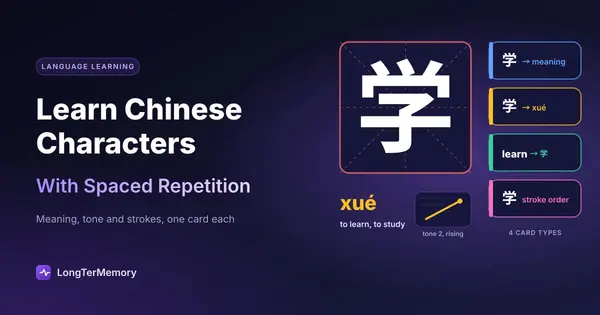
For serious character learning, you want four distinct card types. You don’t need to build all four for every single character, but you should use them strategically:
| Card type | Front | Back | When to use |
|---|---|---|---|
| Character to meaning | 学 | to learn / study | Always, for every character |
| Character to pronunciation | 学 | xué (tone 2) | Always, for every character |
| Meaning to character | to learn / study | 学 | After initial recognition is solid |
| Stroke order prompt | 学 (show animation) | Write the character | For first 500 characters, then as needed |
The character-to-meaning card is your bread and butter. It trains reading comprehension, which is the fastest path to real-world literacy. The character-to-pronunciation card is equally important because without tone recall, you cannot speak or listen effectively. Mandarin has only around 400 syllable sounds, but tones multiply that into roughly 1,600 distinct spoken units. Getting the tone wrong doesn’t just sound accented, it changes the word entirely.
Why tone deserves its own attention
Tonal errors are the single biggest giveaway of a non-native Mandarin speaker. The syllable “ma” can mean mother, hemp, horse, or scold depending entirely on tone. If your flashcards don’t explicitly test tone recall, you’re building a vocabulary full of silent, half-known words that fall apart the moment you try to use them in conversation.
A good pronunciation card looks like this:
- Front: 学
- Back: xué (second tone) + audio clip of native speaker
The audio clip is non-negotiable. Your internal voice is not a reliable guide for Mandarin tones, especially in the first year. Every pronunciation card should include a native audio reference so you can correct yourself immediately.
Stroke order: necessary at first, optional later
For the first 500 characters or so, stroke order matters. It matters because correct stroke order helps your characters look balanced and recognizable, and because it develops motor memory that makes writing feel automatic rather than effortful. It also matters for dictionary lookup by stroke count, and for understanding how radicals combine into full characters.
After those first 500 characters, strict stroke order becomes less critical for most learners unless you specifically care about handwriting. At that point, your time is better spent on reading recognition and vocabulary breadth than on perfect penmanship. The vast majority of modern Mandarin communication happens through typing, not handwriting.
If you do care about handwriting, add a stroke order field to your cards for the first year. Apps like Skritter integrate stroke order testing directly into their SRS, which is a more elegant solution than trying to self-evaluate on paper.
Adding example words and collocations
Characters rarely appear in isolation. The character 学 appears in 学生 (student), 学校 (school), 学习 (to study), 大学 (university), and dozens of other common words. A flashcard that shows only the isolated character gives you an abstract fragment. A flashcard that includes one or two high-frequency compounds gives you context and shows how the character functions in real language.
Recommended format for a richer card:
- Front: 学
- Back: xué (2nd tone) / to learn, to study / 学生 (xuésheng, student), 学习 (xuéxí, to study)
This packs multiple layers of information into one review, but the retrieval target is still focused. You’re being tested on recognition of the single character. The compounds are bonus context that deepens your encoding without adding separate retrieval demands.
Sequencing character learning for HSK levels or general fluency
The two most effective sequencing strategies are HSK level progression and pure frequency ordering. HSK sequencing gives you test-aligned milestones and predictable grammar integration. Frequency ordering builds real-world reading ability faster by teaching the most common characters first regardless of test level. Both work, but frequency ordering tends to produce functional literacy sooner.
The HSK is China’s official proficiency test, and its character lists are well-designed. HSK 1 covers 150 characters, HSK 2 adds another 150, and by HSK 4 you’re at 1,200 characters. This is a perfectly valid path, especially if you plan to take the test or want the structure of clear checkpoints.
However, the HSK sequences characters partly by grammatical function rather than pure frequency. Some very common characters appear in HSK 3 or 4 because they serve more complex grammatical roles, while slightly less common characters appear earlier because they’re needed for simple sentence patterns. For learners focused on real-world use rather than test scores, this can feel slightly inefficient.
Frequency-based sequencing for faster functional literacy
If your goal is to read actual Chinese text as soon as possible, a frequency-based sequence will get you there faster. The most common 500 characters in written Chinese cover roughly 75% of modern text. The most common 1,000 characters cover about 86%. The most common 2,000 cover roughly 95%.
Those are powerful thresholds. At 500 characters, you can read simple children’s books and basic dialogues. At 1,000 characters, you can navigate news headlines and social media posts with a dictionary. At 2,000 characters, you’re functionally literate for most daily purposes.
| Character milestone | Approximate coverage | What you can read |
|---|---|---|
| 500 characters | 75% of modern text | Graded readers, simple dialogues |
| 1,000 characters | 86% of modern text | News headlines, social media, basic articles |
| 1,500 characters | 92% of modern text | General news, blogs, simplified novels |
| 2,000 characters | 95% of modern text | Most daily material with occasional dictionary use |
| 3,000 characters | 99% of modern text | Professional documents, literature, academic texts |
A frequency-based deck teaches characters in order of these real-world statistics. The first 100 cards might include characters like 的, 一, 是, 不, 了, 人, 我, 在, 有, and 大 because those appear in almost every paragraph of Chinese you’ll ever read. An HSK 1 deck would also include many of these, but not necessarily in the exact same priority order.
The radical foundation strategy
One sequencing approach that complements either HSK or frequency ordering is radical-first learning. Chinese characters are built from roughly 200 recurring components called radicals. If you learn the 50 most common radicals before diving into full characters, you start recognizing structural patterns instead of memorizing random shapes.
For example, the radical 氵 (water) appears in 海 (sea), 河 (river), 洗 (wash), and 深 (deep). Once you know that three drops on the left side means water, a whole category of characters becomes visually predictable. This doesn’t tell you pronunciation, but it gives you a semantic hook that makes the character easier to encode and retrieve.
A hybrid approach works well for most learners:
- Learn the 50 most common radicals first, using a small dedicated deck.
- Move to HSK 1 or a frequency-based character deck.
- As you encounter new characters, notice which radicals they contain.
- By HSK 3 or 500 characters, radical recognition becomes automatic and accelerates your acquisition of new characters.
Setting a sustainable daily pace
The most common failure mode in Chinese character learning is going too fast at the beginning and burning out. Adding 30 new characters per day sounds reasonable until you realize that your review backlog will grow to over 200 cards per day within a few weeks.
A sustainable pace for most learners is 5 to 10 new characters per day, with consistent review of all due cards. At 10 characters per day, you reach 1,000 characters in about 3.5 months. At 5 characters per day, it’s 7 months. Both timelines are perfectly respectable, and both produce better retention than rushing through 20 characters per day and quitting after a month.
The math of spaced repetition is unforgiving about consistency. Missing two days of reviews can create a backlog that takes an hour to clear, which makes you more likely to miss the next day, which creates an even bigger backlog. The solution is simple but not easy: do your reviews every single day, even if you only add 5 new characters.
Integrating characters with listening, speaking, and grammar
Characters are only one piece of Mandarin fluency. You also need listening comprehension, spoken fluency, and grammatical knowledge. Spaced repetition handles the character retention, but the actual acquisition of language happens through use.
Think of your study routine as a loop:
- Input: Listen to Chinese podcasts, watch shows, or read graded material. This exposes you to characters in real contexts.
- SRS: Add new characters to your spaced repetition deck and review daily. This locks them into long-term memory.
- Output: Practice speaking with a tutor or language partner, and write short journal entries. This reveals which characters you truly know and which ones are just flashcard recognition.
Each part feeds the others. Your SRS makes input easier because you recognize more characters. Your input gives you new characters to add to your SRS. Your output reveals gaps that flashcards alone will never expose.
If you’re looking for a tool that can speed up the deck-building side of this loop, LongTerMemory can automatically generate Chinese character flashcards from any text you upload. Paste in a graded reader chapter, a news article, or your textbook vocabulary list, and the AI creates properly formatted cards with pinyin, tones, meanings, and example compounds. It saves the hours you would otherwise spend manually typing characters into Anki.
Tools and apps that actually work for Chinese SRS
The tool landscape for Chinese spaced repetition is better now than it has ever been. Here are the options worth considering:
- Anki: Still the gold standard for pure customization. You can build exactly the card types described above, add audio, and control every parameter. The learning curve is steep, but the control is unmatched.
- Pleco: The best Chinese dictionary app also has a built-in flashcard system with spaced repetition. Its advantage is seamless lookup. You see a character in the wild, tap it, and add it to your SRS deck in about three seconds.
- Skritter: Specifically designed for Chinese and Japanese character learning. It tests stroke order by having you draw characters on screen, which is excellent for learners who care about handwriting.
- LongTerMemory: Ideal if you want to generate flashcards automatically from Chinese study materials rather than building decks manually. Upload text, get structured SRS cards with characters, pinyin, tones, and example words.
Most serious learners end up using a combination. Pleco for quick lookups and mining, Anki for a fully customized main deck, and LongTerMemory for bulk card generation from longer texts.
The bottom line
Learning Chinese characters is one of the most cognitively demanding tasks in language education, but it is absolutely achievable with the right system. Spaced repetition is that system. It turns the impossible volume of characters into a manageable daily routine. Well-designed flashcards train the specific skills you actually need: recognition, pronunciation, tone recall, and contextual usage. A logical sequencing strategy, whether HSK-based or frequency-based, gets you to functional literacy in months rather than years.
The learners who succeed are not necessarily the smartest or the most talented. They are the ones who show up every day, do their reviews, and trust the algorithm to handle the scheduling. Chinese characters will not learn themselves, but with spaced repetition, they will stay learned once you put in the work.
Start with a small daily commitment. Ten characters a day, reviewed consistently, becomes 1,000 characters in a few months. That 1,000 characters unlocks 86% of modern written Chinese. From there, the snowball effect takes over. Immersion becomes easier, reading becomes possible, and the language stops feeling like a wall and starts feeling like a world you can actually enter.
The wall is only brick by brick. Start laying yours today.