How to Learn Korean With Spaced Repetition
Master Korean vocabulary and grammar with spaced repetition. Science-backed strategies for efficient language learning and long-term retention.
Table of Contents
- Starting Korean With Hangul Before Moving to Vocabulary SRS
- Building Korean Vocabulary and Grammar Flashcard Decks
- Core Vocabulary Decks
- Grammar and Particle Decks
- Verb Conjugation Decks
- Honorifics and Speech Levels
- How Many Decks Should You Maintain?
- Integrating SRS With Listening, Speaking, and Reading Practice in Korean
- The Input-SRS-Output Loop
- What a Realistic Korean Study Week Looks Like
- Listening Practice: Start Early and Stay Consistent
- Speaking Practice: Do Not Wait Until You Feel Ready
- Reading Practice: Webtoons and Graded Readers
- Mining Real Content for Your SRS Decks
- Setting Realistic Timelines
- The Tools That Make Korean SRS Work
- The Bottom Line
If you have ever fallen down a K-drama rabbit hole, belted out a BTS chorus without knowing what the words mean, or dreamed of ordering samgyeopsal in Seoul without pointing at the menu, you have probably thought about learning Korean. It is an incredibly rewarding language, but it also has a reputation for being difficult. The grammar is nothing like English. The honorific system adds layers of complexity. And then there is the vocabulary, thousands of words that seem to share no roots with anything you already know.
Most people who try Korean start with an app, burn through the basics in a week, and then hit a wall. The problem is not the language itself. The problem is the method. Cramming vocabulary for twenty minutes and never seeing it again is a recipe for forgetting. Reading a grammar rule once and hoping it sticks is wishful thinking. What you need is a system that respects how memory actually works.
Spaced repetition is that system. It is the single most effective tool for building long-term retention of vocabulary and grammar, and Korean is a perfect candidate for it. Here is exactly how to use it, from your first encounter with Hangul to the day you can hold a real conversation.
Starting Korean With Hangul Before Moving to Vocabulary SRS
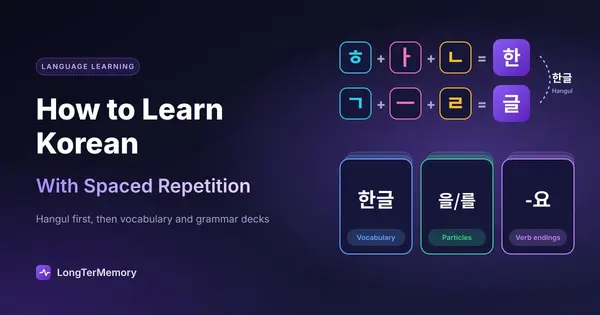
Learn Hangul first, and learn it cold, before you even think about starting a vocabulary SRS deck. Trying to memorize Korean words through romanization builds a harmful crutch that will slow your reading fluency for months.
Korean uses its own alphabet, Hangul, and it is one of the most elegantly designed writing systems in the world. Unlike Japanese, which requires memorizing thousands of characters, or Chinese, which demands even more, Hangul consists of just 24 basic letters: 14 consonants and 10 vowels. There are a few additional combined vowels, bringing the total to roughly 40 shapes you need to recognize. Most learners can read Hangul with reasonable accuracy after just 3 to 5 hours of focused practice.
The science here is straightforward. When you learn words in romanization, your brain stores them as English sounds. Later, when you see the actual Korean word on a sign or a screen, it does not connect to the memory you built. You end up knowing the word phonetically but being unable to read it. That gap is painful, and it creates extra work you could have avoided.
Here is what a solid Hangul foundation looks like:
| Component | What to Learn | Time Needed |
|---|---|---|
| Basic consonants | ㄱ, ㄴ, ㄷ, ㄹ, ㅁ, ㅂ, ㅅ, ㅇ, ㅈ, ㅊ, ㅋ, ㅌ, ㅍ, ㅎ | 1 to 2 hours |
| Basic vowels | ㅏ, ㅑ, ㅓ, ㅕ, ㅗ, ㅛ, ㅜ, ㅠ, ㅡ, ㅣ | 1 hour |
| Combined vowels | ㅐ, ㅒ, ㅔ, ㅖ, ㅘ, ㅙ, ㅚ, ㅝ, ㅞ, ㅟ, ㅢ | 1 to 2 hours |
| Batchim rules | Final consonant pronunciation changes | Ongoing |
You do not need an SRS deck for Hangul itself. Just drill it with flashcards or a simple app until reading Korean feels automatic. Once you can look at a word like 안녕하세요 and read it without thinking, you are ready to start vocabulary spaced repetition. That threshold is worth reaching before you move on, because everything after Hangul depends on it.
Building Korean Vocabulary and Grammar Flashcard Decks
Build separate SRS decks for core vocabulary, grammar particles, and verb conjugations, with every card showing Korean on the front and a context-rich explanation on the back. This separation prevents the cognitive overload that happens when you mix unrelated concepts into one giant deck.
Korean vocabulary acquisition follows the same frequency patterns as every other language. The most common 1,000 words cover roughly 70 to 80 percent of spoken Korean in everyday conversation. The most common 2,000 words push that figure to around 90 percent. That means a focused, frequency-based approach will get you conversational far faster than randomly picking words from a textbook.
Core Vocabulary Decks
Your main vocabulary deck should be built around frequency. Start with the most common 500 to 1,000 words and expand from there. A good card format looks like this:
- Front: Korean word in Hangul + audio pronunciation
- Back: English meaning + a sample sentence using the word
The sample sentence is non-negotiable. Korean is a context-heavy language. The word 치다 can mean “to hit,” “to play an instrument,” or “to strike a match,” depending on what noun it pairs with. Seeing it in isolation teaches you almost nothing useful. Seeing it in a sentence teaches you how it actually functions.
| Card Type | Front | Back | Purpose |
|---|---|---|---|
| Noun | 책 | book / “I read a book every day” | Basic object vocabulary |
| Verb | 먹다 | to eat / “I eat breakfast at 8” | Action vocabulary |
| Adjective | 맛있다 | delicious / “This is delicious” | Descriptive vocabulary |
| Particle | 을/를 | object marker / “I eat an apple” | Grammar integration |
Grammar and Particle Decks
Korean grammar is built around particles and verb endings, not word order in the way English is. The particles 이/가, 은/는, 을/를, and 에/에서 are the glue that holds sentences together. Getting them wrong makes even simple sentences confusing to native speakers.
A grammar card should never just ask “what does 는 mean?” That is abstract and hard to retain. Instead, use fill-in-the-blank sentences:
- Front: “I ___ Korean food eat” (저는 한국 음식을 먹어요)
- Back: 저는 한국 음식을 먹어요, with 을/를 as the object marker
This trains your brain to retrieve the particle in context, which is the only place it actually matters.
Verb Conjugation Decks
Korean verbs conjugate extensively for tense, politeness level, and mood. A single verb stem can produce dozens of forms. The worst way to learn this is with conjugation tables. The best way is with sentence-level cards.
Instead of memorizing 먹다 → 먹어요 → 먹었어요 → 먹을 거예요 as a table, build cards like this:
- Front: “I ate dinner yesterday” (past tense)
- Back: 저는 어제 저녁을 먹었어요
Over hundreds of these sentences, your brain internalizes the patterns the same way a native speaker knows what sounds right. You stop consciously conjugating and just produce the correct form.
Honorifics and Speech Levels
Korean has multiple speech levels that change verb endings based on social context. The most important ones for learners are:
- 해요체: Polite, standard for most conversations
- 합니다체: Formal, used in professional settings
- 반말: Casual, used with close friends or younger people
Your SRS deck should focus heavily on 해요체 early on, since it is the safest default. Add formal and casual forms later as separate cards, always with context about who you are talking to.
How Many Decks Should You Maintain?
Most intermediate Korean learners use three to four active decks:
- Core vocabulary (your daily priority, 10 to 20 new cards per day)
- Grammar particles and endings (5 to 10 new cards per day)
- Personal mining deck (words and phrases you encounter in shows, music, or articles)
- Hanja roots (optional, useful for advanced vocabulary)
Ten to twenty new vocabulary cards per day sounds modest, but it compounds fast. At that pace, you will add 300 to 600 words per month. After six months of consistent review, you will have a solid 1,500 to 2,000 word foundation with genuine retention, not just fleeting recognition.
Integrating SRS With Listening, Speaking, and Reading Practice in Korean
Use SRS as a memory anchor while consuming Korean media every single day, because flashcards build recognition but real fluency only develops when your brain processes Korean at natural speed.
Spaced repetition is unbeatable at preventing forgetting, but it does not teach you how to understand a native speaker who talks at full speed, or how to produce sentences under pressure. That skill comes from immersion and active use. The two systems work together. SRS locks knowledge into long-term memory. Immersion teaches you how that knowledge behaves in the wild.
The Input-SRS-Output Loop
Think of language learning as three connected gears:
- Input: Listening and reading expose you to new vocabulary and grammar in context.
- SRS: Scheduled reviews lock those patterns into memory before they fade.
- Output: Speaking and writing force retrieval, which strengthens memory and reveals gaps.
If you only do SRS, you will ace flashcards and still struggle in conversation. If you only watch dramas, you will pick up phrases and forget them just as fast. The combination is what produces fluency.
What a Realistic Korean Study Week Looks Like
You do not need four hours a day. You need consistency. Here is a schedule that integrates SRS with immersion for a busy adult learner:
| Day | SRS Review | Input / Output Activity |
|---|---|---|
| Monday | 20 min vocabulary + 10 min grammar | 20 min Korean podcast or audiobook |
| Tuesday | 20 min vocabulary + 10 min grammar | 15 min reading webtoon or graded reader |
| Wednesday | 20 min vocabulary + 10 min grammar | 30 min language exchange conversation |
| Thursday | 20 min vocabulary + 10 min grammar | 20 min podcast |
| Friday | 20 min vocabulary + 10 min grammar | 15 min writing journal entry in Korean |
| Saturday | 20 min vocabulary + 10 min grammar | 45 min K-drama or variety show |
| Sunday | 20 min vocabulary + 10 min grammar | Light review, no pressure |
The SRS review is non-negotiable every day. Skipping even two days creates a backlog of overdue cards that can take over an hour to clear, which breaks the habit. The immersion activities can flex based on your schedule, but aim for at least 20 minutes of listening or reading on most days.
Listening Practice: Start Early and Stay Consistent
Korean listening is challenging because connected speech changes pronunciation. The phrase 했어요 (I did it) often sounds closer to 해써요 in rapid conversation. Textbook audio is too slow and too clean to prepare you for this.
Start with learner-oriented content like Talk To Me In Korean or KoreanPod101, then gradually shift to authentic material. Variety shows like Running Man are excellent because the visual context helps you infer meaning. K-dramas are good too, but start with ones that use everyday language rather than heavy historical or legal vocabulary.
When you hear a word in immersion that you recently reviewed in SRS, something powerful happens. The flashcard memory gets anchored to a real moment, and the word jumps from “thing I memorized” to “thing I actually understand.” That connection is what makes vocabulary permanent.
Speaking Practice: Do Not Wait Until You Feel Ready
You will never feel ready. Start speaking as early as possible, even if it is just talking to yourself in the shower. The gap between “I know this word in a flashcard” and “I can retrieve this word in 0.3 seconds during a conversation” is enormous, and only speaking practice closes it.
Language exchange apps like HelloTalk or Tandem let you text and voice chat with native speakers. iTalki offers affordable tutoring. Even 30 minutes a week of real conversation will expose holes in your knowledge that SRS performance alone will never reveal.
Shadowing is another powerful technique. Play a short audio clip, pause, and repeat it out loud immediately, matching the pronunciation and intonation as closely as possible. This trains your mouth to produce Korean sounds and builds automaticity in sentence patterns.
Reading Practice: Webtoons and Graded Readers
Korean webtoons are a goldmine for learners. The visual storytelling provides context, the dialogue is conversational, and the text is broken into manageable chunks. Start with slice-of-life genres rather than fantasy, which tends to use obscure vocabulary.
Graded readers, books written specifically for language learners at defined levels, are another excellent resource. They use controlled vocabulary and repeat grammatical structures enough times for them to sink in.
Whenever you encounter a new word during reading, ask yourself: is this useful? If it is a word you expect to see again, add it to your personal mining deck within 24 hours while the context is still fresh. If it is obscure, let it go. Not every unknown word deserves a flashcard.
Mining Real Content for Your SRS Decks
As you advance, shift from premade decks toward mining your own cards from authentic content. A word you pulled from a drama you love is stickier than a word from a generic frequency list because it already has an emotional anchor.
The mining workflow is simple:
- Watch, read, or listen to Korean content slightly above your level.
- When you encounter a useful word or phrase you can partially infer from context, write it down.
- Create a flashcard within a day, including the original sentence or a similar one.
- Review it with spaced repetition like any other card.
- Use the new vocabulary in speaking or writing within the same week.
This loop connects passive exposure, active retrieval, and production. It is the fastest path from “studying Korean” to “using Korean.”
Setting Realistic Timelines
Learning Korean with spaced repetition is a marathon, not a sprint. Here is what consistent daily practice typically produces:
- Month 1 to 2: Hangul mastery, 500 to 1,000 words, basic sentence patterns
- Month 3 to 6: 1,500 to 2,000 words, simple conversations possible, can navigate daily life
- Month 6 to 12: 2,500 to 3,500 words, real fluency emerging, can understand media with subtitles
- Year 2 and beyond: Native content becomes accessible, spoken fluency strengthens significantly
These timelines assume daily SRS review plus regular immersion. If you are inconsistent, progress slows proportionally. If you are diligent, the compounding effect is genuinely remarkable.
The Tools That Make Korean SRS Work
A few practical recommendations for your toolkit:
Anki remains the gold standard for SRS. It is free on desktop and Android, with a one-time payment on iOS. The scheduling algorithm is excellent, and there are thousands of shared Korean decks available, though building your own decks from mined content is always more effective long term.
Naver Dictionary is indispensable for Korean learners. It provides definitions, example sentences, conjugation tables, and audio for nearly every word in the language. When you are building cards, this should be your first stop.
Forvo is useful for hearing native speaker pronunciations of specific words, especially when you are unsure about subtle sound differences.
LongTerMemory can save you enormous time by generating spaced repetition flashcards automatically from any Korean study material you upload. Whether you have textbook chapters, lesson notes, or transcripts from your favorite K-drama, the AI turns them into review-ready cards and schedules them so the right vocabulary resurfaces exactly when you are about to forget it. You can check it out at https://longtermemory.com.
The Bottom Line
Spaced repetition is not optional for serious Korean learners. The language demands that you retain thousands of vocabulary items, dozens of grammatical particles, and hundreds of verb conjugation patterns, all while using them at speed in real time. No amount of passive exposure alone will build that retention. No amount of cramming will make it last.
Start with Hangul. Build focused, frequency-based decks. Separate vocabulary from grammar from conjugations. Mine your own cards from content you actually care about. Pair your daily SRS reviews with listening, reading, and speaking practice. Be consistent above all else.
Korean is absolutely learnable. The writing system is logical. The grammar, while different from English, is internally consistent. The vocabulary opens up once you start recognizing patterns. What separates learners who succeed from learners who quit is not talent. It is having a system that respects how memory works, and spaced repetition is the core of that system.
Show up every day. Trust the algorithm. Let the compounding do its work. One day you will realize you just understood an entire conversation, or read a full paragraph, or made a joke, without translating in your head. That day is closer than you think.