
How to Learn From Every Exam to Improve Future Results
Learn how to run a post-exam debrief, track patterns across exams, and turn every assessment into deliberate practice for better future results.
Table of Contents
- The Post-Exam Debrief: What to Review Immediately After an Assessment
- Write it down, not just in your head
- Tracking Patterns Across Multiple Exams to Identify Systematic Weaknesses
- Connect the pattern to the fix
- Using Exam Experience as Deliberate Practice for the Next Attempt
- The compounding effect
- Conclusion
- FAQ
- How long should a post-exam debrief take?
- What if my instructor does not return the exam?
- Does this work for professional certification exams too?
You walk out of the exam room, and one of two things happens. Either you feel great and never think about that exam again, or you feel awful and try to never think about that exam again. Either way, most students leave an enormous amount of learning on the table. The exam itself is over, but the exam experience is one of the most information-rich study materials you will ever get, and almost nobody mines it.
Here is the mindset shift that changed how I study: an exam is not just an assessment, it is a diagnostic tool. It shows you, under real pressure and with no notes to hide behind, exactly where your knowledge is solid and where it falls apart. Research on deliberate practice going back to K. Anders Ericsson’s work shows that the fastest way to improve at anything is not doing more of it, it is doing it with structured feedback and targeted correction. Every exam gives you that feedback for free. You just have to collect it and use it.
In this post I will walk you through a concrete post-exam debrief you can do in 20 minutes, how to track patterns across multiple exams to find your systematic weaknesses, and how to turn all of that into deliberate practice so each exam makes you measurably better at the next one.
The Post-Exam Debrief: What to Review Immediately After an Assessment
The core answer is simple: within 24 hours of the exam, while your memory of what happened is still fresh, sit down for 20 minutes and write down three lists, what went wrong, what went right, and what surprised you. That is the whole practice. Everything else in this section is detail on how to make those lists actually useful.
The reason timing matters so much is memory decay. Ebbinghaus’s forgetting curve showed that we lose the majority of new information within days if we do not review it. The specifics of what confused you during the exam are exactly the kind of fragile memory that evaporates fastest. If you wait a week, “I blanked on the Krebs cycle steps” becomes “I don’t know, the exam was just hard.”
Here is the debrief checklist I use after every exam, whether it went well or poorly:
- Question-level recall: Which specific questions did I struggle with or guess on? Write down the topic, not just “question 12.”
- Time audit: Where did I run out of time? Was I slow because of hard content or because of poor pacing?
- Preparation gaps: Was there material on the exam I did not study at all, or studied superficially?
- Strategy wins: Which of my study methods actually paid off on exam day?
- State factors: How were sleep, food, and anxiety? Did they help or hurt?
That last one matters more than people think. If you bombed the second half of the exam because your energy crashed after question 30, that is not a content problem, it is an endurance problem, and the fix is completely different. Treating a stamina issue as a knowledge issue leads to grinding more flashcards when what you actually needed was a practice test under timed conditions.
Write it down, not just in your head
I cannot stress this enough. A mental debrief is almost worthless because you cannot compare it later. I keep a single note file called “exam log” and every exam gets an entry. Over a semester that file becomes a goldmine of personal data about how I actually perform, not how I think I perform. If you want a structured way to capture this, our post on how to become a better test taker covers the strategy side of exam performance in more depth.
Tracking Patterns Across Multiple Exams to Identify Systematic Weaknesses
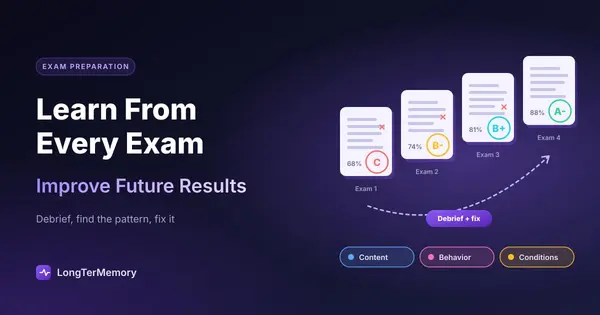
The core answer: one debrief tells you about one exam, but a log of debriefs across several exams reveals your systematic weaknesses, the recurring failure modes that no single exam could show you. You are looking for patterns in three dimensions, content, behavior, and conditions.
This is where the exam log starts paying off in a big way. After three or four exams, read back through your entries and look for repeats. In my own log, the pattern that jumped out was embarrassing in how obvious it was: I consistently lost points on questions that required applying concepts to novel scenarios, while I crushed pure recall questions. My studying was optimized for recognition, not application. No single exam would have shown me that clearly.
Here is a simple tracking framework you can steal:
| Pattern dimension | What to track | Example red flag |
|---|---|---|
| Content | Topics you struggled with across exams | Always shaky on quantitative problems |
| Behavior | Test-taking habits | Rushing the last 20 percent, changing correct answers |
| Conditions | Sleep, timing, exam format | Scores drop on afternoon exams |
When you spot a content pattern, that tells you what to restudy. When you spot a behavior pattern, that tells you how to practice differently. Both are fixable, but only if you name them first.
Connect the pattern to the fix
Here is the important step most people skip. Identifying “I always misread question stems” is only useful if you translate it into a concrete intervention. Some common mappings from my own log and from working with other students:
- Blanking under pressure means your retrieval practice was not hard enough. Closed-book, closed-notes self-testing beats re-reading here. The research by Karpicke and Roediger (2008) showed that practice testing produces dramatically better long-term retention than repeated studying, which is exactly what you need when the stakes are real.
- Running out of time means you need timed practice blocks, not more content review.
- Losing points on application questions means you need to practice with varied examples, not just definitions.
- Silly arithmetic or transcription errors means you need a verification habit, like double-checking units and signs before moving on.
Notice that none of these fixes is “study more hours.” Targeted correction is the entire point of deliberate practice. Ten hours aimed at your specific weakness beats thirty hours of general review, and it is not close. If systematic weakness-finding sounds like something you would like help with, our post on using AI to analyze your study weaknesses goes into how technology can spot patterns you might miss yourself.
Using Exam Experience as Deliberate Practice for the Next Attempt
The core answer: deliberate practice requires a tight loop of attempt, feedback, targeted correction, and re-attempt. Your exams give you the attempts and feedback automatically, so your job is to build the correction and re-attempt steps into your routine, ideally within one week of each exam.
Here is the loop I run after every exam:
- Debrief within 24 hours (covered above).
- Convert mistakes into study material within a week. Every question you got wrong or guessed on becomes a flashcard or practice problem. This is the single highest-yield conversion in all of studying, because these are exactly the items your brain has already shown you it cannot reliably retrieve.
- Schedule spaced reviews of those items. Mistake-derived flashcards need the same treatment as anything else you want to retain. The spacing effect, documented since Ebbinghaus and validated constantly since, says you should review them at expanding intervals rather than cramming them once. If you are newer to this, our active recall techniques post is a great primer on building retrieval practice into your studying.
- Re-test under exam conditions before the next assessment. Take a past paper or self-made practice test covering your weak topics, timed, closed notes. This closes the loop and gives you fresh feedback to start the next cycle.
The compounding effect
What makes this loop so powerful is compounding. Each exam feeds the next one. After two or three cycles, you stop making the same category of mistake because your study material is literally built from your own personal failure history. This is something generic question banks cannot do for you. A commercial question bank covers the average student’s weaknesses. Your mistake-derived deck covers your weaknesses, which is why it converts so efficiently.
There is also a psychological benefit that nobody talks about. Students who debrief stop seeing exams as verdicts and start seeing them as iterations. A bad exam result stops being “I am bad at this subject” and becomes “here are 14 specific fixable items.” That reframe alone reduces exam anxiety for a lot of people, and calmer test-takers perform better, which feeds the loop again.
For the spaced review step, this is exactly where LongTerMemory fits into my own workflow. I feed the PDFs and notes from my courses into it, and it generates Q&A flashcards automatically, then schedules them with spaced repetition so the mistake-derived cards from my debriefs resurface right before I would forget them. If you want to try the same loop without building flashcards by hand, you can start a free trial of LongTerMemory and see how it handles your own course material. It saves me the tedious step so I can spend my time on the actual debriefing and practice testing.
Conclusion
Every exam you take contains a complete, personalized study plan for the next one, but only if you extract it. Do a 20-minute written debrief within 24 hours, log it, look for patterns across exams, convert your mistakes into flashcards and practice problems within a week, and re-test under real conditions. That is the entire system, and it costs almost nothing to run. The students who improve fastest are rarely the ones studying the most hours. They are the ones closing the feedback loop after every attempt. Start with your very next exam.
FAQ
How long should a post-exam debrief take?
Twenty minutes is the sweet spot for most people. Long enough to capture the specifics of what went wrong and why, short enough that you will actually do it consistently. If you find yourself writing for an hour, you are probably re-litigating individual questions instead of extracting lessons.
What if my instructor does not return the exam?
Do the debrief from memory within 24 hours anyway. You will not have the exact questions, but you will remember the topics you struggled with, and that is enough to identify patterns. Request a review session with your instructor if one is offered, since seeing the actual exam adds detail.
Does this work for professional certification exams too?
Absolutely, and arguably even better. Certification exams have published objectives and often practice exams, which makes pattern tracking very precise. Many of our readers preparing for IT, medical, and finance certifications use exactly this loop, and we have covered it in posts like spaced repetition for certification maintenance.