How to Prepare for the ACE Personal Trainer Certification Exam
A practical guide to preparing for the ACE Personal Trainer certification exam: what it tests, high-yield topics, and practice strategies that actually work.
Table of Contents
- What the ACE CPT Exam Tests Across Exercise Science and Coaching Domains
- High-Yield Content Areas for ACE Certification Preparation
- Practice Question Strategy and Study Resources for ACE CPT Readiness
- A Smarter Way to Memorize the Volume of ACE Material
- Frequently Asked Questions
- How hard is the ACE CPT exam, really?
- How long should I study for the ACE personal trainer exam?
- Is ACE or NASM better for personal training?
- Can I pass the ACE CPT exam with just practice tests?
- Conclusion
So you want to become a certified personal trainer and the ACE CPT exam is standing between you and that credential. Maybe you’ve heard it’s brutal. Maybe a coworker who failed it twice has you second-guessing. Let me save you some anxiety: the ACE Personal Trainer exam is absolutely passable on your first attempt, but only if you study with intent instead of just rereading a textbook for two months and hoping it sticks.
I’ve watched plenty of smart people bomb this exam because they treated it like a personality quiz about fitness. It’s not. It’s a rigorous test of exercise science, program design, screening, and coaching psychology, and the questions are deliberately designed to make confident guessers stumble. In this guide I’ll walk you through exactly what the exam tests, where to focus your energy for the best return, and how to use practice questions the way they were meant to be used. If you’re also building your general study skills, our guide to active recall techniques covers the core method behind everything I recommend below.
What the ACE CPT Exam Tests Across Exercise Science and Coaching Domains
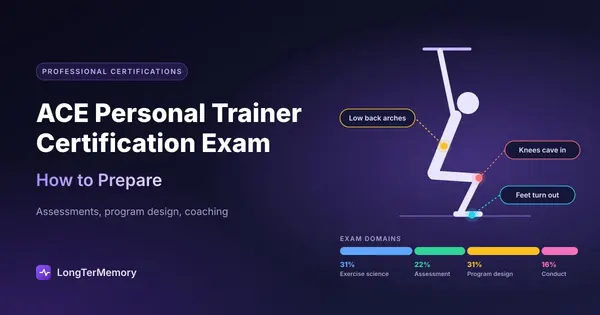
The short version: the ACE CPT exam tests four broad domains, and they are not weighted equally. Roughly a third of the exam is applied exercise science, another chunk is client screening and assessment, a big slice is program design and implementation, and the final portion is professional conduct and coaching psychology. If you only remember one thing from this section, remember that program design and the science behind it together make up well over half of your score.
Here’s how the domains break down:
- Applied exercise science (about 31 percent): anatomy, biomechanics, exercise physiology, and the science of human movement. You need to know prime movers, joint actions, and energy systems cold.
- Screening and assessment (about 22 percent): health history, risk stratification, posture and movement assessments like the overhead squat, and physiological assessments like resting heart rate and body composition.
- Program design and implementation (about 31 percent): periodization models, acute variables (sets, reps, rest, tempo), cardio programming, and progressions and regressions for every major movement pattern.
- Professional conduct and psychology (about 16 percent): scope of practice, ethics, behavioral change theory, and motivational interviewing basics.
The exam is 150 multiple-choice questions delivered by computer, you get three hours, and you need roughly 62 percent to pass on the scaled 200 to 800 scoring system (a passing scaled score is 500). That pass threshold sounds low, but remember the questions are scenario-based. Instead of “what is the origin of the biceps?” you’ll get “a client reports anterior shoulder pain during incline presses, what should the trainer do first?” That second type of question is where most people lose points.
High-Yield Content Areas for ACE Certification Preparation
If your time is limited, and everyone’s is, certain topics punch way above their weight on this exam. Master these before you touch anything else.
The kinetic chain and movement assessments. The overhead squat assessment and its compensations (feet turning out, knees caving in, low back arching, arms falling forward) appear constantly. For each compensation you should know the likely overactive and underactive muscles and which corrective exercises to use. This alone is a reliable cluster of questions on every exam form.
Prime movers and joint actions. Know which muscle is the prime mover for every major movement: squat, lunge, row, press, hip hinge. Know the joint actions too (hip flexion, knee extension, scapular retraction). Flashcards are ideal for this, because it’s pure memorization of muscle-to-movement pairings.
Risk stratification. Learn the ACSM risk factor thresholds: age cutoffs (45 for men, 55 for women), blood pressure categories, cholesterol values, fasting glucose thresholds. These are easy points if memorized, and easy losses if not.
Acute variables and periodization. Sets, reps, intensity, rest intervals, and tempo for each training goal (muscular endurance, hypertrophy, strength, power). ACE programming is built on its own ACE Integrated Fitness Training (ACE IFT) Model, not on NASM’s OPT model, so know how its two components, cardiorespiratory training and muscular training, each progress through phases from building a base to performance, along with the acute variables that change from one phase to the next.
Behavioral change theory. Stages of change (precontemplation through maintenance), self-efficacy, and motivational interviewing. These questions are mostly common sense once you know the vocabulary, which makes them fast wins.
A simple priority list for your study time:
| Priority | Topic Cluster | Why It Matters |
|---|---|---|
| 1 | Overhead squat compensations | Heavy recurring presence, easy to drill |
| 2 | ACE IFT Model and acute variables | Backbone of programming questions |
| 3 | Risk stratification thresholds | Memorize once, bank the points |
| 4 | Prime movers and joint actions | Core science, feeds other domains |
| 5 | Behavioral change stages | Quick vocabulary wins |
Practice Question Strategy and Study Resources for ACE CPT Readiness
Here’s the core insight most candidates miss: practice questions are a study tool, not a test of readiness. Research by Karpicke and Roediger (2008) showed that retrieval practice, pulling information out of your brain, produces dramatically better retention than rereading, and the effect holds across many follow-up studies. Dunlosky et al. (2013) ranked practice testing and distributed practice as the two most effective study techniques out of ten they reviewed. So your study plan should be built around quizzing yourself, not highlighting.
A practical weekly rhythm that works for most people studying 8 to 12 hours a week:
- Days 1 to 3, content blocks: Work through one domain at a time using the ACE Personal Trainer Manual or a structured course. Limit yourself to one domain chapter per session, and convert what you read into flashcards as you go, don’t just read.
- Day 4, mixed quiz day: Answer 60 to 80 practice questions spanning everything you’ve covered so far. Review every wrong answer and every answer you got right but were unsure about.
- Day 5, weak spot repair: Go back to the specific topics you missed on Day 4. This is where the learning actually happens.
- Days 6 to 7, spaced review: Revisit older material with short flashcard sessions. Ebbinghaus’s forgetting curve tells us we lose most new information within days unless we review it at expanding intervals, which is exactly why spaced repetition beats cramming.
Good resource stack, from essential to optional:
- ACE Personal Trainer Manual (7th edition) or the ACE University prep course. The exam is written from this material, so third-party summaries alone won’t cover the nuances.
- ACE practice exams. Take several, spaced weeks apart. Your last one should be within a week of the real thing.
- A flashcard system with spaced repetition for anatomy, risk thresholds, and ACE IFT phases and acute variables. Manual index cards work; so do apps. I use LongTerMemory for this, more on that below.
- Optional extras: YouTube walkthroughs of the overhead squat assessment, and a study group if you stay disciplined.
On practice exams, aim to consistently score in the mid 70s to 80s before booking the real test. If you’re hovering at 60 percent two weeks out, push the exam date. It’s a lot cheaper to reschedule than to retake.
A Smarter Way to Memorize the Volume of ACE Material
Let’s be honest about the scale of this. Between muscle origins and insertions, hundreds of acute variable combinations, and a dozen behavioral theories, the ACE CPT demands serious memorization volume. Cramming it all in the final week is how people fail.
This is the point in my prep where spaced repetition apps became non-negotiable. The concept is simple: review a fact right before you’re about to forget it, and each successful recall pushes the next review further out. Weeks become months. I built my ACE deck by feeding LongTerMemory the anatomy and physiology chapters of the ACE manual as PDFs; it generated question-and-answer flashcards automatically, then scheduled them with spaced repetition so I reviewed risk stratification thresholds one day and overhead squat compensations the next, exactly when each was due. There’s a free trial, and if you’re already drowning in PDFs, it’s worth letting the tool do the card-making grunt work while you focus on understanding program design. Our science of spaced repetition post goes deeper into why this works at the memory level.
Frequently Asked Questions
How hard is the ACE CPT exam, really?
The commonly cited first-attempt pass rate hovers around 65 to 70 percent depending on the year and source. It is considered somewhat harder than the NASM CPT because of its emphasis on coaching psychology and applied scenarios, but well within reach of anyone who studies deliberately for 10 to 12 weeks.
How long should I study for the ACE personal trainer exam?
Most successful candidates report 10 to 16 weeks of consistent part-time study, roughly 8 to 12 hours per week. If you have a kinesiology or exercise science background, you can compress that. If you’re new to anatomy, give yourself the full four months.
Is ACE or NASM better for personal training?
Both are NCCA-accredited and respected by gyms and employers. ACE tends to emphasize behavioral coaching and general population training, while NASM leans more heavily on corrective exercise. For most commercial gym careers, either works; pick the one whose content matches how you want to train clients.
Can I pass the ACE CPT exam with just practice tests?
No. Practice tests tell you what you don’t know, but the underlying knowledge has to come from structured study of the material. The winning combo is content study to build the knowledge, then practice questions and flashcards to make it retrievable under exam pressure.
Conclusion
Passing the ACE Personal Trainer certification exam comes down to three things: knowing the domain weightings so you study what actually matters, drilling the high-yield clusters like the overhead squat assessment and the ACE IFT Model until they’re automatic, and using retrieval practice and spaced repetition instead of passive rereading. Do those consistently for 10 to 12 weeks and you’ll walk into the testing center calm instead of desperate. And once you’re certified, that same spaced repetition system keeps your knowledge fresh for recertification CEUs down the road. Good luck, and go pass this thing.