How to Study Pharmacology: Drug Classes and Mechanisms
Learn how to study pharmacology by mastering drug classes and mechanisms first. High-yield flashcard strategies for USMLE, NCLEX, and pharmacy boards.
Table of Contents
- Understanding Drug Mechanisms Before Memorizing Individual Drugs
- Flashcard Design for Pharmacological Agents: MOA, Indication, Side Effects
- High-Yield Pharmacology for USMLE, NCLEX, and Pharmacy Boards
- Spaced Repetition: Keeping Hundreds of Drugs in Long-Term Memory
- Frequently Asked Questions
- Is pharmacology mostly memorization?
- How many flashcards do I need for pharmacology?
- Should I study drugs by class or by organ system?
- The Bottom Line
Ask any medical student, nursing student, or pharmacy student what the most miserable subject in their curriculum is, and a huge number of them will say the same thing: pharmacology. It is the classic “a mile wide and an inch deep” subject. Hundreds of drugs, each with its own mechanism of action, indications, contraindications, side effects, interactions, and dosing quirks. It feels less like studying and more like memorizing the phone book.
Here is the thing. It does not have to feel that way, and the students who actually crush pharmacology exams are not the ones with the best memory. They are the ones who study it wrong… er, right. They study drug classes and mechanisms first, and let individual drugs fall into place almost as an afterthought. In this post I will show you exactly how that works, how to design flashcards that make pharmacology stick, and how to focus on the high-yield material for the USMLE, NCLEX, and pharmacy boards.
Understanding Drug Mechanisms Before Memorizing Individual Drugs
The single biggest mistake students make with pharmacology is memorizing individual drugs as isolated facts. “Metoprolol is a beta blocker. Atenolol is a beta blocker. Propranolol is a beta blocker.” That is three separate memories for what is really one piece of information.
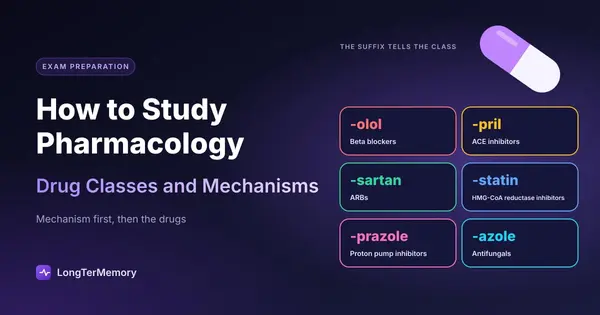
The smarter approach is to flip the order. Learn the mechanism of the class first, and then the individual drugs become just names attached to that mechanism. Once you understand that beta blockers antagonize beta adrenergic receptors, you already know their core effects: decreased heart rate, decreased contractility, decreased renin release. The rest, whether a specific beta blocker is cardioselective or crosses into the brain, becomes a small modifier on top of a solid foundation.
Think of it like learning a language. You do not memorize ten thousand sentences word by word. You learn grammar, and then thousands of sentences become predictable. Drug classes are the grammar of pharmacology.
Here is a concrete example. The ACE inhibitors (lisinopril, enalapril, captopril, ramipril) all:
- Inhibit angiotensin converting enzyme
- Reduce angiotensin II and aldosterone
- Lower blood pressure
- Cause the classic side effect of a dry cough (bradykinin accumulation)
- Are teratogenic, so they are contraindicated in pregnancy
Learn that block once and you can answer questions about any ACE inhibitor. The outliers, like captopril causing a metallic taste or being prone to cause proteinuria, are small add-ons you pick up later. In my experience this cuts the raw memorization load by at least half, and probably more like 60 to 70 percent.
A practical way to build this foundation:
- Learn one prototype drug per class deeply before touching the others. For beta blockers, learn metoprolol. For statins, learn atorvastatin. Prototypes anchor everything else.
- Always ask “why” when you see a side effect. Why do loop diuretics cause hypokalemia? Because they dump sodium into the distal tubule, which gets exchanged for potassium. “Why” chains turn random facts into logic.
- Group by mechanism, not by letter. Sorting drugs alphabetically is the enemy. Sorting them by receptor, enzyme, or pathway is your friend.
This kind of structured, mechanism-first thinking is really just building mental models for a dense topic, and it works for every memory-heavy subject, not just pharmacology.
Flashcard Design for Pharmacological Agents: MOA, Indication, Side Effects
Once you understand the classes, you need a system to keep the details from evaporating. That is where flashcards come in, and where most students sabotage themselves. A bad pharmacology flashcard looks like this:
Front: “Beta blockers?”
Back: “Decrease HR, decrease contractility, bronchospasm, mask hypoglycemia, fatigue, cold extremities, sexual dysfunction, contraindicated in asthma…”
That card is a wall of text. It is impossible to grade yourself on, so you either always “get it right” or always feel vaguely wrong. Neither builds memory.
A much better approach is the one fact per card rule, organized around three question types. For every drug or class, make separate cards for:
- Mechanism of action (MOA): “What is the mechanism of metoprolol?” -> “Selective beta-1 adrenergic receptor antagonist.”
- Indication: “Why is metoprolol prescribed after an MI?” -> “Reduces cardiac workload and remodeling, improving survival post-myocardial infarction.”
- Side effects and contraindications: “Why is metoprolol avoided in asthma?” -> “Blockade of beta-2 receptors in the lungs causes bronchoconstriction.”
You can add a fourth category for the classic exam traps, like “Which beta blocker is safe in pregnancy (labetalol)?” or “Which one treats portal hypertension (propranolol)?” but those come later.
This structure matters because research on retrieval practice backs it up. Karpicke and Roediger showed in their landmark 2008 study that students who tested themselves on material retained far more a week later than students who simply re-studied it, even when the re-studying group felt more confident. Flashcards force retrieval, which is exactly what the brain needs to consolidate a memory. You can read more about why this works in my post on active recall techniques.
Here is a sample card layout for the statin class:
| Question type | Front | Back |
|---|---|---|
| MOA | How do statins lower cholesterol? | Inhibit HMG-CoA reductase, the rate-limiting enzyme in cholesterol synthesis |
| Indication | First-line drug for hypercholesterolemia? | Statins, reduce LDL and cardiovascular events |
| Side effect | Why do patients on statins report muscle aches? | Statin-associated muscle symptoms, rare progression to rhabdomyolysis |
| Trap | Which statin needs dose adjustment in renal failure? | Rosuvastatin at higher doses |
Two more design tips from hard experience:
- Use fill-in-the-blank for lists sparingly. “ACE inhibitor side effects: cough, angioedema, hyperkalemia, renal failure” is too much for one card. Split it. “ACE inhibitors cause cough due to accumulation of which molecule?” is a card you can actually answer.
- Make side-effect cards bidirectional. “What drug class causes a lupus-like syndrome?” -> “Hydralazine” is the reverse direction, and exams love testing it.
If you have hundreds of pages of lecture notes or a dense PDF review book, creating all these cards by hand is a brutal time sink. This is exactly where an AI tool earns its keep. With LongTerMemory, you upload your pharmacology PDF or paste a web resource, and it automatically generates Q&A flashcards from the content, then schedules them with spaced repetition so you review each card right before you would forget it. Instead of spending three hours making cards, you spend twenty minutes reviewing them and fixing the handful that are off.
High-Yield Pharmacology for USMLE, NCLEX, and Pharmacy Boards
Different exams test pharmacology differently, and knowing the flavor of your exam saves you from studying the wrong things.
USMLE Step 1 loves mechanism and side-effect vignettes. A classic question describes a patient with a dry cough after starting a new blood pressure medication, and you have to connect it to ACE inhibitors and bradykinin. Step 1 also loves the “which receptor” and “which enzyme” style questions, so your mechanism cards pay off massively here. Biochem-heavy drug questions, like how methotrexate or 5-FU work on folate metabolism, show up constantly, and spaced repetition is a proven way to keep that material warm. I covered a similar approach for biochemistry in spaced repetition for biochemistry.
USMLE Step 2 CK shifts toward clinical application: picking the right drug for the right patient, adjusting doses for renal failure, knowing the contraindications in pregnancy, recognizing interactions. Here your indication and contraindication cards carry the load.
NCLEX (for nursing students) tests patient safety above all. You will see questions about which medication to give first, what to monitor before administration, and which side effect requires immediate action. Think “hold the metformin before a CT with contrast because of lactic acidosis risk” style questions. Your flashcards should emphasize monitoring parameters and red-flag side effects.
Pharmacy boards (NAPLEX) go the deepest. Dosing calculations, drug interactions, counseling points, therapeutic interchange. If this is your exam, add a fourth card type for dosing pearls and interaction pairs.
Here is a quick checklist of what “high yield” looks like across all these exams:
- Autonomics: beta blockers, alpha agonists/antagonists, atropine and the cholinergics. Shows up everywhere.
- Cardiovascular: ACE inhibitors, ARBs, diuretics (loop vs thiazide vs potassium-sparing), calcium channel blockers, digoxin, statins.
- Antibiotics: beta lactams, macrolides, fluoroquinolones, aminoglycosides, vancomycin. Know mechanisms and the classic toxicities.
- CNS: SSRIs, benzodiazepines, antiepileptics, opioids and their reversal agents.
- Endocrine: insulin types and onset times, metformin, levothyroxine, corticosteroids.
A rough rule of thumb: mastering the top 40 to 50 drug classes covers the large majority of pharmacology questions on any of these exams. You do not need all 400 drugs in your review book.
Spaced Repetition: Keeping Hundreds of Drugs in Long-Term Memory
Now for the part nobody wants to hear. Making great flashcards is not enough. You will forget almost everything within weeks if you do not review it on a schedule. This is the forgetting curve in action, first described by Hermann Ebbinghaus in 1885. His data showed that without review, we lose the bulk of new material within days, and the decay is steepest right at the start.
The countermeasure is spaced repetition: reviewing material at expanding intervals, right at the edge of forgetting. Each successful recall flattens the forgetting curve, so the interval stretches from one day to three days to a week to a month. In the Dunlosky et al. 2013 review of ten common study techniques, practice testing and distributed practice received the highest utility ratings of any method studied. Flashcards plus spacing is literally the most evidence-backed study combo we have.
For pharmacology specifically, this matters more than in almost any other subject because the material is pure memorization with no shortcuts. You cannot reason your way to the answer in the exam hall if you never encoded “loop diuretics cause ototoxicity at high doses.” You either know it or you do not.
A realistic spaced repetition schedule for a class-based pharmacology deck looks like this:
| Review point | What to review |
|---|---|
| Day 0 | Learn the class mechanism, make cards, first pass |
| Day 1 | Review yesterday’s new class cards |
| Day 3 | Second review of the class |
| Day 7 | Third review |
| Day 14 | Fourth review |
| Day 30 | Fifth review, then stretch to monthly |
If you are using a tool like LongTerMemory, this scheduling is handled automatically. You upload your notes, get your flashcards, and the algorithm queues each card at the optimal moment. If you are doing it manually in a paper deck or a simple app, set calendar reminders and actually honor them. The science behind this is worth understanding deeply, so check out the science of spaced repetition if you want the full picture.
One more tip: do a small daily review, 15 to 20 minutes, rather than a giant weekly session. Consistency beats intensity for retention every single time.
Frequently Asked Questions
Is pharmacology mostly memorization?
The facts are memorization, but the structure is not. If you learn mechanisms and classes first, the individual facts become logical deductions. You still need spaced repetition to keep it all accessible, but the load shrinks dramatically.
How many flashcards do I need for pharmacology?
For a typical med school pharmacology course, 800 to 1,200 well-designed cards covering the major classes is enough for top-tier performance. Quality beats quantity by a mile; 200 great cards outperform 1,000 lazy ones.
Should I study drugs by class or by organ system?
Both work, but class-first is stronger because it leverages shared mechanisms. Once you know the classes, you can then map them onto organ systems for clinical context, which is how the boards actually test them.
The Bottom Line
Pharmacology stops being a nightmare the moment you stop memorizing drug lists and start learning drug logic. Master the mechanisms and classes first, build one-fact-per-card flashcards covering MOA, indications, and side effects, and keep everything alive with spaced repetition tuned to your exam, whether that is USMLE, NCLEX, or the pharmacy boards. Do that consistently for a few weeks and you will walk into the exam knowing that the “impossible” subject was just a subject studied with the wrong method.
If you want to skip the hours of card-making, give LongTerMemory a try with its free trial. Upload your pharmacology PDFs or study pages, get automatic Q&A flashcards, and let the spaced repetition engine handle the scheduling while you focus on actually learning.