How to Use Active Reading to Improve Comprehension
Learn how active reading boosts comprehension and retention, with practical annotation, questioning, and prediction strategies for lasting memory.
Table of Contents
- What Active Reading Is and How It Differs From Passive Reading
- Annotation, Questioning, and Prediction: Three Core Active Reading Tools
- Tool 1: Annotation That Actually Means Something
- Tool 2: Questioning Everything
- Tool 3: Prediction
- A Simple Active Reading Checklist
- Converting Active Reading Into Retention Through Retrieval Practice
- Conclusion
- FAQ
- Is highlighting useless?
- How long does active reading take compared to normal reading?
- Can I use active reading for dense academic papers?
Ever finished a chapter, closed the book, and realized you could not summarize a single paragraph of what you just read? I have done this more times than I want to admit. My eyes moved across every line, the pages flipped, the time passed, and yet almost nothing stuck. That is the quiet trap of passive reading, and it is the reason so many students study for hours and still underperform on exams.
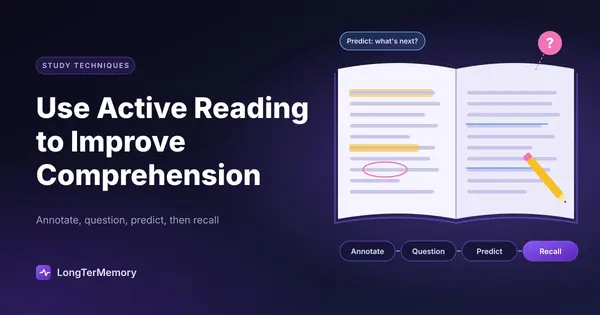
The fix is not reading more. It is reading differently. Active reading is the skill of engaging with a text as a conversation rather than a lecture, and it is one of the highest-leverage habits you can build as a learner. In this post I will show you exactly what active reading is, how it differs from passive reading, three concrete tools you can start using today (annotation, questioning, and prediction), and most importantly, how to convert what you read into long-term retention.
What Active Reading Is and How It Differs From Passive Reading
Active reading means reading with a purpose, interacting with the text, and constantly checking your own understanding as you go. Passive reading means letting your eyes glide over the words while your brain is somewhere else. The difference is not speed or effort on the surface, it is what is happening cognitively underneath.
Research backs this up in a big way. A classic 2009 review by Prince on active learning found that students in interactive learning environments performed significantly better than those in purely passive lecture settings, and the same principle applies to reading. When you read passively, you are essentially decoding symbols. When you read actively, you are building a mental model, connecting ideas, and interrogating the author. That extra processing is what creates comprehension.
Here is a quick comparison of the two modes:
| Aspect | Passive Reading | Active Reading |
|---|---|---|
| Goal | Get through the material | Understand and retain the material |
| Attention | Wanders easily | Anchored by questions and predictions |
| Interaction | Eyes only | Pen, margins, notes, self-quizzing |
| After reading | Vague sense of “I read it” | Concrete takeaways and testable memory |
| Typical outcome | Forgotten within days | Retained through retrieval practice |
One study often cited in this space comes from Karpicke and Roediger (2008), who showed that students who tested themselves after learning vastly outperformed those who simply reread. I mention this early because it reframes everything: reading, even active reading, is only the first half of the equation. The second half is pulling the ideas back out of your brain. But we will get there.
The simplest way to start reading actively is to change one habit: read with a question in mind. Before you open the chapter, write down one thing you want to answer by the end. “What causes enzyme denaturation?” “Why did the author argue X?” Suddenly every paragraph has a job, and your brain starts filtering for relevance instead of drifting.
Annotation, Questioning, and Prediction: Three Core Active Reading Tools
If active reading is a skill, these three tools are the dumbbells. Each one forces your brain to do real work with the text, and each one takes less than a minute to apply. Here is how I use them.
Tool 1: Annotation That Actually Means Something
Most of us were taught to highlight in high school, and most of us did it wrong. Highlights should be rare, intentional, and paired with words you wrote yourself. My rule is simple: never highlight without a margin note.
Good margin notes look like this:
- One-sentence summaries of a dense paragraph
- A ”?” next to anything confusing, followed by the question
- Your own reaction: “surprising”, “contradicts what I learned”, “check this”
- Connections to other ideas or courses
Why does this work? Because summarizing forces elaborative encoding. You cannot compress a paragraph into one line without understanding it first. The act of writing the summary is where comprehension happens, not the rereading of it.
Tool 2: Questioning Everything
Before, during, and after reading, ask questions. This is the engine of active reading.
- Before: What do I already know about this topic? What do I expect the author to say?
- During: Why is this true? What is the evidence? How does this connect to the last section? What would happen if this assumption were wrong?
- After: Could I explain this to a friend? What are the three biggest ideas? What am I still fuzzy on?
Questioning works because it converts reading from a download into a dialogue. Your brain loves answering questions, and it encodes information more deeply when information arrives as the answer to something it was actively wondering about. This is closely related to the ideas in my post on active recall techniques, where the core insight is that effortful retrieval builds stronger memory than passive review.
Tool 3: Prediction
This is the most underrated tool. Before you finish a section, paragraph, or even a sentence, pause and predict what comes next. “Based on this, the author is probably going to argue that…” Then read on and check.
Prediction works because it creates a little tension. When you are right, the confirmation reinforces the logic of the material. When you are wrong, the surprise makes the actual answer memorable. Both outcomes strengthen your grasp of the structure of the content, which is what comprehension really is. Sports fans do this constantly with games, and it is exactly why they remember details casual viewers forget. You can do the same with a biology textbook.
A Simple Active Reading Checklist
Here is the checklist I run through for any dense reading:
- Skim headings, bold terms, and figures first (2 minutes)
- Write one guiding question at the top of the page
- Read one section at a time, annotating as you go
- Predict before each heading what the section will argue
- Write a one-line summary after each section
- Close the book and answer your guiding question from memory
- Note anything you could not recall, then reread only that part
If you do nothing else from this post, do steps 1 and 6. Skimming gives your brain a scaffold, and closing the book forces the retrieval that passive readers never practice.
Converting Active Reading Into Retention Through Retrieval Practice
Here is the uncomfortable truth: active reading dramatically improves comprehension, but comprehension in the moment is not the same as memory over time. Ebbinghaus famously showed that we forget roughly 70% of new material within 24 hours if we do nothing with it. Your beautiful annotations will not save you by themselves.
The bridge from comprehension to retention is retrieval practice, also called the testing effect. Dunlosky et al. (2013) reviewed dozens of learning techniques and ranked practice testing and distributed practice as the two most effective strategies available, far ahead of rereading and highlighting. Karpicke and Roediger (2008) found that students who studied once and then tested themselves retained dramatically more after a week than students who studied the material four times without testing.
So after you read actively, do this:
- Same day: Close the book, write down everything you remember from each section
- Next day: Test yourself on your margin notes and summaries without looking
- Days later: Space out further self-tests, reviewing only what you missed
This is where your annotations become gold. Every margin question and summary is a ready-made flashcard prompt. Instead of rereading a chapter, you quiz yourself on the questions you wrote in the margins. That is spaced repetition in miniature, and it is the same science behind the science of spaced repetition.
Now, doing this by hand for every chapter is a lot of admin. This is exactly why I use tools for the heavy lifting. With LongTerMemory, I can drop in a PDF or paste a web article, and it automatically generates Q&A flashcards from the content, then schedules them for me using a spaced repetition algorithm. So my active reading produces the questions, and the tool handles the remembering. If you have been reading actively but still forgetting everything a week later, the free trial is the easiest fix I know, and it takes about two minutes to set up.
For a broader look at why spaced testing beats rereading, my breakdown of spaced repetition vs traditional studying goes deeper into the numbers. And if you want a refresher on the passive habits you are replacing, active vs passive learning covers the contrast in the study context.
Conclusion
Active reading is not a talent, it is a set of repeatable moves. Read with a guiding question, annotate with your own words, interrogate the text, and predict what comes next. Then close the book and test yourself, because that retrieval step is what turns comprehension into durable memory. The students who seem to absorb everything effortlessly are rarely smarter, they just process the page instead of scanning it. Start with one chapter today, and notice the difference in what you can recall tomorrow.
FAQ
Is highlighting useless?
Not useless, just overused. Highlighting alone is one of the weakest techniques in the Dunlosky et al. (2013) review because it feels like work without much cognitive effort. It becomes powerful when you highlight sparingly and pair each highlight with a margin note in your own words.
How long does active reading take compared to normal reading?
Expect it to be slower, roughly 1.5 to 2 times slower for the first pass. The trade-off is that you need far fewer rereads later, so total time to mastery usually goes down. One active pass plus self-testing beats three passive passes.
Can I use active reading for dense academic papers?
Absolutely, it shines there. Skim the abstract and headings first, predict the paper’s argument, question every claim, and write a one-line takeaway per section. Then generate flashcards from your notes and let spaced repetition handle the long game.