Best Flashcard Apps Compared: Anki, Quizlet, Brainscape
An honest comparison of the best flashcard apps: Anki, Quizlet, Brainscape, and LongTerMemory. Pricing, algorithms, card creation, and which one fits you.
Table of Contents
Flashcards work. That part is not up for debate anymore. Since Ebbinghaus mapped the forgetting curve in the 1880s, and especially since Dunlosky and colleagues ranked practice testing and distributed practice as the two most effective study techniques in their landmark 2013 review, we have known that retrieving information from memory at increasing intervals is about as close to a cheat code as learning science gets.
The harder question is which app you should use to do it. Google “best flashcard app” and you will drown in listicles written by people who compared feature checklists without ever cramming for a board exam. So let me do this the way I would want it done: I have spent years studying with flashcards, helped hundreds of students pick a tool, and I am going to give you the honest trade-offs for the four names that actually matter: Anki, Quizlet, Brainscape, and LongTerMemory.
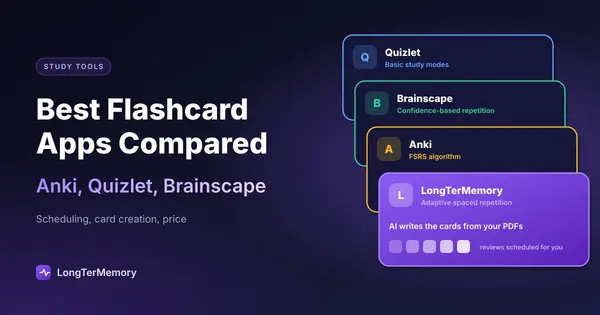
Here is the quick verdict before we go deep: Anki wins on algorithm and community decks if you can stomach the learning curve. Quizlet wins on ease and study modes but not on long-term retention. Brainscape sits in a comfortable middle. LongTerMemory wins if your biggest bottleneck is making cards in the first place. Now let me show my work.
Algorithm Quality: How Each App Schedules Your Review
Here is the core truth: a flashcard app is just a scheduling engine wearing a pretty interface. The spacing algorithm decides when you see each card again, and that decision is the single biggest factor in whether you remember something in three weeks or forget it by Friday.
Anki has the strongest scheduling engine of the group. Its modern default is FSRS, a machine-learning based scheduler that predicts your personal forgetting curve and cuts total review load by roughly 20 to 30% compared to the older SM-2 algorithm it replaced, while holding retention steady. You can also tune retention targets, interval limits, and dozens of other parameters. No other mainstream app gives you this level of control, and for high-stakes exams where forgetting is expensive, that control matters enormously.
Brainscape uses a self-described confidence-based algorithm. After each card you rate your confidence from 1 to 5, and cards you rate low come back more often. It is a solid, proven approach (essentially a refined Leitner system), but it is less personalized than FSRS. You will do somewhat more reviews than necessary to hold the same retention, which adds up over a semester.
Quizlet is the weakest here, and it is not close. Quizlet’s core modes (Flashcards, Learn, Test, Match) are built more for short-term familiarity than durable memory. Its “Long-Term Learning” mode, when available, uses basic spaced repetition, but reviews stop once you finish a set rather than continuing indefinitely on a true forgetting curve. If your goal is passing Friday’s quiz, Quizlet is fine. If your goal is remembering material for finals in four months, or for a professional certification you need for years, it is the wrong tool.
LongTerMemory uses a spaced repetition scheduler built around the same retrieval-practice principles, scheduling reviews at expanding intervals based on how you answer. It is not as configurable as Anki’s FSRS, but it is a genuine long-term scheduler, not a “finish the set and you’re done” system.
Quick comparison:
| App | Scheduling algorithm | Configurable | Built for long-term retention |
|---|---|---|---|
| Anki | FSRS (ML-based, very strong) | Deeply | Yes |
| LongTerMemory | Spaced repetition with adaptive intervals | Limited | Yes |
| Brainscape | Confidence-based repetition | Moderate | Yes |
| Quizlet | Basic modes, limited long-term scheduling | No | Weakly |
The retrieval research backs the top of this table. Karpicke and Roediger’s 2008 studies showed that repeated retrieval practice dramatically outperforms re-reading for long-term retention, and the algorithm’s job is simply to time those retrievals for when you are about to forget. Anki does this best. The others do it acceptably, except Quizlet, which barely tries.
Card Creation: Manual vs. AI-Assisted vs. Shared Decks
This is where most flashcard advice falls apart, because card creation is where students actually burn their time. Let me be blunt: an app with a great algorithm and no cards is worth nothing. Your real comparison is how fast each app gets you from raw material to reviewing.
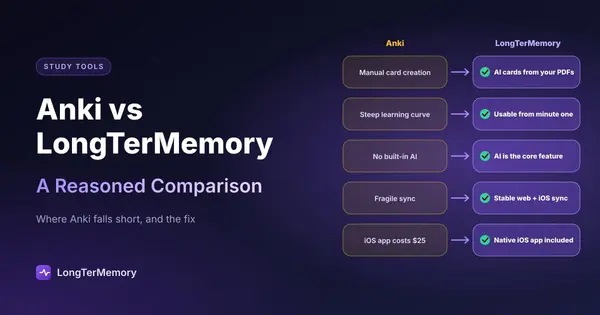
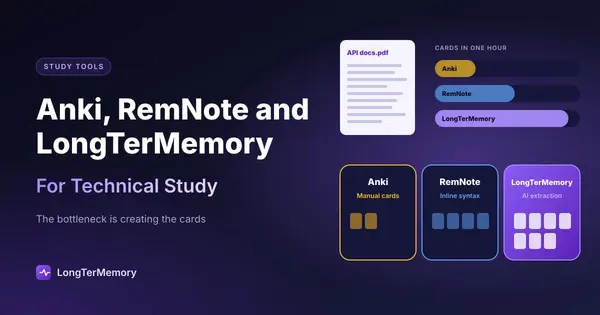
Anki is purely manual, and that is its biggest hidden cost. At roughly 30 seconds per card, building a 1,500-card deck takes over 12 hours of focused work before you review a single card. Students routinely report spending 80% of their flashcard time manufacturing cards instead of studying them. There are no add-ons that fully fix this, and Anki’s dated, technical interface raises the barrier further. What Anki does offer is the best shared-deck library on earth: the AnKing deck for medical students, enormous community decks for languages, law, nursing, and more. If your subject has a great shared deck, Anki’s weakness disappears. If it does not, you are on your own.
Quizlet makes card creation easy and shareable. Typing cards into Quizlet is painless, its search surfaces millions of user-created sets, and importing from a spreadsheet takes minutes. The catch is that shared sets vary wildly in quality, and Quizlet has moved much of its best functionality behind a Plus paywall, including offline access and some long-term learning features.
Brainscape splits the difference nicely. You can make cards manually, import, browse community decks (largest in subjects like Spanish, anatomy, and standardized tests), and the 1-to-5 confidence rating makes reviewing feel fast and game-like. Creation is smoother than Anki, deeper than Quizlet.
LongTerMemory is the only one built around AI-assisted card creation. You upload a PDF, paste a URL, or drop in your notes, and it automatically extracts the key concepts and generates Q&A flashcards for you, then schedules them for review. This directly attacks the 80/20 problem I mentioned above. Instead of 12 hours building a deck, you spend minutes reviewing and editing what the AI generated. The honest trade-off: AI-generated cards occasionally miss nuance or phrasing you would have chosen yourself, so a quick editing pass is still worth it. And the shared-deck library is far smaller than Anki’s or Quizlet’s.
So the real decision rule:
- Great shared deck exists for your subject? Anki or Quizlet wins on day one.
- Your material is custom (lecture PDFs, your notes, a textbook chapter)? AI generation in LongTerMemory saves you enormous time.
- You enjoy crafting your own cards? Brainscape or Anki, depending on how much control you want.
Which Flashcard App Fits Your Study Style and Budget
Let me match apps to people, because “best” is meaningless without “best for you.”
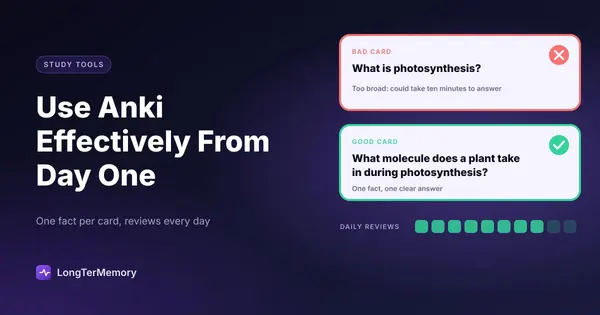
Pick Anki if you are preparing for a massive high-stakes exam (USMLE, bar exam, CFA, JLPT N1), you value the algorithm above all, and you do not mind investing a weekend learning the tool. Cost: free on desktop and Android, $24.99 for the iOS app. If you want a head start on using it well, check out my guide on how to use Anki effectively from day one.
Pick Quizlet if you are a high school or early college student, you study in short bursts, you want game modes to keep it fun, and your exams are coming soon rather than in six months. Cost: free tier is usable; Plus runs about $35.99/year.
Pick Brainscape if you want a polished, modern app with real spaced repetition, you are learning languages or anatomy, and you like rating your confidence rather than binary right/wrong. Cost: free tier exists; Pro is around $59.99/year (lifetime plans are sometimes offered).
Pick LongTerMemory if your bottleneck is turning study material into cards. Med students drowning in lecture PDFs, professionals keeping up with certifications, anyone who reads dense documents and thinks “I should make flashcards from this” but never has the hours to do it. Cost: free trial, then a modest subscription. The pitch is simple: upload your PDF or paste a link, get automatic Q&A flashcards with spaced repetition scheduling, and spend your time actually studying instead of card manufacturing. If you are curious how it stacks up against Anki specifically, I wrote a full Anki vs LongTerMemory comparison that goes deep on the trade-offs.
A quick budget snapshot:
| App | Free tier | Paid price (approx.) | Notes |
|---|---|---|---|
| Anki | Full app on desktop/Android | $24.99 one-time (iOS) | Cheapest long-term if you avoid iOS |
| Quizlet | Limited | ~$35.99/year | Key features paywalled |
| Brainscape | Limited | ~$59.99/year | Lifetime deals appear occasionally |
| LongTerMemory | Free trial | Subscription | Value is in AI card creation |
Whichever you choose, the science only helps if you use it. Retrieval practice and spaced repetition beat re-reading and highlighting every single time, as Dunlosky et al. confirmed in 2013 and as I have watched play out with hundreds of students. If you want to sharpen the underlying technique before picking a tool, read my breakdown of active recall techniques first.
Conclusion
There is no single “best flashcard app,” but there is a best one for your situation. Anki is the algorithm king with a punishing setup cost. Quizlet is the friendly starter that will not carry you through long-term exams. Brainscape is the polished middle ground. LongTerMemory is the efficiency play, replacing hours of card creation with AI generation backed by real spaced repetition.
Pick the tool that matches your material, your timeline, and your tolerance for manual work. Then actually review daily. The best algorithm in the world cannot help the deck you never open.
FAQ
Is Anki still worth learning in 2026?
Yes, if your exam matters and you have the time to learn it. Its FSRS scheduler is the strongest in the industry, and the shared-deck ecosystem is unmatched. If your bottleneck is card creation rather than scheduling, though, an AI-assisted tool will get you studying faster.
Is Quizlet good for long-term studying?
Not really. Quizlet excels at short-term familiarity and quick quizzes, but its scheduling is not built for retention over months. For finals-heavy semesters or certifications, use a true spaced repetition app.
Can AI really make good flashcards?
Mostly, yes. Modern AI extraction from PDFs and web pages produces solid Q&A cards that capture the key concepts. You will still want a light editing pass to fix phrasing and emphasize what your specific exam cares about, but it beats hours of manual typing.