
How to Memorize Scripture and Bible Verses Quickly
Learn the chunk-and-chain method, rhythm-based recitation, and spaced review schedules to memorize Bible verses and scripture passages that actually stay.
Table of Contents
- Why Traditional Methods Fail
- The Chunk-and-Chain Method
- Phase 1: Break it into units
- Phase 2: Learn one chunk at a time
- Phase 3: Chain forward
- Using Rhythm, Repetition, and Recitation
- Understanding Before Memorizing
- Memorizing the Reference: A Common Sticking Point
- Review Schedules That Keep Scripture in Long-Term Memory
- Daily Recitation: The Long-Term Habit
- Special Techniques for Longer Passages
- The Spiritual Dimension
- Quick Reference: Scripture Memorization Method
There’s a reason Christians, Jews, Muslims, and members of virtually every religious tradition have valued scripture memorization for millennia. A verse that lives in your memory is always with you , on a difficult morning, in a moment of doubt, in the middle of a conversation where you need it most. No phone required. No page to flip to. It’s just there.
But memorizing scripture , especially longer passages, chapter-length selections, or specific verse-and-reference combinations , can feel daunting. Most people default to reading the same verse over and over, which is slow, inefficient, and produces the kind of shallow familiarity that evaporates under pressure.
There are better ways. Here’s what actually works.
Why Traditional Methods Fail
Before we get into the techniques, let’s be honest about what doesn’t work.
Reading and re-reading a verse until it “feels” familiar is the most common approach and the least effective. The problem is the fluency illusion , the text starts to feel known because you recognize it when you see it. But recognition and retrieval are completely different things. Can you say the verse with the Bible closed? Can you say it a week later? That’s the real test, and re-reading almost never builds that kind of strength.
Copying it out is better , at least you’re generating the text, which is a form of active encoding. But even copying can become mindless if you’re not paying attention to meaning.
The techniques below are built around two core principles from memory science:
- Active retrieval , you have to produce the verse from memory, not just recognize it
- Spaced review , you have to revisit it at the right intervals to move it into long-term storage
The Chunk-and-Chain Method
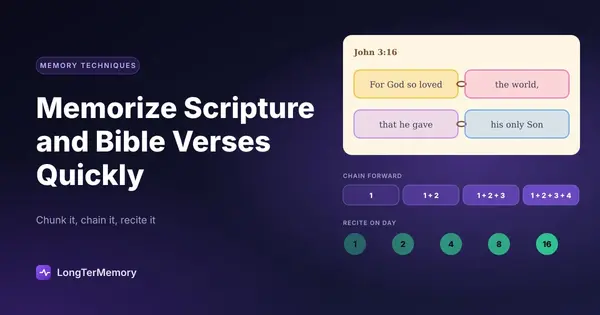
The most reliable technique for memorizing longer scripture passages is chunking the text into small, manageable pieces and then chaining those pieces together.
Here’s the process:
Phase 1: Break it into units
Read the verse or passage and divide it into natural phrase-length chunks of 5-8 words. For example, Psalm 23:1-3:
- “The Lord is my shepherd” / [Chunk 1]
- “I shall not want.” / [Chunk 2]
- “He makes me lie down” / [Chunk 3]
- “in green pastures.” / [Chunk 4]
- “He leads me beside still waters.” / [Chunk 5]
- “He restores my soul.” / [Chunk 6]
The chunks should follow the natural rhythm and meaning of the text. Don’t cut mid-phrase , let the text breathe in its natural units.
Phase 2: Learn one chunk at a time
Take Chunk 1. Read it. Close the page. Say it out loud from memory. Read it again if you missed any word. Say it again. Repeat until you can produce it perfectly three times in a row without looking.
Then move to Chunk 2. Learn it the same way.
Phase 3: Chain forward
Once you know Chunk 2, recite Chunks 1 and 2 together , from the beginning. Once you know Chunk 3, recite Chunks 1, 2, and 3 together. Keep chaining forward.
This cumulative recitation does something important: it builds the passage as a single connected flow, not a series of isolated pieces. The end of each chunk becomes the cue for the next one , exactly like learning a piece of music.
By the time you’ve chained all 6 chunks together and can recite them start to finish without notes, you have the passage.
Using Rhythm, Repetition, and Recitation
Scripture , especially in its original languages and in poetic translations , often has an inherent rhythm. Tapping into that rhythm makes memorization dramatically easier.
When you’re learning a verse, pay attention to:
- Natural stress patterns , where does your voice naturally land?
- Parallel structure , does the verse repeat a grammatical form? (“He maketh me lie down… He leadeth me beside…”)
- Sound patterns , alliteration, rhyme, or repeated vowel sounds
Say the verse out loud, and let the rhythm carry you. If you find yourself stumbling in the same spot every time, it may be because you’re not feeling the natural cadence of that phrase , try slowing down and saying it almost like a song.
Recitation is the engine of scripture memory. Reading is not. The physical act of saying the words , engaging your voice, your breath, your mouth , creates motor memories that support the verbal ones. This is why religious traditions have always used spoken recitation, not silent reading, as the primary memorization tool.
Try to:
- Recite out loud, not just in your head
- Vary the setting: recite while walking, recite while doing dishes, recite in the car
- Recite to someone else whenever possible , a family member, a study partner, a friend
The variety of contexts in which you retrieve the verse increases the number of memory pathways your brain builds for it.
Understanding Before Memorizing
For scripture passages with complex theology or unfamiliar language , especially in older translations , understanding what you’re memorizing will dramatically speed up the process.
This might seem obvious, but many people try to memorize words they don’t fully understand, which is much harder. Meaningless strings of sounds are extremely difficult to retain; meaningful sentences are much easier.
Before you start the chunk-and-chain process on a difficult passage:
- Read it in a modern translation to grasp the basic meaning
- Look up any unfamiliar words or concepts
- Understand what the verse is saying in your own words
- Return to the version you want to memorize (whether KJV, NIV, ESV, etc.)
When you understand why the verse says what it says, and what it means in context, the words become less arbitrary. They’re no longer random tokens , they’re an expression of a specific idea. And ideas are far easier to remember than arbitrary sequences.
Memorizing the Reference: A Common Sticking Point
Many people can recite a verse perfectly but blank on the reference , “John 3:… something?” This is frustrating and common.
The trick is to encode the reference at the beginning and end of your recitation practice from day one.
Every single time you practice the verse, say the reference first: “John 3:16. For God so loved the world…” And then at the end: ”…John 3:16.”
This front-and-back framing means the reference gets as many repetitions as the verse itself. After a week of this, the reference becomes automatic.
For the actual numbers (book, chapter, verse), you can also use a simple number substitution. If you’re learning Philippians 4:13, you might think: “4 is a square, 13 is unlucky , I’m standing on a square unlucky tile, saying ‘I can do all things.’” Silly, but effective.
Review Schedules That Keep Scripture in Long-Term Memory
Learning a verse is only half the battle. The other half is keeping it.
Without review, even well-memorized scripture fades. The research on memory consolidation shows a predictable curve , you lose most newly learned material within days unless you revisit it at strategic intervals. This is spaced repetition, and it applies to scripture just as much as to any other content.
A simple schedule for a newly memorized verse:
| Interval | Action |
|---|---|
| Day 1 (same day) | Learn the verse using chunk-and-chain |
| Day 2 | Recite from memory (first thing in the morning works well) |
| Day 4 | Recite from memory , add to your daily recitation |
| Day 8 | Weekly review , recite all recent verses |
| Day 16 | Bi-weekly review |
| Monthly | Include in your monthly “complete review” list |
As a verse becomes solid, you need to review it less frequently. After 3-6 months of consistent review, most people find that certain passages become permanent , they no longer need to be “maintained,” they’re just there.
Daily Recitation: The Long-Term Habit
The most common practice among serious scripture memorizers is daily recitation , a dedicated time each day, often in the morning, to run through a set of memorized passages.
This doesn’t have to be long. 5-10 minutes of focused recitation each morning can maintain dozens of passages while you continue adding new ones. Many people build this into existing routines: while drinking coffee, during a morning walk, or as part of their prayer or devotional time.
The key is consistency over intensity. Five minutes every morning for a year will produce far more durable scripture memory than a two-hour session every few weeks.
Some practical suggestions:
- Keep a written list of your memorized verses, ordered by how recently you learned them
- Work from most recently learned (needs the most review) to oldest (needs the least)
- As verses become truly solid, move them to a “monthly” or “quarterly” review list
- Add new passages at a pace you can sustain , one verse per week is excellent for most people
Special Techniques for Longer Passages
For memorizing entire chapters , Psalm 119, the Sermon on the Mount, 1 Corinthians 13 , the basic chunk-and-chain method still applies, but you’ll want additional structure.
Use the Memory Palace (Method of Loci): Place each verse or section of the passage in a specific location along a familiar route through your home or a building you know well. As you mentally walk the route, each location triggers the next section. This is how ancient orators memorized hour-long speeches, and it works extremely well for longer scripture passages.
Work in sections: For a 20-verse chapter, don’t try to learn the whole thing at once. Learn verses 1-5, master them, then add 6-10, then chain forward. Use the same cumulative recitation approach, just at a larger scale.
Use a recorded audio version: Listening to the passage recited clearly , while following along, then while not following along , can help with rhythm and phrasing in a way that reading silently can’t quite replicate.
The Spiritual Dimension
Memory techniques are tools, and they can be used reverently or mechanically. Most people who memorize scripture aren’t just trying to acquire facts , they’re trying to carry something meaningful with them.
The techniques above work better when combined with genuine engagement with the text. Pause on verses that challenge you. Think about what they mean in your life. The emotional and spiritual resonance you create around a passage becomes part of its encoding , it gives the memory additional depth.
A verse you’ve wrestled with is harder to forget than a verse you memorized efficiently but never really felt.
Quick Reference: Scripture Memorization Method
| Phase | What to Do |
|---|---|
| Understand | Read in a modern translation; grasp the meaning |
| Chunk | Divide into 5-8 word natural phrase-units |
| Learn | Master each chunk individually via active recall |
| Chain | Recite cumulatively from the beginning each time |
| Reference | Always start and end recitation with the reference |
| Review | Day 2, Day 4, Day 8, Day 16, monthly thereafter |
| Daily habit | Morning recitation of your growing verse list |
The verses you invest in memorizing will stay with you. Start with one. Practice it until it’s solid. Then add another. You’ll be surprised how quickly the library grows.
Looking for tools to help you study religious texts, theology notes, or any educational content with spaced repetition? LongTerm Memory converts your PDFs and notes into automatically scheduled study sessions.