
How to Memorize Names and Faces Instantly
Never forget a name again. Learn the substitution method, facial feature anchors, and repetition strategies that lock in names and faces permanently.
Table of Contents
- Why Names Are So Hard to Remember
- The Substitution Method: Turning Names Into Images
- Step 1: Find a word that sounds like the name
- Step 2: Find a distinctive facial feature
- Step 3: Link the image to the feature
- Using the Name Immediately: The 3x Rule
- Facial Feature Association: Building a Face File
- What to Do When You've Already Forgotten
- Reviewing Names: The Overnight Anchor
- Memory for Names as a Social Superpower
- Quick Reference: The Name Memory System
You meet someone at a networking event, a class, a conference, or a party. They introduce themselves. You nod, smile, say “great to meet you” , and three seconds later the name is completely gone, evaporated like morning mist.
If this sounds familiar, you’re in good company. Forgetting names is one of the most universal and socially awkward memory failures there is. And yet there are people , politicians, salespeople, community leaders, certain professors , who seem to remember every name, every time, without apparent effort.
They’re not naturally gifted. They use specific techniques. Here’s exactly how to do what they do.
Why Names Are So Hard to Remember
Before the techniques, let’s understand the problem.
Names are arbitrary. “Sarah” doesn’t tell you anything about Sarah. It has no inherent connection to who she is, what she does, or how she looks. Compare that to remembering someone as “the woman who works in neuroscience who made that brilliant point about decision fatigue” , that’s a description rich with hooks. “Sarah” gives you nothing.
On top of that, when we meet new people, we’re often distracted. We’re processing their appearance, thinking about what to say next, managing our own social anxiety, or listening to music at a party. The name, which comes in as a brief auditory signal at the very start of the interaction, gets very little focused attention.
The result: it never encodes properly in the first place.
The techniques below work by solving both problems , they give the name a meaningful connection, and they force you to pay deliberate attention at the moment of introduction.
The Substitution Method: Turning Names Into Images
The most powerful single technique for remembering names is the substitution method. It works by replacing the abstract name with a concrete visual image that sounds like the name, then linking that image to the person’s face.
Here’s the process:
Step 1: Find a word that sounds like the name
For every new name you hear, you want a visual substitute , a word or short phrase that sounds similar enough to trigger the name when you see the face.
Some examples:
| Name | Sound-Alike Substitute |
|---|---|
| Marcus | Market, Mars, mark |
| Valentina | Valentine, veil |
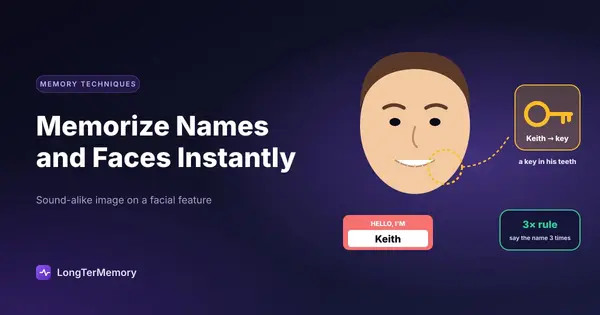
| Keith | Key, kite, teeth |
| Sandra | Sandstorm, sand castle |
| Oliver | Olive, oil |
| Priya | Prayer, pry bar |
| Chen | Chain, chin |
| Bridget | Bridge, fidget |
For less common names, you might split the name into parts: “Esperanza” → “Esper” (whisper) + “anza” (dance). Create an image that includes both.
Step 2: Find a distinctive facial feature
Now look at the person’s face and identify one feature that stands out. This might be:
- The shape of their nose (broad, pointed, upturned)
- Their eyebrows (thick, arched, sparse)
- Their eyes (deep-set, wide, unusual color)
- Their jawline (sharp, round, prominent)
- Their hairline (high, low, distinctive shape)
- Any wrinkles, dimples, or distinctive marks
You’re looking for the most memorable thing about their face , the thing that, if you saw a drawing of them, you’d include.
Step 3: Link the image to the feature
Now create a vivid, active mental image that connects your name-substitute to the distinctive feature you identified.
Say you’ve just met Marcus, who has a very prominent jaw. Your substitute is “Market.” Your image: a busy market has set up stalls on Marcus’s jaw , vendors selling vegetables, little tents, the whole scene on his chin.
Ridiculous? Absolutely. Memorable? Very.
For Sandra with striking blue eyes: a sandcastle being built right in her eyes, sand swirling in the blue.
For Oliver with thick eyebrows: olives growing like fruit from his eyebrows.
The more absurd, specific, and vivid the image, the harder it is to forget. Your brain has a powerful bias toward unusual, concrete, and emotionally striking information. Use that.
Using the Name Immediately: The 3x Rule
The substitution method works best when combined with immediate repetition. As soon as you hear someone’s name, use it three times in the next few minutes:
- At introduction: “Great to meet you, [Name].”
- During conversation: “So [Name], what brings you here?” or “What do you think, [Name]?”
- On departure: “Really enjoyed talking with you, [Name]. Hope to see you around.”
Using someone’s name in conversation doesn’t just help you remember it , it also creates a genuinely warmer interaction. People respond positively to hearing their own name (used naturally, not obsessively). You’re building rapport and encoding memory simultaneously.
The key is that each use forces another retrieval , you’re actively pulling the name out, not just passively holding it. Each retrieval strengthens the memory trace.
Facial Feature Association: Building a Face File
For people you’ll see repeatedly , colleagues, classmates, neighbors , you can build on the basic substitution method by cataloging distinctive features more systematically.
Think of this as creating a mental “face file.” For each person, you have:
- Their name (substituted with a vivid image)
- One or two distinctive features (the anchors for your image)
- A short personal context (where you know them from, what you know about them)
The context is important. “Sandra who studies marine biology and has the sandcastle-in-her-eyes image” is much more robust as a memory than just the image alone. Context creates additional retrieval paths , you might remember her from the topic of conversation before the face fully registers.
For larger groups (a new class, a new team at work), make it a game to build a face file for every person within the first two sessions. The investment is small, and the social and professional payoff is significant.
What to Do When You’ve Already Forgotten
This happens to everyone, even people who use these techniques. You see someone you’ve met before, and the name is just gone. No image comes. No hook.
Here are three options, from least to most socially smooth:
Option 1: Ask directly, but reframe it. “I’m sorry , I remember meeting you, but I’ve blanked on your name completely. Remind me?” This is embarrassing for maybe five seconds, but most people find it more endearing than offensive. Everyone has had this happen to them.
Option 2: Introduce them to someone else. If you’re with a friend or colleague, introduce the other person , “Have you met [Friend]?” , and let the name-forgotten person introduce themselves in response. Smooth, natural, problem solved.
Option 3: Ask for the spelling. “Actually , how do you spell your name?” works well for unusual names and buys you a moment to lock it in properly this time. For common names like “Sarah” or “James,” this only works if you can play it off as a joke.
The worst option is pretending you remember when you don’t. This leads to increasingly awkward conversations where you’re clearly avoiding saying the name, and people usually notice.
Reviewing Names: The Overnight Anchor
Here’s a habit that professional networkers and salespeople use consistently: reviewing names the same evening after meeting new people.
Within a few hours of an event, sit down and write down every name you can remember, along with:
- Where you met them
- One thing you remember about them
- The face image you created (if you used the substitution method)
This immediate review is a form of spaced retrieval practice , you’re strengthening the memory while it’s still fresh, right before consolidation during sleep. The names that feel solid will stay. The ones that required effort to recall are the ones to focus on next time.
If you’re in a professional context , a conference, a networking event, an interview loop , this evening review is genuinely worth the 10-15 minutes it takes. The people you remembered by name the next morning will notice.
Memory for Names as a Social Superpower
Here’s the deeper truth about name memory: it signals respect. When you remember someone’s name , especially after time has passed , you’re communicating that they mattered enough for you to hold onto. That impression is powerful.
Dale Carnegie wrote about this in How to Win Friends and Influence People, and the insight hasn’t aged: “A person’s name is to that person the sweetest and most important sound in any language.” This wasn’t mysticism , it reflects something real about how humans experience social recognition.
The techniques above give you the tools. But the underlying motivation should be genuine interest in the people you meet. Memory techniques work best when they’re in service of real attention, not a substitute for it.
Pay attention at the moment of introduction. Create the image. Use the name. Review it later. Then let the relationship do the rest.
Quick Reference: The Name Memory System
| Step | Action |
|---|---|
| At introduction | Identify one distinctive facial feature |
| Immediately | Create a vivid image linking the name-substitute to that feature |
| In conversation | Use the name naturally 2-3 times |
| On parting | Use the name one final time |
| That evening | Write down names + context, recall the images |
| Next encounter | Retrieve the image before you say hello |
Follow this system consistently for a few weeks, and remembering names will stop feeling like a superpower and start feeling like a basic skill. Because that’s what it is , a skill, not a gift.
Studying for exams that require remembering lots of names, terms, and concepts? LongTerm Memory transforms your study material into smart flashcards with built-in spaced repetition scheduling , so the right information comes up for review at exactly the right time.