How to Prepare for Oral Defense of a Dissertation or Thesis
Expert tips for preparing your dissertation or thesis oral defense, from anticipating committee questions to presenting with confidence and clarity.
Table of Contents
- What Committee Members Actually Look For
- Understanding the Format of Your Defense
- Anticipating Questions: The Most Important Preparation Step
- Read Your Own Dissertation as a Skeptical Examiner
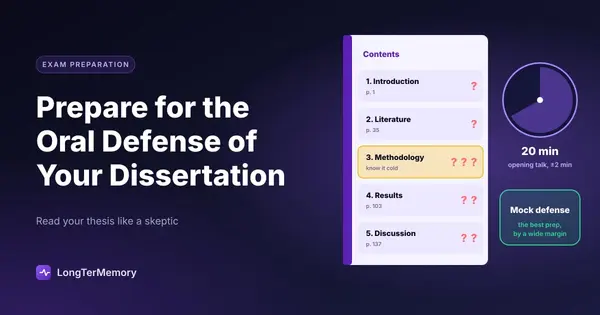
- Know Your Methodology Chapter Cold
- Consult Your Advisor
- Common Question Types to Prepare For
- Practice Strategies for Building Real Fluency
- Mock Defenses
- Out-Loud Practice
- Timed Presentation Practice
- Handling Questions You Didn't Anticipate
- Managing Anxiety Before and During the Defense
- Handling Revisions After the Defense
- The Bottom Line
Few academic experiences carry as much weight as the oral defense. You’ve spent months or years on this dissertation or thesis. You know more about your specific topic than almost anyone else in the room. And yet the prospect of sitting across from a panel of faculty members who will interrogate your work in real time is genuinely intimidating, no matter how well prepared you are.
Here’s the thing though: the oral defense is not designed to be a trap. It’s a scholarly conversation. The committee has already reviewed your written work. They’re not sitting there hoping you fail. What they want is to see that you can engage with your research thoughtfully, handle critiques with intellectual honesty, and speak about your work with the fluency of someone who truly owns it.
Preparation is what gets you there. And preparation, for a dissertation defense, means something much more specific than just re-reading your own document.
What Committee Members Actually Look For
Understanding the evaluative lens of your committee helps you prepare more purposefully.
Mastery of your own work: you should know every claim, every method choice, every finding, every limitation. If you wrote it, you should be able to explain it clearly without notes, in multiple ways, to multiple types of audience. Committee members will notice if you’re reading from a script versus genuinely inhabiting your research.
Intellectual honesty about limitations: committees are experienced researchers. They know no study is perfect. What they respect is a candidate who can articulate the boundaries of their research with clarity, explain why those limitations exist (not just that they do), and identify what would be required to address them in future work.
The ability to think in real time: your committee will ask questions you didn’t rehearse. They want to see genuine scholarly reasoning, not a database of pre-loaded answers. When an unexpected question comes, how you engage with it tells the committee more about your intellectual development than how you answer the prepared ones.
Clarity under pressure: can you explain your core contribution in plain language? Not in the specialized vocabulary of your field, but in a way that a thoughtful non-specialist could understand? This level of clarity is evidence of real understanding, not just familiarity.
Appropriate confidence: not arrogance, but the secure confidence of someone who has done serious work and can stand behind it. If you hedge every statement or preemptively apologize for your methodology, it reads as uncertainty about your own research.
Understanding the Format of Your Defense
Different programs, disciplines, and institutions structure defenses differently. Before you prepare anything, find out exactly what your defense looks like.
Some defenses begin with a 20-minute presentation by the candidate, followed by committee questions. Others go straight into questions. Some are closed (committee only), and others are public events where colleagues, faculty, and students can attend and ask questions.
Ask your advisor for a precise description of the format: how long the presentation is expected to be, whether you’ll have slides, how questions are structured (each committee member takes a turn, open discussion, or a mix), and whether the candidate is asked to leave the room while the committee deliberates.
Also find out how long the entire event typically runs. Knowing the structure removes one significant source of anxiety and helps you calibrate how much preparation is required for each component.
Anticipating Questions: The Most Important Preparation Step
The most valuable preparation you can do for an oral defense is systematic question anticipation, and then practicing your answers out loud.
Here is a structured approach:
Read Your Own Dissertation as a Skeptical Examiner
Read your full dissertation or thesis from start to finish as if you’re a reviewer who is genuinely looking for weaknesses. At every major claim, stop and ask:
- Why did you make this methodological choice rather than an alternative?
- What are the specific limitations of this approach?
- How do your findings relate to the prior literature you cited?
- What would change about your conclusions if one of your key assumptions were wrong?
- What are the practical implications of your findings?
- What future research does this work most urgently call for?
Write every question down. Then close your dissertation and answer each one out loud from memory. This is active recall applied to your own research, and it is one of the most effective preparation methods available to you.
Know Your Methodology Chapter Cold
Methodology is where committee members most commonly probe. They want to know that you didn’t just follow a template, but that you made deliberate, justified choices.
Be ready to explain:
- Why your sample was appropriate for the research question
- How you selected participants or cases and what that selection implies about generalizability
- Why you chose your specific data collection instruments or procedures
- How you approached validity and reliability (or their qualitative equivalents: trustworthiness, credibility, transferability)
- What threats to internal and external validity exist and how you addressed or acknowledged them
If you used statistical analysis, know the assumptions behind each test you ran and be ready to explain why the data met those assumptions.
If you used qualitative methods, know your epistemological stance and be ready to articulate why qualitative approaches were appropriate for your specific research questions.
Consult Your Advisor
Your advisor has likely sat on many committees and knows both your specific committee members and the types of questions they tend to ask. A direct conversation asking “What are the two or three questions you’d expect this committee to ask?” is not presumptuous. It’s efficient preparation, and most advisors are pleased to have the conversation.
If your committee chair or members have published work that overlaps with your research area, read it before your defense. It tells you what they find important in your field, and it’s good practice to be familiar with the perspectives of people who will be evaluating your work.
Common Question Types to Prepare For
Regardless of field, certain question types appear across dissertation defenses:
The “so what” question: “Why does this matter? What does your work contribute to the field that wasn’t there before?” Have a crisp, confident answer. This is not the moment to be modest.
The “why not X instead” question: “Why didn’t you use [alternative method / theory / framework]?” Know the alternatives you considered and why you made the choices you did.
The boundary condition question: “Under what conditions would your findings not hold? Are there populations or contexts where this wouldn’t apply?” This tests whether you understand the scope of your claims.
The implication question: “What should practitioners / policymakers / future researchers do differently based on what you found?” Have a specific answer.
The process question: “Walk me through how you [conducted this analysis / developed this instrument / selected this sample].” Your answer should show that you did the work, not just that you read about how it’s done.
Practice Strategies for Building Real Fluency
Knowing your answers isn’t the same as being able to deliver them under pressure. Fluency requires practice, specifically out-loud practice.
Mock Defenses
The most effective preparation, by a significant margin, is a mock defense. Ask your advisor, a trusted committee member, or advanced peers to play the role of committee for 45 to 60 minutes and ask you questions about your work.
The first mock defense will be uncomfortable. You’ll fumble on questions you thought you had prepared, lose your thread mid-explanation, or realize you haven’t thought carefully about a topic you assumed you knew. That is exactly why the mock defense is so valuable. Better to discover those gaps in a low-stakes rehearsal than in front of your committee.
Try to do at least two mock defenses before your actual defense. The second one will feel dramatically different from the first, not because the questions are easier, but because you’ve already experienced the format and built familiarity with the performance of explaining your work under scrutiny.
Out-Loud Practice
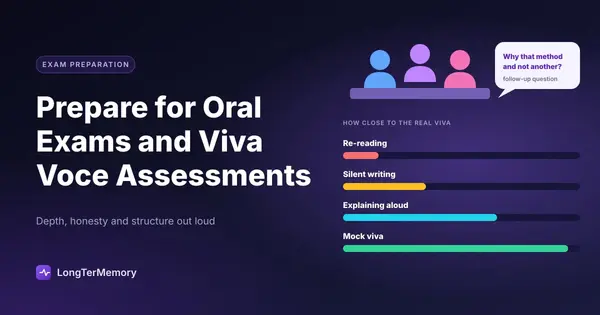
Reading over your dissertation in your head and practicing your defense are two fundamentally different activities. Explaining your research out loud, even to yourself, produces results that silent review cannot.
Pick a key section of your research (your theoretical framework, your core findings, your methodology rationale) and explain it out loud as if you’re speaking to an intelligent but non-specialist listener. Where you stumble or become vague is exactly where you need more preparation. This is the Feynman technique applied to your own work.
Repeat this for every major section. By the time you walk into your defense, the act of speaking about your research should feel as natural as the act of writing about it.
Timed Presentation Practice
If your defense includes an opening presentation, time it repeatedly. Going over the allotted time is unprofessional and starts the session on a wrong note. Going significantly under time suggests a lack of substance.
Aim to land within two minutes of your target time across multiple run-throughs. Record yourself once if you can tolerate watching it: the experience of seeing yourself present is uncomfortable but enormously useful for identifying filler words, pacing issues, and unclear transitions.
Handling Questions You Didn’t Anticipate
Even the most prepared candidate will face questions they haven’t thought about. Here’s how to handle them with composure:
Buy time legitimately: “That’s an interesting angle, let me make sure I understand what you’re asking.” Then restate the question in your own words. This gives you 15 to 20 seconds to think and demonstrates that you’re taking the question seriously rather than pattern-matching to a prepared answer.
Acknowledge what you don’t know: “That’s a limitation I didn’t explore fully in this work, and I think it represents an important direction for future research.” This is vastly better than attempting to bluff. Committee members have deep expertise in your field. They will recognize bluffing, and it undermines your credibility on everything else you say.
Return to your data: when challenged on an interpretation, anchor your response in what your data actually shows. “My data shows X. I recognize that Y is also a plausible interpretation, and here’s the reasoning behind my choice to emphasize X.”
Push back respectfully when you disagree: if a committee member characterizes your work in a way you believe is inaccurate, you are allowed to engage with that characterization. “I see that a little differently, and here’s my reasoning.” Doing this confidently and respectfully is a sign of intellectual maturity. It shows you’re a peer-level thinker, not a student hoping to say the right thing.
Managing Anxiety Before and During the Defense
Moderate anxiety is normal and, in small amounts, actually useful. It sharpens attention and signals that the stakes are real. The goal isn’t to eliminate it but to prevent it from overwhelming your performance.
In the week before: rehearse out loud every day. Familiarity is the most reliable antidote to anxiety. The more times you’ve explained your research clearly under mild pressure, the less threatening the real defense feels.
Sleep adequately: sleep deprivation impairs exactly the capacities you need most for an oral defense: verbal fluency, working memory, the ability to track and respond to complex questions. Prioritize sleep in the days before your defense over late-night cramming sessions. You already know your research. A well-rested version of you will demonstrate that knowledge far better than an exhausted one.
The night before: do light review if you want, but avoid trying to learn new material. The night before is for consolidation, not acquisition. Go to bed at a reasonable hour.
On the day: arrive early. Walk through the room before your committee arrives if you can. Set up any materials, test any technology. Bring water. Talking for an extended period in a stressful context dries your throat and creates physical discomfort you don’t need adding to the cognitive load.
During the defense: remember that pausing before answering a question is a sign of thoughtfulness, not uncertainty. You don’t need to fill every second with speech. A two-second pause before a considered answer is vastly preferable to an immediate but rambling one.
Handling Revisions After the Defense
Most defenses result in a “pass with revisions” outcome rather than a clean pass or a failure. Minor revisions might be fixing typos, clarifying a paragraph, or adding a citation. Major revisions might mean rewriting a chapter or adding additional analysis. This is normal, expected, and not a sign of failure.
When your committee presents revisions:
- Take careful notes during the feedback session, or ask permission to record it
- Don’t argue about revisions in the room; ask clarifying questions where needed, thank your committee, and let the feedback settle before responding
- Create a revision log that maps each committee comment to a specific action you’ll take in response
- Treat the revision process as the final scholarly chapter of your work, not as a punishment
If revisions require sustained engagement with the conceptual content of your research, spaced review helps you keep your own research’s central ideas accessible while you’re working through committee feedback. LongTerMemory lets you convert your research summaries into flashcard questions so the core of your work stays sharp across the revision timeline.
The Bottom Line
The oral defense feels like a high-wire act, but it’s a prepared one. You’ve done the research. You’ve written the work. The defense is your opportunity to demonstrate that you understand it deeply, can defend it honestly, and can engage with it as a peer-level scholar.
The candidates who perform best in oral defenses are not necessarily the ones who know the most. They’re the ones who practiced the most, out loud, under conditions that approximated the real thing, and who walked in prepared for both the questions they anticipated and the ones they didn’t.
Prepare systematically. Practice out loud. Know your methodology cold. Welcome the hard questions as opportunities to show what you know. And walk into that room understanding that the people across the table have invested in your success too.
You’ve earned this moment. Now show them what you know.