How to Prepare for Qualifying Exams in Graduate School
A practical guide to surviving and passing qualifying exams in graduate school, with multi-month review strategies and tips for balancing research.
Table of Contents
- What Qualifying Exams Test and How They Differ by Field
- The Oral Component
- Building a Multi-Month Review Plan for Graduate Qualifying Exams
- Phase 1: Map the Terrain (Weeks 1 to 2)
- Phase 2: Systematic Coverage (Months 1 to 3)
- Phase 3: Integration and Synthesis (Month 3 to Exam)
- Balancing Qualifying Exam Prep With Ongoing Coursework and Research
- Protect Your Peak Hours
- Negotiate a Realistic Timeline With Your Supervisor
- Use the Pomodoro Method or Time Blocking for Alternation
- Build In Recovery
- Preparing for the Oral Component
- The Mental Game
If you are in graduate school and qualifying exams are somewhere on your horizon, you already know the feeling. It is this background hum of dread that never fully goes away, no matter how much work you are doing on other things. It sits there like a low-grade alarm you cannot turn off.
Qualifying exams, sometimes called comprehensive exams or comps, are one of the defining challenges of graduate education. They are also, frankly, some of the least understood ones in terms of how to prepare effectively. Most students figure out their approach through a combination of peer advice, supervisor suggestions, and trial and error. There is no standardized study guide. There is rarely a clear rubric. And the stakes are high enough that getting the preparation wrong can set your timeline back by a year.
This guide is meant to take some of the fog away. Not to make it easy, because it is genuinely hard, but to give you a structure that works.
What Qualifying Exams Test and How They Differ by Field
Before you build a study plan, you need to understand what kind of exam you are actually preparing for, because qualifying exams vary dramatically by discipline, and even by program within the same discipline.
In the sciences, quals often test breadth. You are expected to demonstrate comprehensive knowledge across your field, sometimes far outside your immediate research specialty. A molecular biology student might need to command genetics, biochemistry, cell biology, and physiology. The questions may be written or oral, and you may face a committee that probes your understanding until they find the edges of it.
In the humanities and social sciences, qualifying exams more often test depth in a curated list of works, typically assembled in consultation with your committee. You may have a reading list of 150 to 300 texts and be expected to synthesize, compare, and critically engage with all of them. The written component might be a series of long essays over several days, sometimes from a question bank you receive in advance.
In professional programs (law, medicine, engineering), there may be standardized components alongside field-specific ones, and the criteria for passing may be more explicit.
The first thing you need to do is find out exactly what your qualifying exam requires. Talk to your advisor. Talk to students who have passed recently. Ask for past exam questions if they exist. Read the program handbook carefully. Every hour you spend understanding the specific requirements is worth more than ten hours of generic studying, because studying the wrong thing is the most common way to fail comprehensively.
The Oral Component
Many qualifying exams include an oral defense component where your committee questions you in real time. This is its own skill set. Unlike written exams, where you can plan your response before writing, oral exams require fluency, the ability to think and respond simultaneously without long silences. We will return to how to prepare for this specifically.
Building a Multi-Month Review Plan for Graduate Qualifying Exams
Qualifying exams cannot be crammed. Not meaningfully. If you have a reading list of 200 books and a written exam in four months, the math simply does not allow for it. More importantly, even if you could read everything in the last few weeks, the kind of synthetic understanding that examiners are testing for requires time, repeated exposure, and integration of ideas across a wide field.
You need a multi-month plan. Here is how to build one.
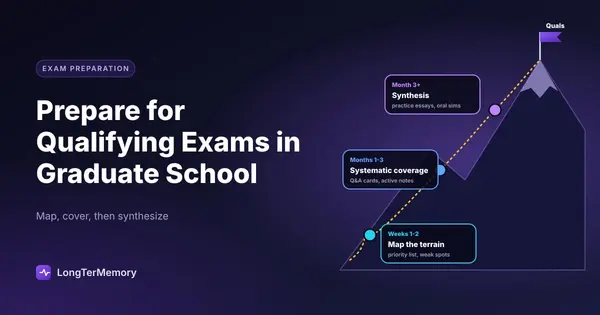
Phase 1: Map the Terrain (Weeks 1 to 2)
Before you start reading or reviewing, spend one to two weeks mapping the full scope of what you need to know.
For a reading list, go through every text and categorize it: what field or subfield does it belong to? What are the central arguments or contributions? Where does it sit in relation to the other texts? This gives you a landscape view before you descend into individual items.
For a breadth-based science exam, map the domains and identify which ones you know well, which ones you know moderately, and which ones feel like genuine weak spots. Do not skip this step in the interest of diving straight into content. The mapping is what makes everything else strategic.
Create a master priority list: the highest-yield topics, the ones most likely to appear on your exam, and the ones where your current knowledge is most deficient. Your study time is finite, and this list tells you where to invest it.
Phase 2: Systematic Coverage (Months 1 to 3)
Work through the material systematically, but not passively. Reading or reviewing content without converting it into retrievable form is one of the most common and costly mistakes graduate students make during qual prep.
As you work through each text, topic, or domain, generate notes in a format designed for later review. The specific format matters less than the principle: your notes should be designed to test you, not just remind you.
This means writing questions alongside your notes, creating summary cards for key arguments or concepts, building comparison frameworks for texts or theories that relate to each other. If you are using a tool like LongTerMemory to generate Q&A cards from your reading notes or PDFs, this is exactly the kind of thing it is built for. Rather than re-reading dense academic texts, you review the questions generated from them, which forces active retrieval rather than passive re-reading.
Phase 3: Integration and Synthesis (Month 3 to Exam)
The final phase is where you shift from coverage to synthesis. You stop adding new material and focus on building connections, identifying themes, and practicing the kind of analysis your exam will actually require.
This is when you write practice essays under timed conditions. This is when you simulate oral exam questions and answer them out loud. This is when you do cross-domain reviews that force you to connect ideas from different parts of your field rather than treating each area as a separate silo.
The goal of this phase is fluency. You want to be able to move around inside the material, not just recite individual pieces of it. Questions like “how does X relate to Y?” or “what are the key debates in this area and how have they evolved?” require you to hold multiple things in mind simultaneously and structure a response quickly.
| Phase | Focus | Key Activities |
|---|---|---|
| 1 (Weeks 1-2) | Mapping | Categorize material, identify weak spots, create priority list |
| 2 (Months 1-3) | Coverage | Systematic review, Q&A card generation, active note-taking |
| 3 (Month 3+) | Synthesis | Practice essays, oral simulation, cross-domain connections |
Balancing Qualifying Exam Prep With Ongoing Coursework and Research
This is where things get genuinely hard. Unlike undergraduate exam prep, you probably have a life during qual preparation. You may be teaching, running experiments, attending seminars, writing papers, meeting with your advisor. The exam is a major obligation, but it is not your only one.
Here is the brutal truth: something will have to give. The question is what, and how to manage it.
Protect Your Peak Hours
Most people have two to four hours per day of genuinely high-quality cognitive work available, the time when their brain is sharpest and most capable of demanding intellectual effort. Identify when yours are, and protect them ferociously for qual prep during the preparation period.
This might mean shifting research meetings to afternoons, front-loading administrative tasks, or communicating explicitly with your advisor that you are in a concentrated prep phase. Most advisors understand this and respect it when you communicate clearly rather than just becoming invisible.
Negotiate a Realistic Timeline With Your Supervisor
If you are doing research alongside prep, have an honest conversation with your advisor early about realistic research output during the qual period. Trying to maintain full research productivity while also preparing for a comprehensive exam is usually not sustainable, and attempting it often results in doing both things poorly.
A good supervisor will help you set a reduced but realistic research goal for the prep period. If you are not having this conversation, have it now.
Use the Pomodoro Method or Time Blocking for Alternation
When you need to do both things on the same day, alternating in focused blocks works better than trying to do both things simultaneously or switching constantly.
Time blocking means assigning specific hours to each activity and treating those blocks as non-negotiable. “9 to 12 is qual prep. 2 to 5 is research.” When you are in one block, you do not think about the other.
This reduces the cognitive overhead of task-switching and gives you the sense of progress on both fronts that makes sustained effort possible over months.
Build In Recovery
Months of intensive preparation without deliberate recovery leads to burnout, which reduces your performance exactly when you need it most. Schedule rest. This does not mean doing nothing; it means activities that genuinely restore you, whether that is exercise, socializing, cooking, music, whatever works for you.
A study plan that has no recovery built into it is a plan that will collapse in month two.
Preparing for the Oral Component
If your qualifying exam has an oral defense, this deserves specific preparation because it is a different skill from written exam performance.
Practice speaking your answers out loud, not in your head. Most graduate students rehearse in silence, which means the first time they actually verbalize a full argument is when they are sitting in front of their committee. That is not where you want to discover how it sounds.
Set up regular oral practice sessions. Ask a fellow student, a friend, or even your advisor to ask you questions from your area and force yourself to respond fully, aloud, without stopping. Record yourself if no one is available. The discomfort of hearing yourself on a recording is valuable because it shows you your verbal habits, your pace, where you reach for filler words when you are uncertain.
Practice handling uncertainty. The committee will likely push into areas where your knowledge is genuinely thin. You should practice saying, clearly and calmly, “I am not certain about that specifically, but based on what I know about the broader area, I would think…” rather than either guessing confidently at something you do not know or falling into panicked silence. Examiners generally respect intellectual honesty about the limits of your knowledge. What they do not respect is bluffing.
The Mental Game
Qualifying exams are psychologically demanding. The open-endedness of what is being tested, the high stakes, and the duration of the preparation period all create conditions for sustained anxiety that can undermine performance.
A few things help.
Know that uncertainty is normal. There is no end point where you feel completely ready. The nature of comprehensive exams is that they cover more than any human can hold in perfect readiness at once. Your goal is not to feel completely ready. It is to be as prepared as you can be given your time and constraints.
Reframe the exam as a conversation. In the oral component especially, the committee is not trying to fail you. They are trying to understand the extent and quality of your knowledge. That framing, a conversation between scholars, reduces the adversarial quality that anxiety gives it.
Connect regularly with peers going through the same process. Not to compare progress in ways that make you feel behind, but to normalize the experience, share strategies, and remind yourself that the discomfort you are feeling is not unique to you.
You will get through it. Graduate students with far less preparation than you are building have passed these exams. Approach it strategically, stay consistent, and trust the process you build.