How to Study for Oral Exams and Viva Presentations
Master oral exams and viva presentations with proven strategies for simulation, handling unexpected questions, and thinking clearly under scrutiny.
Table of Contents
- How Oral Exams Test Knowledge Differently From Written Exams
- What Examiners Are Listening For
- Simulating Viva Conditions Through Structured Mock Questioning
- Setting Up Mock Viva Sessions
- The Topics You Should Drill First
- Building a Question Bank
- Handling Unexpected Questions and Thinking Aloud Under Scrutiny
- The Power of Thinking Aloud
- The Framework for Handling Any Unexpected Question
- Handling Follow-Up Pushback
- Building the Mental Stamina for Oral Assessment
- Practice Under Realistic Conditions
- Manage Your Physical State Before the Exam
- Know Your Opening Move
- What to Do in the Days Before Your Oral Exam
- The Mindset That Changes Everything
Most exam preparation advice is built around written tests. Sit down, read silently, write quietly, no one is watching you. An oral exam is a completely different animal. Someone is watching you. Someone is listening to every word. They are going to ask you things you did not expect, and they are going to watch how you handle not knowing the answer.
If your entire exam preparation career has been built around highlighters and flash cards, the prospect of a viva or oral examination can feel genuinely alarming. The good news is that the skills required for oral exams are entirely learnable, and the preparation strategies are clear. The better news is that a student who has genuinely understood their material will perform better in an oral exam than in a written one, because there is no mark scheme to trip over and no question framing to misread. Your knowledge speaks for itself.
Here is how to prepare for it properly.
How Oral Exams Test Knowledge Differently From Written Exams
Before you can prepare effectively, it helps to understand what an oral examiner is actually measuring. Written exams test what you know. Oral exams test what you understand.
The distinction matters more than it sounds. In a written exam, you can sometimes get through on memorised content. You retrieve the right definition, you reproduce the right formula, you cite the right case. You may not fully understand why it works, but as long as the output matches what the mark scheme expects, you pass.
Oral examiners are specifically trying to probe beneath memorised responses. They will take your first answer and ask a follow-up that only makes sense if the first answer is genuinely understood. They will present a scenario you have not seen before and ask you to apply what you know. They will ask you to compare two things you have not directly compared. They will push back, gently or not so gently, on something you just said to see whether you stand behind it or collapse.
This is sometimes called probing for depth, and it is the defining characteristic of oral assessment. A student who has memorised but not understood will answer the first question fine and then begin to struggle. A student who genuinely understands will become more fluent and confident as the questioning goes deeper, because each follow-up question activates more of what they know.
What Examiners Are Listening For
Oral examiners are typically evaluating several things at once:
- Accuracy: Is what you are saying correct?
- Depth: Do you understand why it is correct, not just that it is?
- Flexibility: Can you apply the concept in a new context, not just the example you studied?
- Coherence: Does your answer hold together logically, or does it contradict itself?
- Confidence: Do you seem to believe what you are saying?
Note that confidence is on that list, but it is last. An examiner who hears a student say “I am not entirely certain about this, but my understanding is…” followed by a correct and well-reasoned answer will be far more impressed than a student who delivers an incorrect answer with total conviction.
Honesty about uncertainty, combined with genuine reasoning, is one of the most respected things you can demonstrate in an oral exam.
Simulating Viva Conditions Through Structured Mock Questioning
The single most effective preparation strategy for an oral exam is also the one most students skip: practice out loud with a real human asking you real questions.
Reading your notes in silence is not preparation for an oral exam. It trains you to retrieve information in the wrong format. Writing practice answers is better, but still wrong, because writing gives you time to compose and edit that speaking does not. Only speaking practice trains speaking performance.
Setting Up Mock Viva Sessions
Find someone who is willing to play examiner. This person does not need to be an expert in your subject. In fact, a non-expert examiner is often more useful for certain types of practice, because they will ask genuinely naive follow-up questions that reveal gaps in your ability to explain.
Give your mock examiner a list of core topics from your syllabus. Ask them to pick a topic and ask you to explain it. Then ask them to ask a follow-up question. Then another. A session of thirty to forty-five minutes of this kind of practice will reveal gaps in your understanding that you had no idea existed, and it will begin training your brain to retrieve and articulate knowledge under conversational pressure.
If you cannot find a willing human, the next best option is to use an AI tool as an interlocutor. You can ask a language model to act as an examiner for a specific subject area and drill you with questions. It is not perfect, but it is dramatically better than studying in silence.
The Topics You Should Drill First
Not all exam content is equally likely to generate follow-up questions. Examiners tend to probe hardest in a few areas:
Foundational concepts. The basic building blocks of your subject are the things most likely to be interrogated. If you say something in passing that relies on a foundational concept, the examiner may ask you to explain it. Make sure you can.
Definitions. Oral examiners love asking for definitions. Not because the definition itself is important, but because a clear, confident definition tells them immediately whether you understand the concept or just recognize the word.
The “why”. After almost anything you say, prepare to answer “why” or “how do you know”. If you say spaced repetition improves retention, be ready to explain the mechanism. If you cite a statistic, be ready to explain what it measured and why it is relevant.
Comparisons. “How does X differ from Y?” is an extremely common oral exam question. Make a list of the key compare-and-contrast pairs in your subject and practice explaining the differences out loud.
Building a Question Bank
As you study, write down every question you can imagine an examiner asking about each topic. Not multiple choice questions, open-ended ones. What is this? Why does it work? When would you use this instead of that? What are the limitations?
Then answer each question out loud, as if you were in the exam. Record yourself if possible. Listen back. Are you clear? Are you accurate? Are you answering the question that was actually asked, or the one you wanted to be asked?
That last one is a real trap in oral exams. Students who have prepared a detailed answer on a specific topic will sometimes deliver that answer regardless of what the question actually was. Examiners notice this immediately.
Handling Unexpected Questions and Thinking Aloud Under Scrutiny
The moment that most oral exam candidates dread is the one where a question arrives that they did not prepare for. This is going to happen. The question is what you do with it.
The Power of Thinking Aloud
In a written exam, your thought process is invisible. In an oral exam, it is not only visible, it is often what is being evaluated. Many oral examiners are explicitly assessing how you think, not just what conclusions you reach.
This means that thinking out loud is not a weakness, it is a technique. When you encounter a question you do not know the answer to, instead of going silent and panicking, narrate your thinking:
“I haven’t seen this specific case before, but let me work through it. The relevant principle here seems to be… and if I apply that to this situation… then I would expect…”
This kind of thinking-aloud response demonstrates exactly what oral examiners value: the ability to reason from what you know to what you do not yet know. It shows depth of understanding in real time. Even if your conclusion is incomplete or slightly wrong, a well-reasoned attempt will often earn more credit than silence or a confident wrong answer.
The Framework for Handling Any Unexpected Question
When a question arrives that you did not prepare for, a simple three-step framework helps:
-
Pause and clarify. If there is any ambiguity in the question, ask for clarification. “When you say X, do you mean Y or Z?” This is not stalling, it is professional and shows that you are thinking carefully before speaking.
-
Connect to what you know. Ask yourself what the question is related to in your existing knowledge. It is almost never the case that an examiner asks something completely disconnected from the material you have studied. Find the anchor.
-
Reason through it explicitly. Then work through the answer out loud, narrating your logic. You may not arrive at a complete answer, and that is fine. The quality of your reasoning is what counts.
Handling Follow-Up Pushback
Sometimes an examiner will push back on a correct answer. This is deliberate. They want to see whether you will stand firm on something you know to be true, or whether you will fold under social pressure.
If you are confident your answer is correct, defend it. Politely but clearly: “I understand that might seem counterintuitive, but my reading of the evidence is that…” and then explain your reasoning. Examiners respect intellectual confidence. What they do not respect is false confidence or an inability to take in new information.
If you realize mid-pushback that your answer was actually wrong, acknowledge it clearly and correct yourself. “Actually, thinking about that more carefully, I think I was wrong to say… because…” This is not weakness. It is intellectual honesty and the ability to update on new information, which is a genuinely valued academic skill.
Building the Mental Stamina for Oral Assessment
Oral exams are cognitively tiring in a way that written exams are not. Talking, listening, reasoning, and maintaining composure simultaneously drains attention faster than writing quietly does. Mental stamina preparation matters.
Practice Under Realistic Conditions
Do not do all your mock sessions when you are relaxed and well-rested. Deliberately practice when you are a little tired, a little stressed, a little distracted. Simulate the conditions of the actual exam, not the ideal conditions you would prefer.
If your oral exam will take place in the morning, practice in the morning. If it will last forty-five minutes, do at least some mock sessions that run the full length. Stamina is built by doing the thing, not by thinking about it.
Manage Your Physical State Before the Exam
The research on test performance is fairly consistent on a few physical factors. Sleep the night before matters more than a late-night cramming session. Light physical activity in the morning reduces cortisol and improves verbal fluency. Controlled breathing in the minutes before you begin, specifically slow exhalation, activates the parasympathetic nervous system and reduces the fight-or-flight response.
None of these are magic. But they collectively give you a better baseline than sitting in a waiting room refreshing your notes anxiously.
Know Your Opening Move
One practical technique that reduces oral exam anxiety significantly is to know exactly what you are going to say in the first thirty seconds. When the first question is a standard opener like “Tell me about your topic” or “Can you summarise your work?” having a prepared, confident opening answer means you enter the exam in a state of competence rather than improvisation. That early confidence tends to carry forward.
What to Do in the Days Before Your Oral Exam
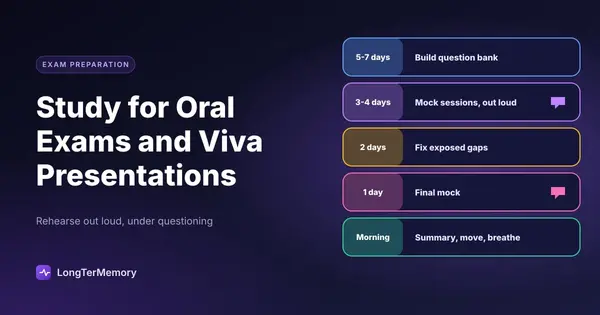
The week before an oral exam should look different from the week before a written one. Here is a condensed preparation sequence that works:
| Day | Focus |
|---|---|
| 5-7 days before | Build your question bank, identify your weakest topics |
| 3-4 days before | First round of mock questioning sessions, out loud |
| 2 days before | Targeted review of gaps exposed in mock sessions |
| 1 day before | Final mock session, light review of core definitions and comparisons |
| Morning of | Brief summary review, physical activity, breathing practice |
The pattern here is deliberate: heavy preparation early, tapering toward the exam so you arrive rested and confident rather than exhausted and anxious.
If you are looking for a tool that helps you generate practice questions from your own study materials automatically, LongTerMemory does exactly that. Upload your notes or a PDF, and it creates question-and-answer pairs you can drill through spaced repetition. It is built for this kind of self-testing practice.
The Mindset That Changes Everything
There is one mindset shift that, more than any technique, changes how students perform in oral exams.
Written exams are adversarial. You versus the question paper. Oral exams do not have to be. Reframe them as conversations about something you know and care about. The examiner is not trying to catch you out. They are trying to understand how you think. If you approach the exam as a chance to show someone what you know, rather than a gauntlet designed to expose everything you do not, the entire experience changes.
The best oral exam performances look less like a nervous student answering interrogation and more like a knowledgeable person explaining something they find genuinely interesting. That is the standard to aim for. And with the right preparation, it is entirely reachable.