How to Manage Your Time During a Timed Exam
Master timed exam strategy with proven pacing techniques: calculate time per question, know when to skip, and use the final 10 minutes for maximum recovery.
Table of Contents
- Calculating Time Per Question Before You Start
- Weighting your time by point value
- Building in checkpoint times
- When to Skip and Return vs. When to Push Through
- The signals that tell you to skip
- The signals that tell you to push through
- The two-pass strategy in practice
- What to do when you genuinely don't know
- Using the Last 10 Minutes for Maximum Recovery
- What to do in the final 10 minutes
- What NOT to do in the final 10 minutes
- Building the Time Management Habit Before the Exam Day
- The Psychology of Timed Exams
- Summary: Your Exam-Day Time Management System
There’s a specific kind of panic that hits when you look up from an exam paper and realize you’re only halfway through with a quarter of the time remaining. The questions start blurring. Your hand speeds up. You start guessing where five minutes ago you knew the answer. And by the end, you’re filling in responses you’re not even reading properly.
This scenario is astonishingly common. And nearly always, it’s not a knowledge problem. Students who run out of time on exams usually know the material. What they don’t have is a working time management system for the exam itself.
That’s fixable. The strategies in this article are used consistently by high performers on standardized tests, professional licensing exams, and high-stakes university finals. None of them are complicated. All of them require practice to become automatic.
Calculating Time Per Question Before You Start
The moment you receive your exam and are told to begin, most students immediately start reading the first question. This is a mistake.
Spend the first sixty to ninety seconds doing a quick exam survey. This is not time wasted, it’s an investment that pays dividends for the entire exam duration.
Here’s what to do in that ninety seconds:
- Flip through the entire exam (without reading questions closely)
- Count the total number of questions
- Note if any questions are worth more points than others (essays, extended problems, etc.)
- Calculate your basic time budget
The calculation is simple:
Total exam time / Total questions = Time available per question
Then apply a small buffer factor. If you have 90 minutes for 60 questions, that’s 1.5 minutes per question. In practice, plan to spend about 1 minute per question, leaving a 30-minute buffer for difficult questions, review, and any administrative overhead (transferring answers to a bubble sheet, for example).
Write this number somewhere on your exam. Glance at it regularly throughout the exam.
Weighting your time by point value
Not all questions are worth the same. If your exam has 40 multiple-choice questions worth 1 point each and 2 essay questions worth 30 points each, the math changes drastically. The 40 multiple-choice questions are worth 40% of your grade. The 2 essays are worth 60%.
Weighting your time accordingly, spending more time on high-value sections and moving efficiently through lower-value ones, is the single most impactful time management decision you can make before the exam begins.
A common mistake is spending 80% of exam time on 40% of the grade, simply because the multiple-choice questions come first and students get absorbed in them. Know your point distribution before you start allocating your time.
Building in checkpoint times
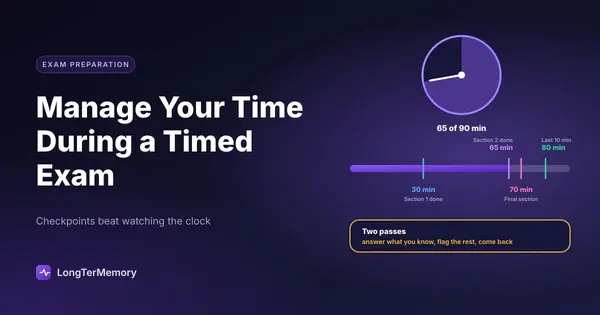
Instead of just calculating time per question, set explicit checkpoints. For a 90-minute exam with 3 sections:
| Checkpoint | Time | Goal |
|---|---|---|
| Section 1 complete | 30 minutes | First 20 questions done |
| Section 2 complete | 65 minutes | Next 25 questions done |
| Final section begin | 70 minutes | Final questions + review |
| Final 10 minutes | 80 minutes | Recovery and check |
Write these checkpoints on your exam paper. When you hit the 30-minute mark, glance at where you are. Ahead? You have buffer to use on hard questions. Behind? Time to accelerate and skip anything you’re stuck on.
This turns vague time anxiety into specific, actionable information. You’re not wondering “am I going fast enough?”, you’re checking “am I at question 20 at the 30-minute mark?”
When to Skip and Return vs. When to Push Through
This is the decision that separates efficient exam-takers from inefficient ones. And getting it right consistently requires understanding one uncomfortable truth:
Sticking with a hard question you can’t answer is usually not perseverance. It’s a poor use of time.
There’s a meaningful difference between a question you can work through if you think carefully, and a question where you’ve genuinely hit a wall after 90 seconds of honest effort. One deserves more time. The other deserves a strategic skip.
The signals that tell you to skip
Skip a question and mark it for return when:
- You’ve read the question twice and don’t understand what it’s asking
- You know the topic but the specific detail being tested isn’t coming to you
- You’ve been on the question for more than twice your per-question budget with no convergence
- You feel mounting anxiety about this question spilling over into subsequent questions
Note: skip and mark, don’t skip and forget. A circled number in the margin, a small flag, a mark on your scratch paper, whatever system you use, ensure you can find skipped questions quickly when you come back.
The signals that tell you to push through
Stay with a question when:
- You’ve started to work through it and you’re making progress, even if slowly
- The question is worth significantly more points than average (an essay or extended problem)
- You’re close to the end of the exam and have time remaining, there’s nowhere better to spend it
- You have a specific approach in mind and just need to execute it
The push-through/skip decision is not about confidence or effort. It’s about expected value. If spending three more minutes on a one-point question has a 40% chance of getting it right but guarantees you won’t have time for two other questions you’d almost certainly answer correctly, the math says skip.
The two-pass strategy in practice
This is the structural answer to the skip/push-through dilemma:
First pass: Move through every question at your budgeted pace. Answer confidently where you can. For uncertain questions, make your best guess (never leave anything blank), mark the question, and continue. Never spend more than 1.5x your time budget on any question in the first pass.
Second pass: Return only to marked questions. You now have context for the full exam. Some questions that seemed hard early on will have context provided by later questions (exams are often written with this in mind). You’re also no longer carrying the anxiety of the unknown, since you’ve seen everything.
Third pass (if time allows): Spot-check questions you answered confidently. Look specifically for misread words (“EXCEPT,” “NOT,” “ALWAYS”) that might change your answer.
What to do when you genuinely don’t know
Sometimes you hit a question and nothing comes. You know the general subject area but the specific detail being tested is simply not there.
In this situation, stop using time hoping something will emerge. It usually won’t. Do the following instead:
- Eliminate any answer you can identify as clearly wrong
- From what remains, choose your best guess based on: familiarity, which option sounds most specific to the topic, which option avoids absolute language if you’re uncertain
- Mark the question
- Move on
A strategic guess on a question you can’t answer is better than spending four minutes staring at it and arriving at the same guess, having wasted four minutes.
Using the Last 10 Minutes for Maximum Recovery
The last ten minutes of any timed exam are a distinct phase that most students either waste by continuing to answer new questions or misuse by anxiously rereading everything. There’s a better approach.
What to do in the final 10 minutes
At the 10-minute mark, stop answering new questions. This sounds radical. It isn’t. If you reach the final ten minutes with unfinished questions, you have a time management problem that ten minutes of panic won’t fix. Accept that, answer any remaining blank questions with your best guess, and shift modes.
In the final ten minutes, focus on:
1. Ensure every question has an answer. If your exam doesn’t penalize for wrong answers (which most modern exams don’t), there is zero benefit to leaving anything blank. Go through quickly and fill in any blanks with a guess. A 20-25% chance of credit is better than a guaranteed zero.
2. Return to marked questions you haven’t resolved. If you have marked questions and haven’t had time for a second pass, now is when you address the most valuable ones. Work highest-point-value questions first.
3. Check for misread qualifiers. Scan your answers for the question types most likely to harbor misreading errors: NOT/EXCEPT questions, “best” or “most likely” questions, “first” or “initial” questions. Make sure your answer aligns with what was actually asked.
4. Check for transfer errors (bubble sheets). If you’re filling in an external answer sheet, verify that your answer numbers match your question numbers. A single misalignment early in the exam can cascade into twenty wrong answers if you don’t catch it.
What NOT to do in the final 10 minutes
Don’t change answers based on anxiety. The research is consistent: students who change answers based on genuine insight (spotting a misread word, recalling information that changes the calculus) improve their scores. Students who change answers because they suddenly feel uncertain about choices they made confidently tend to reduce their scores. “I second-guessed myself” is one of the most common post-exam regrets.
Unless you have a specific reason to change an answer, your first instinct was probably right.
Don’t start a question you can’t finish. An unfinished essay or calculation problem gets partial credit at best and costs time better spent on questions you can actually complete. If you have an unfinished extended response, add a concluding sentence that signals your intended direction, even if the body is incomplete.
Don’t catastrophize. If the exam has been harder than expected, it’s been harder for everyone. Exam grades are often curved, and the performance that feels catastrophic in the moment is frequently more acceptable than it feels. Maintain composure in the final minutes and execute the strategy. A calm, methodical final ten minutes recovers more points than a frantic scramble.
Building the Time Management Habit Before the Exam Day
The strategies above are most effective when they’ve been practiced before the exam, not improvised during it. Here’s how to build these habits in preparation:
Do timed practice exams. Find past papers, official practice tests, or question banks and complete them under realistic time pressure, without pausing, without looking things up, without giving yourself extra time. The discomfort of practicing under real conditions is exactly what prepares you for the real thing.
Track your time per question during practice. After a practice exam, calculate how much time you spent per question on average. If it’s consistently over your budgeted amount, you need to practice moving faster. If you’re finishing early, you might be rushing.
Identify your slow question types. Everyone has question types that take longer than average. Scenario-based questions, calculation-heavy problems, passage-based reading comprehension. Identifying yours tells you where to build in extra time budget during the actual exam.
Practice the two-pass strategy. Do a full timed practice exam using the two-pass approach: first pass at pace, second pass on marked questions. It feels uncomfortable the first few times. It becomes second nature with repetition.
Debrief after every practice session. After each timed practice, review: Which questions did you run out of time on? Which did you spend too long on? Which did you guess on that you could have worked out with more time? This diagnostic reveals exactly where your time management breaks down.
The Psychology of Timed Exams
One more layer that rarely gets discussed: the psychological experience of time pressure changes how your brain works.
Under acute time stress, the prefrontal cortex, responsible for complex reasoning and working memory, is somewhat suppressed. Your brain defaults to faster, more automatic processes. This is why exam anxiety specifically hurts performance on questions that require careful reasoning, and why it has less effect on questions testing recall of well-practiced information.
The practical implication: the harder a question seems, the more important it is not to rush. Paradoxically, taking a slow, methodical breath and approaching a difficult question calmly produces better performance than accelerating through it. You access your full reasoning capacity when you’re calm. You access a degraded version of it when you’re panicking.
This is why time management discipline, knowing that you have a system and trusting it, is itself anxiety-reducing. The student who has a clear time budget, checkpoints, and a two-pass plan is not anxious about time the same way a student who’s improvising is. The structure itself is calming.
Summary: Your Exam-Day Time Management System
| Phase | Action |
|---|---|
| First 90 seconds | Survey exam, count questions, calculate time budget, write checkpoints |
| First pass | Answer at budget pace, mark uncertain questions, never go more than 1.5x budget |
| Second pass | Return to marked questions, highest-value first |
| Final 10 minutes | Ensure all questions answered, check for misreads, verify transfer accuracy |
| Throughout | Trust your first instinct unless you have a specific reason to change |
LongTerMemory helps you build the content knowledge that makes time management on exams easier, because the less time you spend searching your memory for answers you’re uncertain about, the more time you have for questions that genuinely need your attention. Upload your study materials, generate flashcards automatically, and practice with spaced repetition until the content is solid. Then walk into your timed exam knowing the material is there, and trust your strategy to make the most of the time you have.
The clock is ticking. But you have a plan.