How to Prepare for the Licensed Professional Counselor (LPC) Exam
Expert LPC exam prep guide covering counseling theory, clinical vignettes, study timelines, and spaced repetition to pass your counseling licensure test.
Table of Contents
- What the LPC Exam Tests Across Counseling Theory and Practice
- The NCE vs NCMHCE: Know Which One You Are Taking
- Content Domains and Approximate Weightings
- Counseling Theories You Must Know Cold
- Practice Question Strategy and Clinical Vignette Preparation for LPC
- How to Read Clinical Vignettes
- Question Bank Volume and Schedule
- Analyzing Wrong Answers Systematically
- Study Timeline and Resource Recommendations for LPC Licensing
- A 12-Week Study Timeline
- The Best Books and Question Banks for LPC Prep
- Flashcards and Spaced Repetition for Dense Content
- Using AI Study Tools Wisely
- Managing Exam Day Anxiety and Final Logistics
- Putting It All Together
You have finished your graduate coursework, survived practicum and internship, and probably cried at least once in your supervisor’s office. Now there is one final gate between you and the title you have worked years to earn: the Licensed Professional Counselor exam. If you are staring at a mountain of study materials and wondering where to even start, take a breath. This exam is absolutely passable with the right plan, and thousands of new counselors cross this finish line every single year.
The National Board for Certified Counselors (NBCC) reports that first-time pass rates for the National Counselor Examination (NCE), one of the two main LPC licensing exams, sit around 82 to 85 percent. For the National Clinical Mental Health Counseling Examination (NCMHCE), pass rates are slightly lower, typically in the 75 to 80 percent range for first attempts. Those numbers mean the exam is genuinely challenging, but they also mean that with focused preparation, you are statistically likely to pass.
This guide walks you through exactly what the LPC exam tests, how to attack clinical vignettes, which resources are worth your money, and a study timeline that builds real competence instead of just short-term cramming.
What the LPC Exam Tests Across Counseling Theory and Practice
The LPC exam, whether your state uses the NCE or NCMHCE, is designed to assess whether you can function as a safe, competent, entry-level professional counselor. It is not a trivia contest about who memorized the most theorists. It is a test of applied clinical judgment, professional ethics, and foundational counseling knowledge.
The NCE vs NCMHCE: Know Which One You Are Taking
Before you open a single book, confirm which exam your state licensing board requires. Some states use the NCE, others require the NCMHCE, and a few accept either. The two exams are structurally different and demand different preparation strategies.
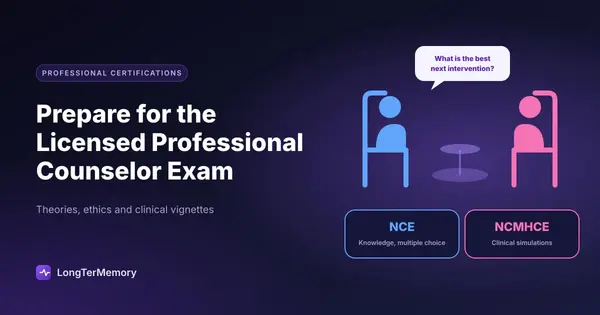
The NCE consists of 200 multiple-choice questions administered over four hours. It is a broad, knowledge-based exam that covers counseling theory, assessment, career development, group counseling, and professional ethics. Think of it as a comprehensive final exam for your entire graduate program.
The NCMHCE is a clinical simulation exam. You face 10 to 12 clinical scenarios, each with multiple decision points. You must choose the best initial response, the best assessment strategy, and the best treatment approach based on the information provided. There are no standalone multiple-choice questions. Every item is embedded in a unfolding client scenario.
Knowing which format you are preparing for changes everything, from which practice materials you buy to how you study.
Content Domains and Approximate Weightings
For the NCE, content is organized into eight core domains. The NBCC publishes exact weightings, and you should build your study plan around them rather than studying everything equally.
| NCE Content Domain | Approximate % of Exam |
|---|---|
| Professional Practice and Ethics | 12% |
| Intake, Assessment, and Diagnosis | 12% |
| Areas of Clinical Focus | 12% |
| Treatment Planning | 12% |
| Counseling Skills and Interventions | 12% |
| Core Counseling Attributes | 12% |
| Theories of Counseling and Personality | 12% |
| Career Development and Appraisal | 8% |
| Group Counseling and Assessment | 8% |
The domains are relatively balanced, but professional ethics, intake and assessment, and treatment planning together account for over one-third of the exam. These are high-yield areas where every extra hour of study pays disproportionate returns.
For the NCMHCE, the content areas map differently because the exam is scenario-based. The NBCC organizes it around four clinical work behaviors:
- Information gathering and assessment
- Diagnosis and treatment planning
- Clinical interventions and client management
- Professional practice and ethics
Each scenario on the NCMHCE tests multiple work behaviors at once, so preparation needs to integrate these skills rather than studying them in isolation.
Counseling Theories You Must Know Cold
Both exams expect you to know the major counseling theories in enough detail to identify which approach a given scenario describes, and which theory would best fit a particular client presentation.
You should be able to distinguish between and apply:
- Psychoanalytic and psychodynamic approaches (Freud, Jung, object relations)
- Person-centered therapy (Rogers, core conditions, self-actualization)
- Cognitive behavioral therapy (Beck, Ellis, thought records, cognitive restructuring)
- Existential and Gestalt approaches (Yalom, Perls, here-and-now awareness)
- Solution-focused brief therapy (de Shazer, miracle question, scaling)
- Family systems theories (Bowen, structural, strategic)
- Reality therapy and choice theory (Glasser, WDEP model)
For each theory, know the founder, core assumptions, key techniques, and the type of client or problem it best addresses. The NCE loves questions that ask you to match a theory to a clinical vignette. The NCMHCE will embed theoretical orientation into the treatment planning decisions you make.
If you need a refresher on how to memorize dense theoretical material efficiently, our guide on how to memorize everything you read breaks down active reading strategies that work especially well for conceptual content like counseling theory.
Practice Question Strategy and Clinical Vignette Preparation for LPC
No matter which LPC exam you take, your preparation needs to center on practice. Not passive reading, not highlighting, not re-watching lecture videos. Practice questions are the engine of LPC exam preparation. They train you to think like a licensed counselor under timed conditions.
How to Read Clinical Vignettes
Clinical vignettes are the heart of both the NCE and the NCMHCE, and the most common mistake candidates make is reading too quickly. A vignette is a short story about a client, and every sentence contains information you might need. The age of the client, the presenting problem, the duration of symptoms, the cultural context, and the specific wording of the question stem all matter.
Here is a systematic approach that top scorers use:
- Read the question stem first. Before you read the vignette, know what you are being asked. Are you identifying a diagnosis? Choosing an intervention? Recognizing an ethical dilemma? This prevents you from getting lost in irrelevant details.
- Read the vignette once carefully. Note demographics, symptoms, duration, and any risk factors.
- Predict the answer before looking at the options. This engages active recall and reduces the influence of distractors.
- Evaluate every answer choice against your prediction. Even if option A looks correct, read B, C, and D. The NCE and NCMHCE are designed to have plausible-sounding wrong answers.
- Watch for absolute language. Words like “always,” “never,” and “must” often signal incorrect answers in counseling, because clinical work is nuanced.
On the NCMHCE specifically, pay close attention to what the scenario tells you versus what it does not. If the client mentions suicidal ideation but denies a plan or intent, your next step is different than if they have a specific plan and means. The exam tests whether you can make clinically appropriate decisions with incomplete information, which is exactly what real counseling requires.
Question Bank Volume and Schedule
For the NCE, aim to complete between 800 and 1,200 practice questions before exam day. For the NCMHCE, because the questions are embedded in scenarios, aim for at least 15 to 20 full clinical simulations, plus individual decision-point practice.
A sustainable daily target is 40 to 60 questions for the NCE, or one full clinical simulation for the NCMHCE. Spread this over 8 to 12 weeks. Cramming 500 questions in the final week is less effective than 50 questions per day for 10 weeks because your brain needs time to consolidate clinical reasoning patterns.
Our article on how to become a better test taker goes deeper into the psychology of exam performance, including how to manage timing pressure and avoid second-guessing yourself under stress.
Analyzing Wrong Answers Systematically
The value of a practice question is not in getting it right. It is in what you learn when you get it wrong. Every incorrect answer is a diagnostic tool pointing to a gap in your knowledge or reasoning.
Sort your errors into three categories:
- Knowledge gap: You did not know the ethical guideline, theory, or assessment tool being tested.
- Reasoning gap: You knew the content but misapplied it to the scenario.
- Reading gap: You misread the question or the vignette and answered a different question than the one being asked.
Knowledge gaps are fixed with targeted content review. Reasoning gaps are fixed with more vignette practice and rationale reading. Reading gaps are fixed by slowing down and using the systematic approach described above. Most candidates have a mix of all three, and knowing your personal error profile lets you study far more efficiently.
If you are taking the NCMHCE, the NBCC publishes an official Case Simulation Study Guide that includes practice scenarios with detailed rationales for each decision point. It is one of the most valuable investments you can make because it teaches you how the exam writers think.
Study Timeline and Resource Recommendations for LPC Licensing
A haphazard study plan is the single biggest reason otherwise prepared candidates fail the LPC exam. You need a timeline that front-loads content review, transitions into heavy practice, and leaves time for consolidation and self-care in the final weeks.
A 12-Week Study Timeline
This timeline assumes you are studying part-time while working or finishing internship hours. If you have more time, stretch it. If you have less, compress the content review phase and lean harder on practice questions.
| Week | Focus Area | Daily Target |
|---|---|---|
| Weeks 1-3 | Content review by domain (ethics, theories, assessment, diagnosis) | 1-2 hours content review, 20 practice questions |
| Weeks 4-6 | Mixed practice questions and domain-specific weak spots | 40-60 practice questions, review all rationales |
| Weeks 7-9 | Heavy practice emphasis, full-length simulated exams | 60+ questions or 1-2 clinical simulations |
| Weeks 10-11 | Focused review of weakest domains and error log | Light question volume, targeted review |
| Final week | Rest, light review, exam logistics, sleep | No new content |
The most important rule is this: do not learn new content in the final week. Your working memory is not a hard drive you can fill at the last minute. Memory consolidation requires sleep and time, which is why our article on sleep as a study strategy is one of the most-read pieces on this blog. Protect your rest like it is a study tool, because neurologically, it is.
The Best Books and Question Banks for LPC Prep
The LPC prep market is smaller than the market for medical or nursing exams, but there are still solid resources available.
For the NCE, the Encyclopedia of Counseling by Howard Rosenthal is widely considered the gold standard. It is comprehensive, well-organized by domain, and written in a conversational style that makes dense theory more digestible. Many candidates use it as their primary content review text.
For practice questions, Rosenthal’s NCE Practice Exam Book contains full-length simulated exams with detailed answer explanations. The questions are calibrated to match the difficulty and style of the actual NCE, and the rationales teach you the reasoning behind both correct and incorrect answers.
For the NCMHCE, the NBCC Official Case Simulation Study Guide is essential. It is written by the same organization that creates the exam, and it provides the most accurate representation of what you will face on test day. Third-party NCMHCE prep courses, such as those from Counselor Exam Prep or Dr. Arthur’s NCMHCE Prep, are also popular and can provide structure if you prefer guided study.
Flashcards and Spaced Repetition for Dense Content
There is a lot of memorization involved in LPC exam prep. You need to know the DSM-5-TR criteria for common diagnoses, the ACA Code of Ethics, the stages of group counseling, dozens of assessment instruments, and the key concepts of every major theory. Trying to hold all of that in working memory through repeated reading is inefficient and exhausting.
Spaced repetition solves this by scheduling review at scientifically optimized intervals. Instead of re-reading the same ethics chapter every week, you review specific facts exactly when you are about to forget them. This cuts study time dramatically while improving long-term retention.
Tools like LongTerMemory are built for exactly this workflow. You can upload your counseling textbooks, class notes, or PDF study guides, and the platform automatically generates question-answer flashcards from your materials. It then schedules those cards using a spaced repetition algorithm so you review the right concepts at the right time. Instead of spending hours manually creating flashcards, you can focus on actually learning the content.
For an exam like the LPC, where the content volume is high and the stakes are meaningful, automating your review scheduling is a genuine advantage. It removes the cognitive load of deciding what to study each day and replaces it with a system that adapts to your personal memory patterns.
If you want to understand the science behind why spaced repetition works so well for professional licensing exams, read our deep dive on the science of spaced repetition. The research is remarkably consistent across domains, from medical boards to counseling licensure.
Using AI Study Tools Wisely
The landscape of exam prep has changed significantly with the rise of AI-powered study tools. You can now generate practice questions from your own notes, create simulated clinical vignettes on demand, and get instant explanations for confusing concepts.
The key is to use AI as a supplement, not a replacement, for official materials. Generate extra practice questions on weak domains, but verify the accuracy of AI-generated content against authoritative sources like the DSM-5-TR or the ACA Code of Ethics. AI is excellent for volume and variety, but it can occasionally hallucinate details that matter on a licensing exam.
Our comparison of AI study tools for technical certifications includes principles that apply equally to counseling licensure, especially around verifying accuracy and using AI for active recall rather than passive reading.
Managing Exam Day Anxiety and Final Logistics
Exam anxiety is real, and for the LPC exam it makes sense. This test determines whether you can practice independently. A moderate level of anxiety actually improves focus and performance through heightened physiological arousal. The problem is when anxiety tips into panic, which impairs working memory and clinical reasoning.
Here are strategies that research and candidate reports both support:
- Simulate the exam environment during practice. Take full-length practice exams at the same time of day as your real exam, in a quiet space, with a timer running. Familiarity reduces novelty anxiety.
- Use positive visualization. Spend five minutes each day for the week before the exam visualizing yourself walking into the testing center, working through questions calmly, and finishing with confidence. Sports psychology research consistently shows that mental rehearsal improves performance.
- Arrive early and prepared. Bring two forms of ID, know the testing center location, and dress in comfortable layers. Small logistical stressors compound exam anxiety.
- Use the full time. There is no prize for finishing early. If you finish a block with time remaining, use it to review flagged questions carefully.
If you struggle with test anxiety generally, our guide on studying with burnout signs includes evidence-based techniques for managing chronic study stress before it becomes performance-impairing anxiety.
Putting It All Together
The LPC exam is a rigorous but entirely surmountable hurdle. It tests the exact knowledge and skills you have been developing throughout your graduate training. The candidates who pass are not necessarily the ones with the best memories. They are the ones who prepare systematically, practice deliberately, and enter the testing center with confidence built from months of consistent work.
Start by confirming whether you are taking the NCE or NCMHCE. Build your study plan around the official content domains. Center your preparation on practice questions and clinical vignettes, not passive reading. Use spaced repetition to lock in the high-volume factual content like ethics codes, DSM criteria, and theoretical concepts. Sleep well, simulate exam conditions, and trust your training.
You have already done the hardest part: becoming a competent counselor. The exam is just the formal recognition of what you already know. Prepare well, walk in with confidence, and join the profession you have worked so hard to enter.