Speed Reading Techniques That Actually Improve Retention
Evidence-based speed reading strategies that help you read faster without sacrificing comprehension, including how to read 100 pages a day.
Table of Contents
- Evidence-Based Speed Reading Improvements vs. Marketing Claims
- Subvocalization Reduction: The Technique With Real Support
- Chunking and Expanding Your Visual Span
- Regression: The Habit That Slows You Down
- Reading Faster in the Right Contexts
- Active Reading: The Key to Retention
- Combining Speed Reading With Spaced Repetition
- What to Avoid in Speed Reading
- A Simple Speed Reading Practice Routine
- How to Measure Your Progress
- The Bottom Line
Speed reading is surrounded by myths. Some courses promise you will read thousands of words per minute with perfect recall. Apps sell eye-training exercises and rapid serial visual presentation as if they unlock a hidden superpower. The reality is more modest but still useful. You can read faster and remember more, but only if you use techniques grounded in how reading actually works.
The goal of real speed reading is not to skim everything at maximum velocity. The goal is to eliminate the habits that slow you down without improving comprehension, so you can move through material efficiently while still learning from it.
This post covers speed reading techniques that actually improve retention. These are evidence-based strategies for reading faster, understanding more, and remembering what you read long enough to use it.
Evidence-Based Speed Reading Improvements vs. Marketing Claims
The most common speed reading claims do not hold up under scrutiny. Research consistently shows that reading faster than about 400 to 500 words per minute significantly reduces comprehension for complex material. Claims of 1,000 or 2,000 words per minute with full comprehension are not supported by science.
A 2016 review by Elizabeth Schotter and colleagues examined decades of speed reading research and concluded that true speed reading, defined as dramatically increasing speed without losing comprehension, is essentially impossible for most people. The bottleneck is not eye movement. It is cognitive processing.
That does not mean you cannot improve. Most people read more slowly than necessary because of habits like subvocalization, regression, and fixation on individual words. Fixing these habits can increase your reading speed by 20 to 50 percent while maintaining or even improving comprehension.
Subvocalization Reduction: The Technique With Real Support
Subvocalization is the inner voice you hear when you read. It is a natural part of reading for most people, and some research suggests it helps with comprehension and memory. However, excessive subvocalization can limit your speed because you read at roughly the pace you can speak.
The goal is not to eliminate subvocalization entirely, which is difficult and may hurt understanding. The goal is to reduce it for material that does not require deep verbal processing. When you are reading a textbook chapter to extract key ideas, you can often move faster than your inner voice.
To practice, try reading while gently pressing your tongue to the roof of your mouth or humming softly. This interrupts the full articulation of subvocalization without stopping comprehension. Another technique is to focus on reading phrases rather than individual words, which naturally reduces the urge to pronounce each one.
Chunking and Expanding Your Visual Span
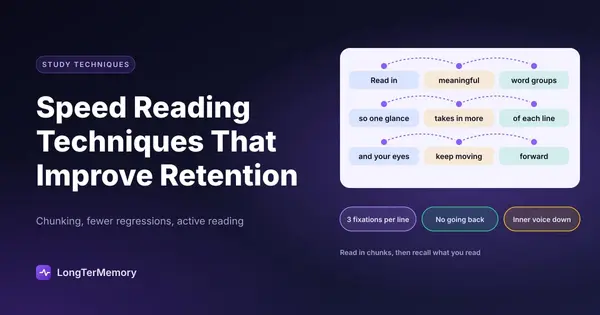
Efficient readers take in several words at once. Inefficient readers focus on one word at a time, making many small eye movements called saccades. Each saccade takes time and mental effort.
Chunking means training yourself to perceive groups of words in a single glance. Start by consciously reading two or three words at a time, then gradually expand to larger phrases. This is easier on a screen or with a guide, like a pen or your finger, that pulls your eyes forward at a consistent pace.
Using a pointer is one of the oldest and most effective speed reading techniques. It prevents regression, the habit of rereading words or sentences unnecessarily, and it sets a rhythm that keeps your eyes moving forward. Your pointer does not need to be fast. It just needs to be consistent.
Regression: The Habit That Slows You Down
Regression is when your eyes move backward to reread something. Some regression is necessary when you did not understand a sentence. But most regression is automatic and unnecessary. You reread not because you missed something, but because it feels safer.
To reduce unnecessary regression, use a pointer and commit to moving forward. Trust that if something is truly important, you will remember enough to return to it later. You can also use a card or piece of paper to cover the lines you have already read, physically preventing your eyes from moving back.
Another useful habit is to preview material before reading in detail. Skim the headings, subheadings, first sentences, and conclusion. This gives you a mental map, so you know what to expect and are less likely to get lost and regress.
Reading Faster in the Right Contexts
Speed reading techniques are not equally useful for all material. A dense legal text requires slower reading than a novel or a news article. A biology textbook chapter demands more attention than a syllabus.
The smart approach is to match your speed to the material and your purpose. Use faster techniques for previewing, finding specific information, or reviewing familiar content. Use slower, more deliberate reading for new, complex, or exam-critical material.
| Reading goal | Appropriate speed | Best technique |
|---|---|---|
| Previewing a chapter | Fast | Skim headings and first sentences |
| Finding a specific fact | Fast | Scan for keywords |
| Reviewing familiar material | Moderate to fast | Pointer pacing, chunking |
| Learning new complex concepts | Slow | Active reading with notes |
| Memorizing definitions | Slow | Active recall and spaced repetition |
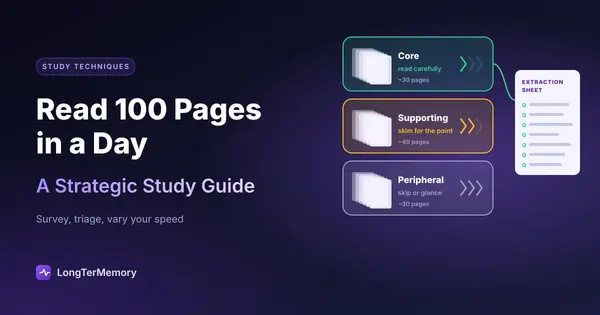
Flexibility is more valuable than a single top speed. If you need to process a large assignment under a hard deadline, our guide on how to read 100 pages in a day shows how to combine speed reading with selective triage so you don’t lose comprehension.
Active Reading: The Key to Retention
Reading speed is only useful if you remember what you read. The best way to improve retention is to read actively. This means asking questions, making predictions, connecting ideas to what you already know, and testing yourself.
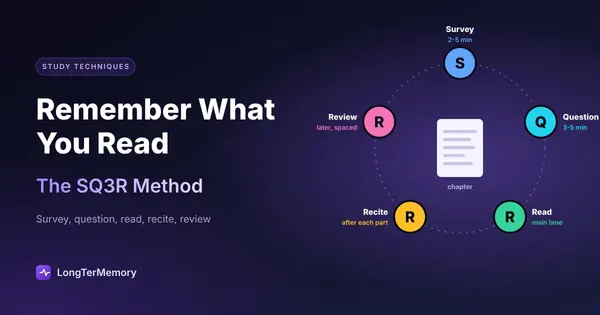
Before you read a section, ask what you expect to learn. While you read, ask how the new information relates to previous sections. After you read, close the book and summarize the main points from memory. This summary step is one of the highest-leverage techniques for retention.
Note-taking also helps, but only if you do it strategically. Avoid copying long passages. Instead, write questions, connections, and brief summaries in your own words. These notes become much better review material than highlighted text.
Combining Speed Reading With Spaced Repetition
Speed reading helps you cover material faster. Spaced repetition helps you remember it longer. Together, they make a powerful study system.
As you read, identify the facts, definitions, and concepts you need to remember. Turn them into flashcards or use a tool to generate them. Then review those cards on a spaced schedule. This way, the time you save by reading faster is invested in long-term retention rather than lost to forgetting.
If you are reading from PDFs, textbooks, or lecture notes, LongTerMemory can automatically generate question-and-answer cards from your material. You read efficiently, identify the key content, and let the system handle the review scheduling.
What to Avoid in Speed Reading
Be skeptical of any method that claims to let you read entire pages in a single glance. Techniques like rapid serial visual presentation, where words flash one at a time at high speed, often reduce comprehension without providing real speed benefits. They feel fast because the screen changes quickly, but your brain may not be processing the content.
Also avoid the trap of measuring speed without measuring comprehension. Reading 600 words per minute is only useful if you understand and remember the material. Test yourself periodically by summarizing what you read. If comprehension drops, slow down.
A Simple Speed Reading Practice Routine
If you want to read faster while retaining more, try this routine.
First, preview the material for two to five minutes. Read the title, headings, introduction, and conclusion. Note any bold terms, lists, or diagrams.
Second, set a timer and read at a pace slightly faster than your normal speed. Use a pointer or your finger to keep moving forward. Resist the urge to regress.
Third, after reading, spend five minutes writing a summary from memory. Include the main ideas, key terms, and any questions you still have.
Fourth, review your summary the next day and convert important facts into flashcards for spaced repetition.
Do this for twenty to thirty minutes a day, and you will gradually build both speed and retention.
How to Measure Your Progress
Improvement in reading speed is easy to track but easy to mismeasure. The number that matters is not how fast your eyes move. It is how much you understand and remember per minute of reading.
Once a week, pick a passage of moderate difficulty and time yourself while you read it normally. Immediately after, write a short summary or answer a few basic questions about the content. Divide your word count by the time in minutes to get your words-per-minute score, and grade your comprehension separately.
Over several weeks, you should see one of three patterns. Your speed may increase while comprehension stays the same. Your comprehension may increase at the same speed. Ideally, both improve together. If your speed goes up but comprehension drops, you have pushed too hard and need to slow down.
Tracking both numbers keeps you honest. It also shows you the real payoff of better reading habits, which is not a flashy number but more useful learning in less time.
The Bottom Line
You cannot become a super reader overnight, and you should not try. Real speed reading is about removing inefficiencies, matching your pace to the material, and combining faster reading with active learning techniques.
Reduce subvocalization when possible. Use a pointer to prevent regression. Read in chunks. Preview before diving in. And always test your comprehension so you are not just moving your eyes faster.
If you want to keep more of what you read, pair faster reading with spaced repetition. LongTerMemory can generate review cards from your reading material, so the facts you spend time learning actually stick. Speed is useful, but retention is what gets you through the exam.