How to Remember What You Read: The SQ3R Method
Master the SQ3R method to boost reading retention. Learn how survey, question, read, recite, and review transform passive reading into active memory.
Table of Contents
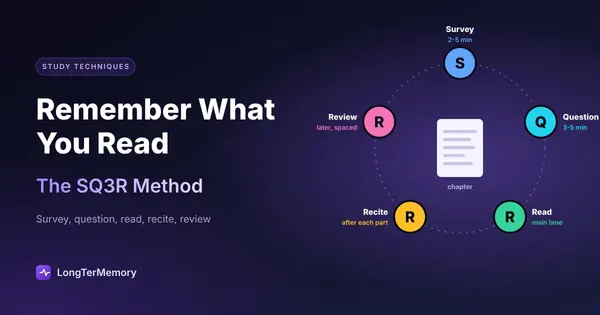
- Survey, Question, Read, Recite, Review: The Complete SQ3R Walkthrough
- Step 1: Survey
- Step 2: Question
- Step 3: Read
- Step 4: Recite
- Step 5: Review
- How SQ3R Eliminates Passive Reading and Forces Active Encoding
- The Role of Cognitive Effort
- Why Passive Reading Feels Better But Works Worse
- Active Encoding in Action
- Adapting SQ3R to Different Types of Texts and Reading Purposes
- Textbooks and Academic Papers
- Professional Reports and Non-Fiction Books
- Technical Documentation and Manuals
- Digital and Web Content
- Building a Sustainable SQ3R Habit
- The Bottom Line
You finish a chapter, close the book, and try to explain what you just learned. Your mind goes blank. You remember a few scattered terms, maybe a heading or two, but the actual content has already started to dissolve. This happens because most of us were never taught how to read for retention. We were taught how to read for comprehension in the moment, which is a completely different skill.
The SQ3R method fixes this. Developed by Francis P. Robinson at Ohio State University in 1941, SQ3R is one of the oldest and most validated active reading systems in existence. It stands for Survey, Question, Read, Recite, Review, and it transforms reading from a passive activity into a structured memory-building process. Students who use SQ3R consistently report retention improvements of 30 to 50 percent compared to passive re-reading, and research on active learning supports those numbers across multiple decades of study.
This post walks you through the complete SQ3R process, explains why it works at a cognitive level, and shows you how to adapt it to whatever you are reading, from dense textbooks to online articles.
Survey, Question, Read, Recite, Review: The Complete SQ3R Walkthrough
SQ3R is a five-step reading strategy that forces your brain to interact with text before, during, and after reading. Each step builds on the last, creating multiple encoding opportunities that passive reading simply cannot match. The method takes slightly more time than skimming, but the retention payoff is so large that most users actually save time by avoiding the repeated re-readings they would otherwise need.
Here is the complete walkthrough.
Step 1: Survey
Before you read a single paragraph, scan the entire chapter or section. Look at the title, the introduction, all headings and subheadings, any bold or italicized terms, summary paragraphs, and review questions at the end. If there are charts, diagrams, or images, look at those too. This should take two to five minutes, depending on the length of the material.
The purpose of the survey is not to understand everything. It is to build a mental framework, a kind of skeleton that the details will hang on when you read them. When your brain knows the overall structure in advance, it processes individual facts more efficiently because it knows where they fit. Cognitive psychologists call this advanced organization, and studies consistently show that readers who preview structure before diving into details comprehend and retain significantly more than those who start cold.
Think of it like assembling furniture. If you dump all the pieces on the floor and start attaching things randomly, you will make mistakes and have to backtrack. If you first look at the diagram and understand what the finished product should look like, every step makes more sense.
Step 2: Question
Turn every heading and subheading into a question. If the heading is “The Causes of the Great Depression,” your question becomes “What were the causes of the Great Depression?” If the heading is “Neural Plasticity in Adult Brains,” your question becomes “What is neural plasticity in adult brains, and how does it work?”
Write these questions down. You can put them in the margin, in a notebook, or on a digital document. The act of converting a statement into a question does something powerful: it shifts your brain from passive reception to active search mode. Instead of letting information wash over you, you are now hunting for specific answers.
Research on question-driven learning shows that readers who generate pre-questions before a section score 20 to 30 percent higher on retention tests than readers who simply read the same material without questions. The questions create what neuroscientists call “prediction errors,” small gaps between what you expect and what you find, and those gaps are exactly what trigger deeper encoding.
If a section does not have a clear heading, skim the first sentence or two and generate a question from that. There is always something to ask.
Step 3: Read
Now you read the section actively, looking for the answer to your pre-question. This is not the same as normal reading. Normal reading is linear: you start at the top and move to the bottom, accepting whatever the author gives you. SQ3R reading is targeted: you are reading to answer a specific question, which means you are constantly evaluating, connecting, and summarizing as you go.
Read one section at a time. Not a whole chapter, not a whole page if the page is dense, but one coherent chunk, usually a few paragraphs under a single subheading. After each chunk, stop. Do not keep scrolling. The stopping is essential, because it creates a natural boundary for the next step.
While reading, underline or highlight only sparingly, and only after you have finished the section. Most students highlight while they read, which leads to massive over-marking because everything seems important in the moment. If you wait until after you have read the section, your judgment about what matters is much sharper.
Step 4: Recite
Close the book or look away from the screen and answer your pre-question out loud or in writing. Do not paraphrase from memory while looking at the text. Actually cover the text. The recite step is where the real learning happens, and it is the step most people skip because it feels uncomfortable.
That discomfort is the point. When you struggle to recall an answer, your brain is forced to reconstruct the information from fragmented traces. That reconstruction process, difficult as it feels, is what builds durable memory. Research on retrieval practice demonstrates that the act of pulling information out of memory strengthens the memory far more than simply putting information in. A 2013 meta-analysis by Dunlosky and colleagues ranked retrieval practice as one of the two most effective learning techniques based on available evidence, with effect sizes roughly double those of passive re-reading.
If you cannot answer the question fully, that is valuable feedback. It tells you exactly what you did not encode, and you should re-read that specific passage before moving on. Then try the recite step again.
Some people prefer to write their answers. Others prefer to say them aloud. Both work, but writing tends to produce slightly better retention because it forces more complete and precise answers.
Step 5: Review
After you have worked through the entire chapter using the first four steps, go back and review all your questions and answers. Try to answer each question again without looking at your notes. This second retrieval attempt, spaced after the initial learning, produces another large retention boost.
The review step is also where you identify weak spots. If you cannot answer a question during review, that section needs another pass. Do not wait until the night before an exam to discover these gaps.
For maximum long-term retention, schedule additional reviews at expanding intervals: once after 24 hours, once after three days, once after a week. This pattern, known as spaced repetition, aligns with the brain’s natural forgetting curve and can increase long-term retention by 100 to 200 percent compared to cramming.
| Step | What You Do | Time Investment | Core Benefit |
|---|---|---|---|
| Survey | Scan headings, summaries, visuals | 2-5 minutes | Builds mental framework |
| Question | Turn headings into questions | 3-5 minutes | Activates search mode |
| Read | Read actively to find answers | Varies by text | Targeted comprehension |
| Recite | Answer questions without looking | 5-10 minutes per section | Triggers retrieval practice |
| Review | Re-answer all questions later | 10-15 minutes | Spaced consolidation |
How SQ3R Eliminates Passive Reading and Forces Active Encoding
Passive reading is the default mode for almost every untrained reader, and it is neurologically designed to fail. When you read passively, your eyes move across the text, your brain processes the words into meaning, and you feel like you understand. But that feeling, called the fluency illusion, is not memory. It is real-time comprehension, and it fades within hours unless you do something to convert it into long-term storage.
SQ3R breaks this pattern by inserting active encoding requirements at every stage.
The Role of Cognitive Effort
The survey step requires you to synthesize structure. The question step requires you to generate language. The read step requires targeted search. The recite step requires retrieval. The review step requires spaced reconstruction. Each of these demands effortful processing, and effortful processing is exactly what the brain needs to build durable memories.
This aligns with the levels of processing effect, first described by Craik and Lockhart in 1972. Their research showed that shallow processing, such as attending to the visual appearance of words, produces weak memories. Deep processing, such as thinking about meaning, generating examples, and asking questions, produces strong memories. SQ3R is essentially a systematic way to force deep processing on material that would otherwise receive only shallow attention.
Why Passive Reading Feels Better But Works Worse
There is a reason people prefer passive reading: it is smooth, fast, and comfortable. You cover more pages per hour, and covering pages feels like progress. But cognitive science has repeatedly shown that the learning strategies that feel easiest in the moment often produce the worst long-term results.
A famous 2009 study by Karpicke and Roediger had students learn material using different methods and then tested them later. Students who re-read the material multiple times predicted they would perform well. Students who practiced retrieval predicted they would perform poorly. But the actual test results were the opposite: the retrieval group dramatically outperformed the re-reading group. The students’ own intuitions about what worked were completely wrong.
SQ3R forces you to override that intuition. The recite step feels slower and harder than just turning the page, but it is where the memory is actually built.
Active Encoding in Action
Consider what happens neurologically during the recite step. When you try to recall information without the text in front of you, your prefrontal cortex coordinates a search through your hippocampus and neocortex for the relevant memory traces. If the search succeeds, the connection between those traces is strengthened through a process called long-term potentiation. If the search partially fails and you then check the text, the corrected memory is encoded more strongly than if you had never attempted retrieval at all. This is called the retrieval effort hypothesis, and it explains why difficult retrieval produces better learning than easy retrieval.
By embedding retrieval into the reading process itself, SQ3R turns every section into a mini memory-building event. Passive reading gives you one shot at encoding. SQ3R gives you three: during the initial read, during the recite step, and during the review step.
Adapting SQ3R to Different Types of Texts and Reading Purposes
SQ3R is flexible enough to work across almost any reading context, but the application changes depending on your goal and the material. A student reading a biology textbook uses the same five steps as a professional reading a market analysis, but the emphasis and speed shift significantly.
Textbooks and Academic Papers
This is SQ3R’s home territory. Textbooks are already structured with headings, subheadings, summaries, and review questions, which makes the survey and question steps extremely efficient. For academic papers, the abstract and section headings serve the same function.
When using SQ3R for textbooks, stick closely to the original method. Generate questions for every subheading, recite after every section, and do a full review at the end of the chapter. Academic papers can often be handled in larger chunks because they are shorter, but the recite step is still essential after each major section (Introduction, Methods, Results, Discussion).
Professional Reports and Non-Fiction Books
Business reports and narrative non-fiction do not always have clear subheadings that convert easily into questions. In these cases, use paragraph breaks as your natural stopping points. After every two to three paragraphs, pause and ask yourself: what is the main point here? What is the evidence? What is the conclusion?
For non-fiction books, you can also use chapter summaries or table-of-contents entries to generate your pre-questions. The goal is less about memorizing every fact and more about retaining the core argument and supporting evidence so you can discuss or apply it later.
Technical Documentation and Manuals
Technical documentation tends to be dense with procedures, parameters, and specific values. Here, SQ3R works best when combined with hands-on practice. Survey the documentation to understand the overall workflow, generate questions about each step, read to find the specifics, and then recite by actually performing the procedure rather than just describing it.
If you cannot perform the procedure immediately, write out the steps from memory and then compare your version to the documentation. The mismatch between what you remembered and what is correct tells you exactly what to focus on.
Digital and Web Content
Reading online comes with extra distractions, which makes the structure of SQ3R even more valuable. Before you start, use a tool like a reader mode or a PDF viewer to strip away ads and sidebars. Then apply SQ3R in compressed form: survey the page in 30 seconds, generate two to three questions based on the headings, read to answer them, and then recite by summarizing the article in one or two sentences before you close the tab.
If you are doing research across multiple sources, keep a running document with your SQ3R questions and answers for each source. This becomes a powerful review resource and prevents the common problem of forgetting which source said what.
| Text Type | Survey Focus | Question Strategy | Recite Method |
|---|---|---|---|
| Textbooks | Headings, summaries, review questions | Turn every subheading into a question | Write or speak answers after each section |
| Academic papers | Abstract, section headings, figures | Frame questions around hypotheses and findings | Summarize each section in your own words |
| Reports / non-fiction | Chapter titles, intro, conclusion | Ask about main arguments and evidence | State the core claim and three supporting points |
| Technical docs | Table of contents, workflow overviews | Ask about procedures and parameters | Perform the procedure or write the steps |
| Web articles | Headings, first sentences, conclusion | Generate 2-3 questions about key claims | Summarize in 1-2 sentences before closing |
Building a Sustainable SQ3R Habit
The biggest barrier to using SQ3R is not understanding it. It is remembering to use it while you are reading. Most of us have years of passive reading habit built in, and habits do not change overnight.
Start by applying SQ3R to just one reading session per day. Pick the most important material you need to retain, and commit to the full five steps for that material only. Once the process feels natural, expand it to other readings.
Use a timer to keep yourself honest. Set a timer for 15 minutes of reading, followed by 5 minutes of recitation. The time boundary prevents you from drifting back into passive mode and creates a rhythm that makes the method sustainable.
Keep your questions and answers in one dedicated place, either a physical notebook or a single digital document. This running log becomes a review resource and lets you track your progress over time.
If you find manual review scheduling difficult to maintain, consider using a tool that automates spaced repetition. LongTerMemory lets you upload PDFs, web content, or notes and automatically generates flashcards with spaced review schedules. You do the active reading with SQ3R, and the system handles the timing so you never miss an optimal review window. This combination of structured reading and automated repetition is one of the most efficient ways to build long-term knowledge with less total study time.
The Bottom Line
If you want to remember what you read, you need to stop treating reading as a single activity and start treating it as a multi-step process. The SQ3R method gives you that process. Survey to build structure. Question to activate your brain. Read with purpose. Recite to encode. Review to consolidate.
Each step is simple. None of them require special tools or unusual talent. But together, they transform reading from a passive activity where information passes through you into an active one where information sticks.
The next time you sit down with a textbook, an article, or a report, try SQ3R for just one section. Generate one question. Read to answer it. Close the book and recite. Notice how different it feels from your usual reading. That difference is not just a change in technique. It is the difference between consuming words and building memory.