How to Use the SQ3R Reading Method for Dense Textbooks
Master the SQ3R reading method to tackle dense textbooks with active engagement, better comprehension, and long-term retention.
Table of Contents
- What Is SQ3R?
- Step 1: Survey
- Step 2: Question
- Tips for Better Questions
- Step 3: Read
- Step 4: Recite
- What Good Recitation Looks Like
- Step 5: Review
- Applying SQ3R to Different Types of Dense Texts
- Scientific and Technical Textbooks
- Legal Texts and Case Books
- Certification Study Guides
- Why SQ3R Works: The Science
- SQ3R vs. Other Active Reading Strategies
- Making SQ3R a Consistent Habit
- The Bottom Line
If you’ve ever sat down with a thick textbook, read thirty pages, closed it, and thought “I have absolutely no idea what I just read,” you’re not alone. Dense academic texts are genuinely hard to process, and the default strategy most people use, which is to just read from the top of the page to the bottom, is one of the least effective ways to absorb complicated material.
There’s a structured alternative that has been taught in study skills courses for decades, and it works. It’s called SQ3R, and once you understand how each step works, you’ll never want to read a difficult textbook the old way again. If you need to apply SQ3R under a hard deadline, our guide on how to read 100 pages in a day compresses the same survey-and-recall logic into a single intense session.
What Is SQ3R?
SQ3R stands for Survey, Question, Read, Recite, Review. It was developed by educational psychologist Francis Pleasant Robinson in 1946 and published in his book Effective Study. The method was designed specifically to help students engage actively with dense academic text rather than passively absorbing it.
The basic idea is simple: instead of reading a chapter like a novel, you approach it as a series of structured activities that force your brain to engage with the material before, during, and after reading. Each stage builds on the previous one, and together they convert a passive reading session into something that resembles active recall practice.
Let’s go through each step in detail.
Step 1: Survey
Before you read a single word of the main text, you spend five to ten minutes surveying the chapter. This means:
- Reading the chapter title and any introduction or overview
- Scanning all the headings and subheadings
- Looking at any charts, diagrams, tables, or highlighted terms
- Reading the summary at the end if there is one
- Noting any bold or italicised vocabulary
This step sounds trivial, but it’s genuinely powerful. What you’re doing is building a mental map of the chapter before you encounter the details. Your brain now has a framework to attach information to, which dramatically improves how much you retain.
Think of it like looking at the picture on a jigsaw puzzle box before you start. The puzzle pieces still need to go together, but you have a target image to work toward. Without the survey step, you’re assembling a jigsaw with no reference picture.
The survey should take no more than ten minutes for most chapters. You’re not trying to understand anything yet. You’re just building structure.
Step 2: Question
Once you’ve surveyed the chapter, go back to the first heading and turn it into a question. Then do the same for each subsequent heading before you read that section.
For example:
- Heading: “The Role of Mitochondria in Cellular Energy Production”
- Your question: “What role do mitochondria play in producing cellular energy?”
Or:
- Heading: “Contract Formation in Common Law”
- Your question: “How is a contract formed under common law?”
Write these questions down if possible. They become your reading agenda. Instead of reading to get through the text, you’re now reading to find the answer to a specific question. This shift is enormous for comprehension and retention.
The question step activates curiosity, and curious brains encode information more effectively. There’s actual neuroscience behind this: when your brain anticipates an answer to a question, it releases dopamine upon finding that answer, which strengthens the memory trace. You’re essentially hacking your own reward system to make textbook reading more engaging.
Tips for Better Questions
- Use the classic interrogatives: what, why, how, when, who
- If a heading is vague, make the question more specific than the heading suggests
- Don’t overthink it. Spending thirty seconds per heading is enough
Step 3: Read
Now you actually read the section, but you’re reading with purpose. You’re looking for the answer to the question you just wrote down.
This is fundamentally different from passive reading. Your eyes are scanning for specific information. You’re actively matching what you read against the question in your head. When you find material that addresses your question, you slow down and engage with it carefully. When you’re reading material that doesn’t seem relevant to the question, you can move through it more quickly.
A few things to keep in mind during the reading phase:
- Don’t highlight indiscriminately. Highlighting feels productive but does very little for retention. If you must mark the text, use question marks for things you don’t understand, and circles or brackets for direct answers to your questions.
- Read one section at a time, not the whole chapter. The SQ3R method works section by section.
- Read slowly enough to understand, but don’t re-read paragraphs multiple times in the same sitting. If something doesn’t click, mark it and come back.
- Don’t stop to take long notes during this phase. That will come in the next step.
The reading phase is also when you’ll notice gaps between what you expected (from your question) and what the text actually covers. That gap is valuable information. It tells you either that you need to revise your question, or that the textbook covers the topic from an angle you hadn’t anticipated.
Step 4: Recite
After you finish reading a section, close or cover the book and recite the answer to your question from memory.
This is the most important step in the entire method, and it’s the one that most people skip because it feels awkward and hard. That’s exactly why it works.
Recitation is retrieval practice. When you try to recall what you just read without looking at the text, you’re performing the cognitive act that actually consolidates memory. Research consistently shows that a single retrieval attempt after reading is more effective for long-term retention than re-reading the same material two or three additional times.
You can recite out loud, write in your own words, or just think through it in your head. Writing is generally the most effective because it forces precision. Vague mental recall often masks incomplete understanding.
If you can’t remember the answer to your question, look back at the text, re-read the relevant section, then cover it again and try once more. This struggle-to-retrieve, then check-and-retry cycle is the engine of the SQ3R method.
What Good Recitation Looks Like
A good recitation answers your question in your own words, includes any key terms from the section, and briefly connects the concept to something you already know. You don’t need to reproduce the text verbatim. You need to demonstrate to yourself that you actually understand the content, not just that you read it.
Move to the next section only after you’ve successfully recited the answer to the current one.
Step 5: Review
Once you’ve worked through the entire chapter section by section using the Survey-Question-Read-Recite cycle, do a final review of the whole chapter.
This review typically takes ten to fifteen minutes and involves:
- Going back through your written questions
- Trying to answer each one without looking at your notes
- Checking your answers against the text or your notes where needed
- Paying special attention to questions you struggled with during the recite phase
The review step creates a second retrieval attempt across the full chapter, which is the beginning of spaced repetition even within a single study session. It also helps you see how the individual sections relate to each other, which deepens understanding beyond isolated facts.
If you can revisit your questions the following day and answer them again, you get a third retrieval attempt, and your retention will be dramatically better than if you’d simply read the chapter once.
Applying SQ3R to Different Types of Dense Texts
SQ3R was designed for academic textbooks, but it adapts well to other demanding reading contexts.
Scientific and Technical Textbooks
In STEM subjects, headings often describe processes or systems (“Mechanism of Action in Beta-Blockers,” “The Krebs Cycle and ATP Production”). Your questions for these sections should focus on mechanisms and sequences: “How does this process work, step by step?” Diagrams are particularly important to engage with during the survey step, because they often encode the same information as several pages of text.
During recitation, try to reconstruct diagrams or describe processes step by step in your own words. Being able to walk through a mechanism verbally is a strong indicator that you actually understand it.
Legal Texts and Case Books
Legal materials often present principles through cases, which means the text structure can be harder to survey. In law school reading, headings may be case names rather than conceptual topics. Turn case names into questions like “What rule did this case establish?” or “What was the court’s reasoning here?”
During recitation, a good legal review includes being able to state the holding, explain the reasoning, and distinguish the case from related cases. This maps directly onto what you’ll need to do in cold-calling and exam scenarios.
Certification Study Guides
Professional certification materials are often organized by competency domains, which makes them relatively SQ3R-friendly. Survey the domain structure first, then work through subsections with specific questions drawn from the official exam outline. Recitation should focus on being able to state definitions, distinguish between similar concepts, and apply principles to scenarios.
Why SQ3R Works: The Science
There are three main cognitive mechanisms behind SQ3R’s effectiveness.
1. Advance organizers. The survey step creates what psychologist David Ausubel called an “advance organizer,” a cognitive framework that makes new information easier to attach and remember. Without this framework, new facts float in isolation. With it, they connect to structure.
2. Purpose-driven reading. Turning headings into questions gives your reading a goal. Purposeful reading activates deeper processing than passive reading, because your brain is continuously monitoring whether the incoming text matches the target it’s looking for.
3. Retrieval practice. The recite and review steps are forms of active recall, which is the single most evidence-backed study technique in educational psychology. Multiple studies, including Roediger and Karpicke’s landmark 2006 research on the testing effect, demonstrate that testing yourself on material produces far better long-term retention than additional reading or review.
SQ3R vs. Other Active Reading Strategies
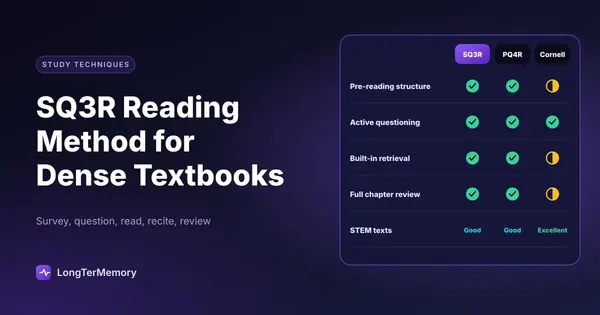
You might have encountered other reading frameworks. Here’s how SQ3R compares to two common alternatives.
| Feature | SQ3R | PQ4R | Cornell Notes |
|---|---|---|---|
| Pre-reading structure | Yes (Survey) | Yes (Preview) | Partial |
| Active questioning | Yes | Yes | Yes |
| Built-in retrieval | Yes (Recite) | Yes (Reflect) | Partial (cue column) |
| Full chapter review | Yes | Yes | Partial |
| Works for STEM texts | Good | Good | Excellent |
| Time investment | Medium | High | High |
SQ3R is slightly lighter than PQ4R (Preview, Question, Read, Reflect, Recite, Review) and more structured for dense readings than pure Cornell Notes. For most students, SQ3R is the right starting point because the five steps are concrete and the time investment is manageable.
Making SQ3R a Consistent Habit
The method requires more upfront effort than passive reading, and that can feel discouraging at first. Here’s how to build the habit without burning out.
Start with one chapter per session. Don’t try to SQ3R an entire textbook in one sitting. Pick one chapter, do the full five steps, and stop. Consistency over multiple sessions beats marathon sessions that erode your willingness to continue.
Keep your questions in a dedicated notebook or document. Over time, your list of questions becomes a complete self-testing resource for the subject. Before an exam, you can work through all your questions as a comprehensive review without re-reading the whole textbook.
Time each step. Survey: 5-10 minutes. Questions: 30 seconds per heading. Read: whatever the content requires. Recite: 2-3 minutes per section. Review: 10-15 minutes. Knowing the expected time for each step makes the method feel less open-ended and more manageable.
Pair SQ3R with a tool like LongTerMemory, which can automatically generate question-answer pairs from your uploaded materials. If you export your SQ3R questions into a spaced repetition system, you convert a one-time reading session into a long-term retention system. Your questions and their answers get reviewed at scientifically optimal intervals, so the knowledge stays accessible months after you first encountered it.
The Bottom Line
SQ3R turns passive reading into active learning. It’s not complicated, it doesn’t require special materials, and it’s been shown to work across subjects and levels of complexity. The five steps, Survey, Question, Read, Recite, Review, address every major failure mode of textbook reading: lack of context, aimless scanning, passive absorption, and immediate forgetting.
The students who consistently score well on exams covering dense textbook material tend to have one thing in common: they interact with the text. They ask questions of it, argue with it, and test themselves on it. SQ3R is a structured way to do exactly that, chapter by chapter, section by section, until the knowledge is genuinely yours.
The next time you open a textbook and feel that familiar anxiety about whether any of this is going to stick, start with the survey. Give yourself five minutes before you read a single word. You’ll be surprised how much it changes the experience.