How to Study With Chronic Fatigue or Chronic Illness
Practical, science-backed strategies for studying with chronic fatigue or illness: energy-based planning, short high-value sessions, and accommodations.
Most study advice is written for a body that cooperates. Wake up early, do a 90-minute deep work block, take a brisk walk, come back for another block. For readers with chronic fatigue syndrome, long COVID, fibromyalgia, autoimmune conditions, or any illness that taxes energy unpredictably, that advice is not just useless, it can be actively harmful. Pushing through is the exact behavior that triggers crashes in many energy-limiting conditions.
I want to offer something different: a way of thinking about studying that starts from the body you actually have, on the day you actually have it. As a neuroscientist, I will be honest about what cognition under fatigue can and cannot do, and as someone who has worked with many students managing illness, I will keep every suggestion grounded in what is realistic when your capacity fluctuates.
One note before we begin: nothing here is medical advice. Your condition, your doctor, and your own pattern of symptoms outrank anything in a blog post.
Why Standard Study Advice Fails Your Situation
Almost all mainstream productivity and study systems share a hidden assumption: that energy is stable and time is the scarce resource. Time-blocking, two-hour deep work sessions, “just show up every day”, all of it treats your capacity as a constant you can schedule against.
Chronic illness inverts that. For you, energy is the scarce resource and it does not arrive on a schedule. A plan that assumes Tuesday-you will have the same capacity as Friday-you is a plan that generates failure, guilt, and, for many conditions, symptom flares from overexertion. People with post-exertional malaise know this cycle intimately: a good day tempts you into overdoing it, which buys you three bad days, which puts you behind, which makes the next good day even more tempting to overload.
There is also a cognitive dimension that healthy study advice ignores. Fatigue and brain fog disproportionately impair executive functions: working memory, task switching, sustained attention, and the effortful retrieval of words and facts. What stays relatively robust is recognition, well-consolidated long-term memory, and simple, structured tasks. A good illness-adapted study system leans on what stays robust and protects what gets fragile.
Plan by Energy, Not by Time
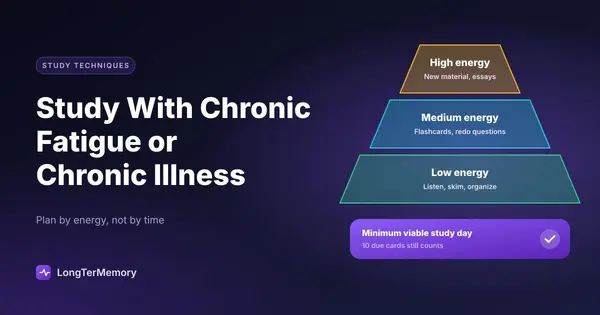
The single most useful shift is replacing time-based planning (“study 9 to 11”) with energy-based planning (“this is a 2-spoon task, and today I have about 5 spoons”).
If you know the spoon theory from chronic illness communities, this will feel familiar. The practical version for studying looks like this:
1. Sort your study tasks into energy tiers. Not all studying costs the same. A rough taxonomy:
| Energy tier | Cognitive load | Example tasks |
|---|---|---|
| High | Heavy executive function | Learning brand-new material, writing essays, hard problem sets |
| Medium | Moderate, structured | Reviewing flashcards, redoing practice questions, organizing notes |
| Low | Light, recognition-based | Listening to a familiar lecture recording, reading summaries, light re-reading |
2. Match the task to the day, in the moment. On a rare clear-headed day, spend it on high-tier work, learning genuinely new material, because that is what you cannot do foggy. On a bad day, drop to the low tier without renegotiating your self-worth. A bad-day session of 10 minutes of review is a complete success, not a diminished version of a real session.
3. Bank against the crash, not against the calendar. If your condition involves post-exertional symptoms, plan deliberately below your maximum. The old athletic advice to leave one rep in the tank applies doubly here: stopping while you still feel okay is how you protect tomorrow’s capacity. Progress that arrives slowly and steadily beats progress that arrives in bursts followed by week-long crashes, and it is not close.
This approach requires making peace with a planning horizon of hours rather than weeks. Your syllabus still needs long-range awareness, deadlines exist, but your daily execution should be decided by a two-minute morning check-in with your actual state, not by what a past, more optimistic version of you wrote in a planner.
Short-Session, High-Value Methods for Limited Capacity
Here is the genuinely good news, and it comes straight from the memory research: the most effective study techniques known to cognitive science happen to be the ones that work in short sessions.
The techniques with the largest evidence base, retrieval practice and spaced repetition, are not endurance activities. They are naturally granular:
- Retrieval practice means testing yourself rather than re-reading. A single flashcard is a complete unit of it. Five minutes of self-testing produces more durable memory than thirty minutes of passive review, which is exactly the trade you want when minutes of clear cognition are your scarcest asset.
- Spaced repetition distributes reviews over increasing intervals, which means the system is designed around many small sessions rather than few large ones. A schedule of 10 minutes daily fits fluctuating energy far better than a weekly 2-hour marathon, and it also produces better retention. The illness-friendly format is also the scientifically superior format. That is a rare and welcome alignment.
Some implementation details that matter more when you are sick:
Automate everything that is not learning. Building flashcards by hand is a medium-to-high energy task that produces zero retention by itself. This is precisely the kind of overhead worth deleting from your life. A tool like LongTerMemory lets you upload your course PDFs and notes and generates the question-answer pairs for you, then handles all the scheduling automatically. On a foggy day, you open it and it simply tells you what to review. No decisions, no setup cost, no executive function tax. For energy-limited students, removing the decision-making layer is not a convenience, it is the difference between studying and not studying.
Use recognition to warm up retrieval. On foggy days, pure recall can feel like grasping at smoke. It is legitimate to start a session with a lighter form: read a question, attempt the answer, and if nothing surfaces in ten seconds, reveal it and move on. Even failed retrieval attempts followed by feedback strengthen memory, the research on this is solid, so a foggy session still counts biologically, even when it feels unproductive.
Externalize your memory ruthlessly. Brain fog punishes anything you try to hold in working memory. Write down where you stopped, what confused you, and what comes next, every single session, in the same place. Your notes should let a stranger resume your studying, because on some days, the person resuming it will feel like a stranger to the person who left it.
Pair studying with your body’s rhythm, not the clock’s. Many chronic conditions have a daily symptom pattern, better mornings, or a mid-afternoon window. Track your fog for two weeks (a 1-to-5 rating three times a day is enough) and schedule your medium and high-tier work inside your statistical best window. This one adjustment often recovers more usable study time than any technique.
The Minimum Viable Study Day
Every illness-adapted system needs a floor: the smallest session that still counts as maintaining momentum. I suggest defining it explicitly, writing it down, and treating it as fully legitimate.
A reasonable minimum viable study day is: open your spaced repetition app, review whatever is due, stop. On many platforms that is 5 to 15 minutes, seated, in bed if needed. It requires no planning, no materials, no executive function beyond opening an app.
The purpose is not the volume, it is the continuity. Spaced repetition in particular rewards continuity disproportionately: daily contact with due cards keeps the review load small and the forgetting curves shallow, while a two-week gap lets a mountain of overdue reviews accumulate, which then greets you on your next attempt like a punishment for having been sick. Protecting the minimum day protects you from that mountain.
And on days when even the minimum is impossible: rest is not a study failure. It is treatment. The plan resumes when you do.
Accommodations and Resources You Are Entitled To
Now the part too many students skip out of pride, ignorance, or fear of being a burden: formal accommodations exist for exactly your situation, and using them is neither cheating nor weakness.
Depending on your country and institution, chronic illnesses, including energy-limiting conditions without visible symptoms, commonly qualify you for:
- Extended time on exams, or exams split across multiple sittings
- Flexible deadlines on coursework, negotiated in advance rather than begged for in crisis
- Reduced course loads while keeping full-time student status, which protects financial aid, insurance, and visas
- Lecture recordings, note-taking support, or priority access to materials
- Exam scheduling adjustments, like avoiding your known worst time of day
The route is usually the campus disability or accessibility services office, with documentation from your physician. Two pieces of practical advice from students who have walked this path: register with the disability office before you are in crisis, even if you never use the accommodations, because retroactive accommodations are far harder to arrange; and get everything in writing, because accommodations that live in a professor’s memory have a way of evaporating mid-semester.
For professional certifications, the major testing bodies (Pearson VUE, Prometric, and the certification boards themselves) all have formal accommodation request processes. They typically need weeks or months of lead time, so file early.
Beyond formal accommodations, remember the informal resources: sympathetic professors respond far better to a brief early conversation than to a mid-crisis email, and student communities for your specific condition often maintain hard-won advice about which local systems actually work.
Redefining What a Good Study Career Looks Like
I will end with the reframe I most want you to keep. Studying with chronic illness means your progress will look different: slower some months, nonlinear, assembled from ten-minute fragments instead of heroic library days. The neuroscience is genuinely on your side here, distributed, retrieval-based micro-sessions are not the consolation-prize version of studying. They are the evidence-based gold standard that healthy students should be using and mostly are not.
You are not doing a worse version of studying. You are doing the effective version, under harder conditions, which takes more discipline, not less. Build the system around your real energy, automate the overhead, protect your minimum day, take the accommodations you are entitled to, and let consistency do the compounding for you.