How to Stay Consistent With Studying During Holidays and Travel
Keep your study habit alive through holidays and travel with portable tools, minimal routines, and momentum-preserving strategies.
Table of Contents
- Why Study Habits Break Down During Time Off
- Designing a Minimal Holiday Study Routine That Preserves Momentum
- Portable Study Tools for Travel: Apps, Downloaded Content, and Offline Decks
- The Minimal Consistency Strategy: What to Protect When You Can't Do Everything
- How to Study Without Ruining Your Holiday
- Returning to Full Study After a Break
- Using LongTerMemory to Stay Consistent on the Go
- Common Holiday Study Mistakes
- Building a Study Identity That Survives Disruption
Holidays and travel are supposed to be breaks. They are also one of the most common times when study habits fall apart. After a few days away from your routine, it becomes harder to restart. A week off turns into two. By the time you sit down again, you have lost momentum, forgotten material, and convinced yourself that you will get back to it after the new year.
The good news is that you do not have to choose between enjoying your time off and protecting your progress. With a minimal, realistic plan, you can keep your study habit alive through holidays and travel without turning your vacation into a work trip.
Why Study Habits Break Down During Time Off
The biggest reason study habits collapse during breaks is that they are tied to a specific environment and schedule. Your normal study happens at your desk, after dinner, with your favorite coffee mug. When you leave that environment, the cues that trigger your habit disappear.
Travel adds extra friction. You might not have your books, your laptop, or reliable internet. Your sleep schedule changes. Family or friends expect your attention. Under these conditions, trying to maintain your full normal routine is unrealistic and often demoralizing.
The solution is to design a minimum viable study routine for time away. Something so small that it is almost impossible to skip. The goal is not to make massive progress during your break. The goal is to avoid losing the habit entirely.
Designing a Minimal Holiday Study Routine That Preserves Momentum
A minimal routine has three characteristics. It is short, it is portable, and it is scheduled in advance. If your normal study sessions are sixty minutes, your holiday version might be ten minutes. That is fine. Ten minutes every day beats zero minutes for a week.
The content of those ten minutes matters less than the fact that they happen. Good options include:
- Reviewing your spaced repetition flashcard deck.
- Reading one page of notes or one article.
- Listening to a study-related podcast during transit.
- Writing three sentences summarizing something you learned recently.
The key is to pick one anchor activity and commit to it. Do not try to do everything. One consistent action preserves momentum far better than an ambitious plan that fails on day two.
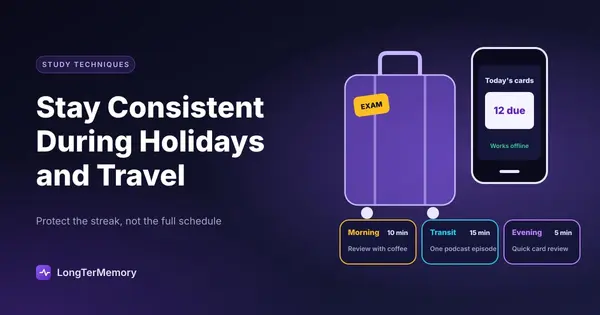
Here is an example of a minimal holiday routine:
| Time | Activity | Duration |
|---|---|---|
| Morning | Spaced repetition review while having coffee | 10 minutes |
| Transit | Listen to one educational podcast episode | 15-20 minutes |
| Evening | Quick journal note or flashcard review | 5 minutes |
This routine is intentionally light. It keeps the habit warm without competing with your vacation.
Portable Study Tools for Travel: Apps, Downloaded Content, and Offline Decks
The right tools make holiday studying much easier. Before you leave, prepare your study materials so they work without internet.
Download podcasts, videos, or articles to your phone. Many learning apps allow offline access if you sync content ahead of time. If you use a spaced repetition app, make sure your deck is synced and available offline.
A small physical notebook can also be surprisingly useful. It does not need charging, it works on planes, and writing by hand can improve memory. Keep it in your bag so study is always possible.
| Tool Type | Best For | Offline? |
|---|---|---|
| Spaced repetition app | Daily review | Yes, if synced |
| E-reader or tablet | Reading textbooks and articles | Yes, if downloaded |
| Podcast app | Passive learning during transit | Yes, if downloaded |
| Physical notebook | Notes, summaries, journaling | Always |
| Flashcard printouts | Quick offline quizzing | Always |
The goal is to remove friction. If studying requires you to hunt for Wi-Fi or unpack a heavy bag, you probably will not do it.
The Minimal Consistency Strategy: What to Protect When You Can’t Do Everything
When your schedule falls apart, protect the highest-leverage activity first. For most learners, that is spaced repetition review. It takes the least time, it prevents forgetting, and it keeps your study identity active.
If you can only do one thing, do your flashcard review. If you can do two things, add a short reading or listening session. If you can do three, add some form of active production like writing or speaking practice.
This hierarchy helps you make good decisions under limited time and energy. It also reduces guilt. You do not need to do everything. You just need to do enough to keep the habit alive.
How to Study Without Ruining Your Holiday
Study should not dominate your break. The point of time off is recovery, and recovery is valuable for long-term performance. If you try to study full hours while traveling, you will probably resent it and burn out.
Instead, attach study to natural gaps. Review flashcards while waiting for coffee. Listen to a podcast on the train. Read for ten minutes before bed. These micro-sessions add up without stealing time from the people and experiences that matter.
It also helps to communicate your plan. If your family knows you will do a short review each morning, they are less likely to interrupt or pressure you. A small, visible commitment is easier to maintain than a hidden one.
Returning to Full Study After a Break
The real danger of holidays is not the days you study less. It is the difficulty of restarting. To make the transition easier, plan your first full study session before the break ends.
Pick a specific time and place for your first session back. Decide in advance what you will study. Having a plan removes the decision fatigue that often prevents restarting. Even a simple plan like “Tuesday evening, desk, review flashcards and do one practice test section” is enough.
When you return, do not try to catch up on everything at once. Resume your normal routine gradually. If you missed a week, you do not need to double your study time to compensate. Just get back on schedule and trust that consistency will rebuild your momentum.
Using LongTerMemory to Stay Consistent on the Go
One of the biggest advantages of digital spaced repetition tools is portability. LongTerMemory works across devices, so your study deck travels with you. Whether you have five minutes at an airport or ten minutes before a family dinner, you can review cards that are scheduled for that day.
Because LongTerMemory generates cards from your own materials, the review content is always relevant to what you are actually studying. You are not stuck with generic decks. You are reviewing your notes, your textbook chapters, and your weak areas, even while you are away from home.
If consistency is your goal during holidays and travel, a tool that makes review easy and automatic is one of the best investments you can make.
Common Holiday Study Mistakes
The first mistake is the all-or-nothing mindset. People either try to study full hours and fail, or they abandon studying completely. The middle path, a minimal daily habit, is almost always better.
The second mistake is not preparing materials in advance. If you wait until you are traveling to figure out what to study, you will not study. Download, sync, and pack your materials before you leave.
The third mistake is guilt. Feeling bad about studying less does not help you study more. A lighter routine during a holiday is not a failure. It is a sustainable way to protect long-term progress.
Building a Study Identity That Survives Disruption
The ultimate goal is to become someone who studies consistently, not someone who studies only when conditions are perfect. That identity is built through small actions repeated over time, including during imperfect periods.
Holidays and travel are actually great opportunities to strengthen that identity. If you can study for ten minutes in an airport, you prove to yourself that the habit is real. If you can review flashcards at a family gathering, you show that learning is part of who you are, not just something you do at a desk.
Keep your routine small, keep your tools portable, and keep your expectations realistic. The students and professionals who succeed over the long term are not the ones who never take breaks. They are the ones who know how to take breaks without losing themselves.
If you want to make holiday and travel study effortless, try LongTerMemory. It keeps your review schedule running automatically, works on your phone, and turns your study materials into portable flashcards. That way, no matter where you are, your learning keeps moving forward.