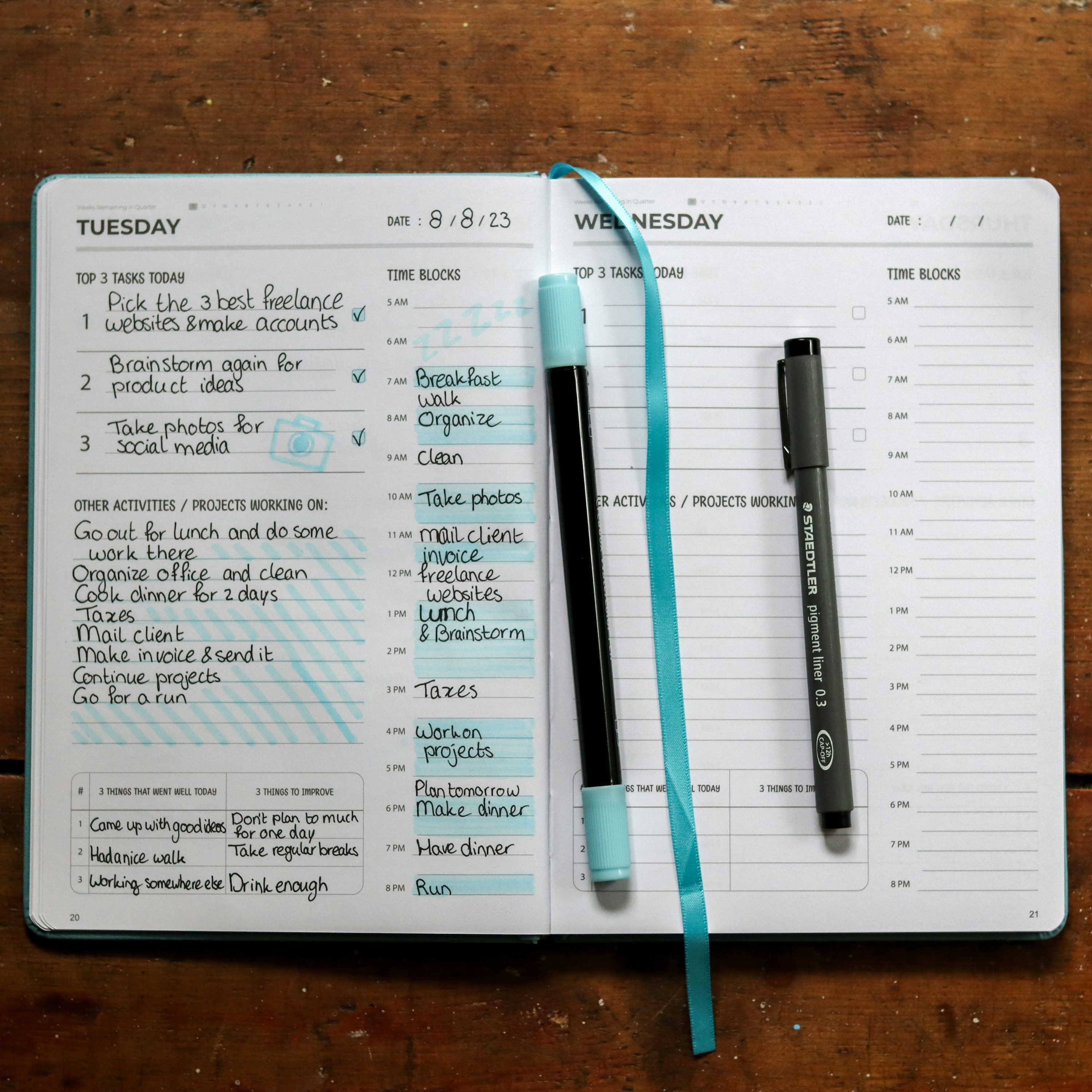

Most study schedules fail before the end of week one. Not because the person making them is lazy or undisciplined, but because they were built on guesswork rather than any understanding of how the brain actually works under load. You block out “study time,” sit down at the designated hour, stare at the material, grind through some of it, feel vaguely productive, and then wonder weeks later why so little of it stuck.
The problem usually isn’t the number of hours. It’s the shape of those hours , when they happen, how long each stretch runs, what goes in them, and how much recovery sits between them. Get that right, and the same amount of time produces dramatically better results. Get it wrong, and more hours don’t help. They might actively make things worse.
Here’s what the research actually says about building a study schedule that works.
Your Brain Has Its Own Clock, and Ignoring It Is Expensive
There’s a concept in chronobiology called the ultradian rhythm , a biological cycle your brain runs through roughly every 90 minutes throughout the day. During the high phase of each cycle, your capacity for focused cognitive work is near its peak. During the low phase, it drops significantly, and trying to push through it doesn’t produce full-quality focus , it produces a fatigued simulation of focus that encodes information poorly and costs more energy than it’s worth.
The practical implication is that your effective study sessions shouldn’t run much longer than 90 minutes before a real break. Not a “glance at my phone for two minutes” break. A genuine mental rest , get up, move around, let your mind wander, do something that doesn’t require concentrated thought. Twenty minutes is roughly what it takes to complete the recovery phase and set up the next high-performance window. Fighting through the low phase instead is like running a car without oil , it keeps moving for a while, but it’s degrading the engine.
Beyond the 90-minute cycles, there’s the bigger question of what time of day you’re sharpest. People vary enormously here, and the research on chronotypes is pretty clear: trying to conform to a study schedule that fights your natural alertness pattern is a losing battle. Morning larks genuinely hit their cognitive peak in the first half of the day. Night owls genuinely hit theirs in the evening. Forcing an owl to do their hardest work at 7am, or a lark to grind through complex problem sets at 10pm, produces measurably worse results than letting each type work during their actual peak window.
If you don’t know which you are, spend a week noticing when your thinking feels sharpest and most effortless , when new material clicks easily, when problems feel tractable, when you’re not fighting your own brain to concentrate. That’s your window. Build your hardest sessions there.
The Single Most Important Scheduling Insight: Spacing Beats Cramming. Every Time.
This is the finding that most dramatically separates effective study schedules from ineffective ones, and yet it’s the one that most people never operationalize.
The spacing effect , one of the most replicated findings in all of cognitive psychology , tells us that spreading study sessions out over time produces dramatically better long-term retention than concentrating the same amount of study time into fewer, longer sessions. The same three hours of study, distributed differently, produces wildly different outcomes:
| Study Pattern | Retention After 1 Week |
|---|---|
| 3 hours in one session | 20% |
| 1 hour × 3 sessions | 65% |
| 30 min × 6 sessions | 85% |
Look at that table again. Six half-hour sessions spread across a week produces more than four times the retention of a single three-hour marathon. Same total time. Completely different outcome.
The reason comes down to how memory consolidation works. Each time you return to material after a gap, you’re forcing your brain to retrieve it , which strengthens the memory trace , and then re-encoding it in a slightly different context, which deepens the neural connections. Cramming all your study into one session means encoding once, deeply, but with no subsequent retrieval practice. The memories form but then decay rapidly because they’ve never been exercised.
The rule of thumb that falls out of this research: any material worth knowing should be revisited at least three times, with meaningful gaps between each encounter. That’s not optional if long-term retention is the goal.
Building the Schedule: Actually Doing It
Theory is useful. Here’s how to translate it into something you can actually use next week.
Start with an Honest Audit
Before you design anything new, spend one week just watching what you actually do. Not what you intend to do , what you do. Track when you sit down to study, how long each session actually runs, when you get distracted, when you feel sharp, when you feel like you’re grinding through mud. Rate your energy on a simple 1-10 scale at different points in the day.
This isn’t about judging yourself. It’s about data. The schedule you build needs to fit your actual life, not an idealized version of it. Knowing that you’re always mentally fried after your afternoon class, or that you consistently get your best focus from 8 to 10am, is information you can design around. Ignoring it means designing a schedule that looks good on paper and collapses in reality.
Get Specific About What You’re Actually Trying to Learn
Vague goals produce vague schedules that produce vague results. “Study for the exam” is not a goal , it’s a category. “Work through practice problems from chapters 4-7, focusing on the problem types I got wrong last time” is a goal. It has a shape you can fit into a time slot.
Before each week’s schedule gets made, the week’s specific learning objectives should be named. What chapters, what problems, what vocabulary sets, what skills? Only when you know what goes into the time blocks can you know how many blocks you actually need and what difficulty level to expect.
Estimate Time Realistically , Then Add Overhead
Here’s a formula that’s actually useful for estimating how long something will take to learn properly:
Total Time = Content Hours × Difficulty MultiplierWhere the difficulty multiplier runs roughly:
- Familiar, straightforward material: 1.0×
- Moderately challenging material: 1.5×
- Difficult, new conceptual territory: 2.0×
- Very difficult, highly abstract or technical: 3.0×
So ten hours of genuinely difficult content , something like organic chemistry mechanisms or a new programming language , realistically needs around 20 hours of study time to get through properly, not 10. Building a schedule around the 10-hour estimate guarantees either rushing and shallow learning, or blowing the timeline and feeling like you’ve failed.
Most people systematically underestimate how long difficult learning takes. Building the multiplier in from the start means your schedule is honest, and honest schedules are ones you can actually stick to.
The 50/10 Structure
Once you know what you’re learning and roughly how long it’ll take, the question is how to structure individual sessions. The research-backed sweet spot for most people is 50 minutes of focused study followed by 10 minutes of genuine rest.
Fifty minutes is long enough to get into a real flow with material, short enough that you’re not fighting biological fatigue cycles, and it creates natural check-in points to assess whether you’re actually making progress. The 10-minute break should be a real break , not checking messages about the subject you’re studying, not organizing your notes, just stepping away from the work mentally.
Here’s what a solid study day looks like built on this structure:
7:00 AM , Study Session 1 (50 min)
7:50 AM , Break (10 min)
8:00 AM , Study Session 2 (50 min)
8:50 AM , Long break / classes / other commitments
1:00 PM , Study Session 3 (50 min)
1:50 PM , Break (10 min)
2:00 PM , Study Session 4 (50 min)
2:50 PM , Long break
7:00 PM , Study Session 5 (50 min)
7:50 PM , Break (10 min)
8:00 PM , Review/active recall (50 min)
9:00 PM , Wind down
10:00 PM , Sleep
That’s just over four hours of actual focused study, spread across the day in a way that respects how attention and energy work. It’s also sustainable , you could run this schedule for weeks without burning out, which a six-hour marathon session schedule absolutely cannot claim.
The Strategies That Separate Good Schedules from Great Ones
Once the basic structure is in place, a few principles consistently separate people who make genuine progress from people who stay busy but don’t improve as fast.
Interleave Your Subjects
The instinct is to block-study , spend all of Monday on math, all of Tuesday on history, all of Wednesday on chemistry. It feels organized. It feels like you’re giving each subject proper attention before moving on.
The research says it’s actually worse for retention and problem-solving than mixing subjects within the same study period.
Instead of:
- 3 hours of math, then 3 hours of history, then 3 hours of science
Try:
- 50 min math → 50 min history → 50 min science → repeat
This is called interleaving, and studies have found it improves long-term performance by around 43% compared to blocked study, particularly for problem-solving subjects. The likely reason is that switching between subjects forces your brain to load and reload different knowledge frameworks, which strengthens each one and also helps you understand when to apply which approach , a skill that blocked practice never develops.
It feels harder while you’re doing it, which is actually part of why it works. That slight cognitive friction of having to re-orient with each switch is desirable difficulty , evidence that deeper processing is happening.
The 2-Day Rule
Simple and effective: never let more than two days pass without touching a subject you’re actively trying to learn. Memory decay accelerates sharply when material sits untouched. Maintaining a minimum contact frequency , even a fifteen-minute review session , keeps the forgetting curve from resetting and means you spend less time re-learning things you’d already acquired.
Match Task Difficulty to Energy Level
Not all study is the same, and not all hours of the day are equivalent. Scheduling new, complex material during your peak energy window and saving lighter review work for low-energy periods is one of the easiest schedule optimizations you can make. It sounds obvious, but most people do the opposite , they tackle the easy stuff first to warm up and leave the hard stuff for later, by which point they’re tired and making poor cognitive decisions.
Hard things when you’re sharp. Review and practice when you’re not. Keep that principle consistent and you get noticeably more out of the same hours.
Build In the Review Cascade
This is the scheduling move that most directly translates the spacing effect into practice. Rather than just adding new material to every session, build a layered review structure:
| Review Level | When | How Long |
|---|---|---|
| Immediate | End of each session | 5 minutes |
| Daily | First session of the next day | 10 minutes |
| Weekly | Saturday or Sunday session | 30 minutes |
| Monthly | End of month | 1 hour |
The five-minute immediate review at the end of each session is especially underrated. Just closing your notes and trying to recall the main points you covered , without looking , costs almost nothing and dramatically improves how much of that session’s content makes it into the consolidation process that night.
When Life Gets in the Way
Real schedules have to survive real lives. A few adjustments for common constraints:
When your schedule is genuinely packed: The minimum effective dose for learning a subject is around 25 focused minutes, three times a week. Less than that and you’re mostly fighting the forgetting curve rather than making progress. That’s actually quite achievable even in a busy week , commute time, lunch breaks, and morning half-hours add up. Twenty-five minutes of genuine active recall beats an hour of tired re-reading every time.
When you’re juggling multiple subjects: A rotation helps prevent any single subject from going cold. Something like:
Monday: Math, History
Tuesday: Science, English
Wednesday: Math, Science
Thursday: History, English
Friday: Review all
Every subject gets touched at least twice a week, nothing waits more than two days, and Friday’s review session gives you a week-end consolidation pass across everything.
When you keep skipping sessions: The bottleneck is usually activation energy, not actual lack of time. The 5-Minute Rule is genuinely useful here: commit only to sitting down and studying for five minutes. That’s the entire commitment. What almost always happens is that once you’re in the material, the resistance evaporates and you keep going. The hard part is always starting, and five minutes is a threshold low enough to bypass most of the resistance that kills consistency.
More structurally, implementation intentions , the research term for specific if-then plans , increase follow-through by two to three times compared to vague intentions. “I’ll study Spanish this week” is a vague intention. “I will study Spanish vocabulary for 30 minutes in my kitchen at 7:30pm on Monday, Wednesday, and Friday” is an implementation intention. The specificity of time, place, and duration makes the behavior far more likely to actually happen.
The Mistake That Kills Most Schedules
Over-scheduling. It is by far the most common error, and it’s worth dwelling on.
A schedule that accounts for every available hour feels ambitious and productive when you’re building it on Sunday afternoon. By Wednesday it’s fallen apart because something took longer than expected, or you had a bad night’s sleep, or an unexpected obligation appeared, and suddenly you’re “behind” , and being behind on a schedule with no slack means either panic or giving up entirely.
Build buffer into any schedule you actually intend to keep. Roughly 20% of your allocated study time should be unscheduled , reserved for overflow, catch-up, or simply not showing up so that when you do use it, it feels like a bonus rather than mandatory. A schedule you follow 80% of the time because it has breathing room beats a schedule you follow for six days and then abandon because it’s too rigid to survive contact with reality.
Checking Whether It’s Working
A weekly review , ten or fifteen minutes, same time each week , is what separates a study schedule that improves over time from one that just repeats its failures indefinitely. Ask yourself honestly: What actually got done this week? Where did sessions get skipped or cut short? Are test scores or practice results moving in the right direction? What does next week need to look like given what you learned?
The schedule is a hypothesis, not a contract. Your job is to test it, notice what the results tell you, and adjust. The people who learn fastest aren’t the ones who found a perfect schedule and followed it , they’re the ones who iterated quickly, stayed honest about what was and wasn’t working, and kept refining. The schedule that’s working for you in month three is going to look pretty different from the one you started with, and that’s exactly how it should be.