How to Study for Multiple Choice Exams Strategically
Master multiple choice exams with strategic study techniques, elimination methods, and practice approaches built specifically for MCQ success.
Table of Contents
- How MCQ Tests Differ from Short-Answer and Essay Exams
- Recognition vs. Recall
- Fine-Grained Distinctions
- Speed and Coverage
- Elimination Strategies and Avoiding Common Multiple Choice Traps
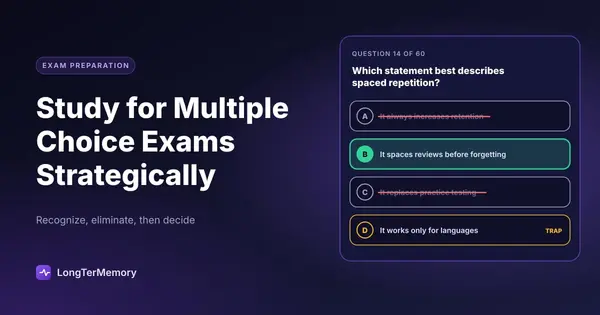
- The Absolute Language Trap
- The Familiarity Trap
- The Partial Truth Trap
- The Opposite Trap
- Systematic Elimination
- Practice Approaches That Build MCQ Performance Specifically
- Write Your Own Multiple Choice Questions
- Practice Under Timed Conditions
- Build an Error Log
- Interleave Topics
- Simulate Exam Conditions
- Using Technology to Speed Up MCQ Practice
- The Bottom Line
Multiple choice exams are deceptive. They look easier than essay tests because the answer is right there on the page. You just have to pick it. But anyone who has sat through a tough multiple choice exam knows that recognizing the correct answer and reasoning your way to it are two completely different skills. The wrong answers are carefully designed to be plausible. The questions are written to test subtle distinctions. And the time pressure is real.
Studying for multiple choice exams requires a different approach than studying for essays or short-answer tests. You need to prepare not just for knowing the material, but for navigating the specific traps and patterns that multiple choice questions use. This guide will show you exactly how to do that.
How MCQ Tests Differ from Short-Answer and Essay Exams
The first step to strategic MCQ preparation is understanding what multiple choice exams actually test. They are not just simplified versions of other exam types. They assess specific cognitive skills that essays and short answers do not.
Recognition vs. Recall
Essay exams require recall. You see a question, and you generate an answer from memory. Multiple choice exams require recognition. You see a question and four or five possible answers, and you must recognize which one is correct. This sounds easier, and in some ways it is, but it also means that partial knowledge can work against you. A student who vaguely remembers a concept might see an answer choice that looks familiar and select it, even if it is wrong. The familiarity creates a false sense of confidence.
Fine-Grained Distinctions
Multiple choice questions often test the difference between two closely related concepts. An essay might accept a broadly correct explanation. A multiple choice question might force you to choose between two explanations that are both mostly right, but one is more precise. This means your study preparation needs to focus on precision, definitions, and boundary cases.
Speed and Coverage
Multiple choice exams typically cover more material in less time than essay exams. You might have 90 seconds per question instead of 20 minutes per essay. This means breadth of knowledge matters as much as depth. You need to be familiar with a wide range of topics, even if your understanding of each one is not exhaustive.
| Exam Type | Primary Skill | Time Pressure | Knowledge Depth | Risk of Guessing |
|---|---|---|---|---|
| Essay | Recall and synthesis | Lower | Deep | Low |
| Short Answer | Targeted recall | Medium | Medium | Medium |
| Multiple Choice | Recognition and precision | High | Broad | High |
Elimination Strategies and Avoiding Common Multiple Choice Traps
The people who write multiple choice exams are not trying to trick you maliciously, but they are definitely trying to test whether your knowledge is solid or superficial. Understanding the common traps makes you much harder to fool.
The Absolute Language Trap
Be extremely suspicious of answer choices that use absolute words like “always,” “never,” “all,” or “none.” In most academic subjects, there are exceptions to almost every rule. An answer that says, “Mitosis always produces identical daughter cells,” might sound right, but if there is even one exception in the curriculum, that answer is wrong. Correct answers tend to use qualified language: “usually,” “most often,” “typically.”
The Familiarity Trap
The wrong answer that contains words or phrases you recognize from your notes is often the most dangerous. Your brain latches onto familiarity and interprets it as correctness. A good test writer knows this and deliberately includes wrong answers that use the same terminology as the textbook. The correct answer might be phrased differently or require you to apply the concept rather than just recognize the vocabulary.
The Partial Truth Trap
Some wrong answers are partially correct. They contain accurate information, but they do not fully answer the question. For example, a question might ask, “What is the primary function of the mitochondria?” One answer might say, “They are involved in energy production.” That is true, but another answer might say, “They produce ATP through cellular respiration.” The second answer is more complete and more precise. In multiple choice exams, the most complete correct answer is usually the right one.
The Opposite Trap
Sometimes the correct answer is the one that seems counterintuitive. If three answers point in one direction and one points in the opposite direction, do not automatically assume the majority is right. Test writers know that students tend to follow the crowd, so they sometimes make the outlier the correct answer.
Systematic Elimination
The best defense against all these traps is systematic elimination. Read the question carefully. Then read every answer choice before selecting one. Cross out answers you know are wrong. For the remaining options, ask yourself: “Which answer is the most complete, most precise, and best supported by what I know?” If you are stuck between two, look for absolute language, partial truths, or familiarity cues that might be misleading you.
Practice Approaches That Build MCQ Performance Specifically
Knowing the traps is useful, but the real improvement comes from deliberate practice. Here are study techniques that build the exact skills multiple choice exams require.
Write Your Own Multiple Choice Questions
This is one of the most effective techniques for MCQ preparation. After studying a topic, write three to five multiple choice questions about it. Force yourself to create plausible wrong answers. This exercise makes you think like a test writer. You have to identify the common misconceptions, the partially correct answers, and the precise definitions that separate right from wrong. The process of writing the question often teaches you more than answering one.
Practice Under Timed Conditions
Multiple choice exams are as much about speed as they are about knowledge. If you only practice untimed, you never build the decision-making speed you need under pressure. Use a timer when you do practice tests. Aim to answer each question in roughly the same amount of time you will have on the real exam. If you are stuck on a question for more than a minute, mark it and move on. You can come back if you have time, but you do not want to sacrifice five easy questions for one hard one.
Build an Error Log
Every time you get a practice question wrong, write down four things:
- The topic the question tested.
- Why you chose the wrong answer.
- Why the correct answer is right.
- What you will do differently next time.
Review this error log every few days. You will start to see patterns. Maybe you consistently fall for the absolute language trap. Maybe you rush through questions and misread key terms. Maybe you are weak on a specific topic. The error log turns random mistakes into actionable intelligence.
Interleave Topics
Do not practice one topic for an hour and then move to the next. Mix questions from different topics in the same session. This is called interleaving, and research shows it improves your ability to identify which concept applies to which question. On the real exam, the questions will not be grouped by topic. You need to be able to switch mental gears quickly.
Simulate Exam Conditions
At least once before the real exam, do a full practice test under conditions that mimic the actual test. Same time limit, same number of questions, same environment if possible. No phone, no notes, no snacks. This builds mental stamina and reduces anxiety on exam day because the experience feels familiar.
Using Technology to Speed Up MCQ Practice
Creating enough practice multiple choice questions by hand is time-consuming. Many students simply do not have access to enough high-quality practice material. This is where AI-powered study tools can fill the gap.
LongTerMemory can take your PDF notes, textbook chapters, or lecture slides and automatically generate multiple choice questions based on the content. These are not generic questions pulled from the internet. They are specific to your material, which means they test the exact concepts your professor cares about. You can use these questions for daily practice, timed drills, and error log building.
The platform also tracks which questions you get wrong and schedules review of those concepts using spaced repetition. Instead of randomly re-reading chapters, you focus your time on the exact topics where your MCQ performance is weakest. For students preparing for certification exams, standardized tests, or any course with a heavy multiple choice component, this targeted approach is dramatically more efficient than generic study guides. Try LongTerMemory free and start building your MCQ skills with questions generated directly from your own study materials.
The Bottom Line
Multiple choice exams reward a specific combination of broad knowledge, precise understanding, and test-taking discipline. You cannot just know the material. You have to know how to navigate the format. Study with precision, practice under timed conditions, build an error log, and learn to spot the common traps. The students who ace multiple choice exams are not luckier than everyone else. They are more prepared for the specific challenges the format presents.