How to Prepare for a Technical Interview at a Tech Company
Complete guide to technical interview prep for tech companies: algorithms, system design, behavioral questions, and effective study strategies.
Table of Contents
- Understanding What Technical Interviews Actually Test
- The Coding Interview
- The System Design Interview
- The Behavioral Interview
- Data Structures and Algorithms: The Core Technical Interview Curriculum
- The Essential Data Structures
- The Essential Algorithm Patterns
- Leetcode Strategy: How to Practice Effectively Without Grinding Randomly
- Topic-by-Topic, Not Random
- The Right Volume Per Problem
- The Target Problem Set
- Mock Interviews
- Behavioral Interview Prep Alongside Technical Study
- The STAR Format
- Company-Specific Values
- What to Do in the Room When Your Brain Goes Blank
- One More Thing: Start Before You Feel Ready
Technical interviews are their own genre of challenge. They are not quite like anything else you will encounter in your professional life. You sit across from one or two engineers, someone hands you a problem you have probably never seen before, and you are expected to think out loud, write working code, analyze its efficiency, and do it all in 45 minutes while being observed. Oh, and also be friendly and collaborative.
No wonder most people find them terrifying.
The thing is, technical interviews are learnable. They test a specific, defined body of knowledge using a specific set of problem patterns, and people who prepare systematically, with the right approach, dramatically improve their performance. This guide covers how to actually do that, from what to study, to how to practice, to what to do in the room when your brain goes blank.
Understanding What Technical Interviews Actually Test
Before you can prepare effectively, you need to understand what you are preparing for. The technical interview process at most software companies follows a fairly consistent structure, even if the specific questions vary.
The Coding Interview
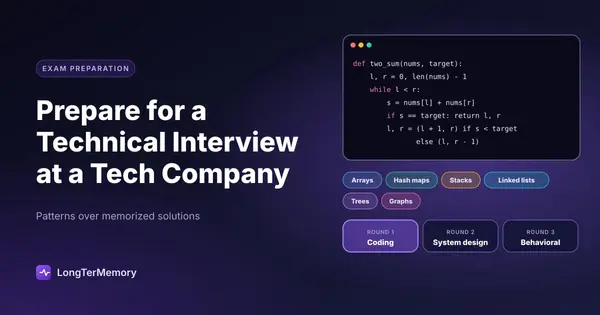
This is the core of the technical interview process. You will be given a problem, typically a data structures and algorithms problem, and asked to solve it, usually on a whiteboard or in an online coding environment. The interviewer is evaluating:
- Can you understand and clarify the problem?
- Can you develop a working approach?
- Can you code that approach correctly?
- Can you analyze the time and space complexity?
- Can you identify and handle edge cases?
The last three are what most people focus on. The first two are often where interviews are won or lost.
The System Design Interview
More senior roles and final-round interviews often include a system design component. You will be asked to design a system, something like “design a URL shortener” or “design a real-time messaging service.” These interviews test your ability to think at scale, make engineering tradeoffs, and communicate architectural decisions. They matter a lot for mid-level and senior candidates.
The Behavioral Interview
Every company, including the most technical ones, will ask behavioral questions. “Tell me about a time you disagreed with a team member.” “Describe a project you are most proud of.” These are not box-checking exercises. Strong answers to behavioral questions can compensate for a slightly weaker coding performance, and weak answers can torpedo an otherwise strong technical showing.
Data Structures and Algorithms: The Core Technical Interview Curriculum
The foundational question is: what do you actually need to know? The answer is narrower than most people think.
The Essential Data Structures
You need to know these deeply, not just conceptually but in terms of implementation and common operations:
| Data Structure | What to Know |
|---|---|
| Arrays and strings | Traversal, two-pointer, sliding window |
| Hash maps and hash sets | Lookup, frequency counting, deduplication |
| Stacks and queues | LIFO/FIFO operations, monotonic stacks |
| Linked lists | Traversal, reversal, cycle detection, merging |
| Trees (binary and BST) | DFS, BFS, recursive traversal, insertion, search |
| Graphs | Adjacency list, DFS, BFS, topological sort |
| Heaps (priority queues) | Min/max heap, kth largest/smallest problems |
Notice what is not on this list: tries, segment trees, Fenwick trees, heavy-light decomposition. These are real data structures, but they appear rarely in standard software engineer interviews outside of specialized competitive programming contexts. Focus your energy on the structures above.
The Essential Algorithm Patterns
Similarly, there is a set of patterns that covers the overwhelming majority of interview problems:
- Two pointers: for problems involving sorted arrays or in-place operations
- Sliding window: for substring and subarray problems with a size or sum constraint
- Binary search: for any problem where you can eliminate half the search space
- Depth-first search (DFS): for tree and graph traversal, backtracking
- Breadth-first search (BFS): for shortest paths, level-order processing
- Dynamic programming: for optimization problems, counting problems, overlapping subproblems
- Greedy: for problems where locally optimal choices produce globally optimal solutions
- Divide and conquer: merge sort, quicksort, related patterns
Dynamic programming deserves special attention. It is the most feared topic in technical interviews, and for good reason: the problems can feel wildly different on the surface while using the same underlying structure. The key insight is that most DP problems are variations of a small number of patterns: 0/1 knapsack, unbounded knapsack, longest common subsequence, and a few others. Once you can recognize which pattern a problem belongs to, solving it becomes far more mechanical.
Leetcode Strategy: How to Practice Effectively Without Grinding Randomly
Here is where most candidates go wrong. They open Leetcode, start doing random problems, and after three months of inconsistent practice feel like they have covered a lot of ground but have not actually improved systematically. The problem is that volume without structure does not build pattern recognition. You need to practice in a way that builds transferable skills, not just problem-specific familiarity.
Topic-by-Topic, Not Random
Organize your practice by topic. Spend a week on arrays and hash maps. The next week on trees. The week after on dynamic programming. When you do all your array problems together, you start to see the shape of array problems. You notice when two pointers applies versus when a hash map is the right tool. That pattern recognition is what you are actually trying to build.
Doing random problems mixes topics randomly, which feels more like the real interview (where you do not know what is coming) but does not build the underlying competency as efficiently.
The Right Volume Per Problem
Many guides suggest doing hundreds of problems. The number matters less than the quality of each practice session. Here is the framework that produces better results:
- Try the problem yourself for 20 to 30 minutes.
- If you solve it, analyze your solution for time and space complexity and see if you can improve it.
- If you are stuck after 30 minutes, look at the solution approach (not the code, the approach), then implement it yourself.
- After seeing a solution, understand why it works and which pattern it belongs to.
- The next day, try the same problem from scratch without looking at your previous solution.
That last step is what most people skip. It is also where the learning actually happens. The problem you solved yesterday is exactly the kind of spaced retrieval session that builds durable memory for the pattern. If you can solve it cleanly the next day without looking at your code, you own that pattern. If you cannot, you need more repetition.
LongTerMemory is useful here in a specific way: you can document the key insight from each problem type, upload those notes, and use the platform’s spaced repetition system to review pattern recognition at increasing intervals. Instead of re-doing full problems, you are reviewing the core insight that unlocks each pattern. “Sliding window: what triggers its use and what the general structure looks like.” That kind of micro-review keeps patterns accessible without consuming hours.
The Target Problem Set
For a standard software engineer interview at a mid-tier or top-tier tech company, a solid preparation plan involves:
- 50 to 70 easy problems (to build fluency with fundamentals)
- 80 to 120 medium problems (the core of what you will actually face)
- 20 to 30 hard problems (for stretch preparation and to sharpen pattern recognition)
This is not a number you can achieve in two weeks. Plan for eight to twelve weeks of preparation if you are targeting top-tier companies. Four to six weeks is feasible if you already have a solid CS foundation and just need to sharpen your interview skills.
Mock Interviews
At some point, you need to switch from doing problems at your own pace to doing problems under realistic interview conditions. This means time pressure, verbal explanation, and an observer.
Options:
- Pramp: free peer-to-peer mock interview platform where you interview each other
- interviewing.io: anonymized mock interviews with engineers at real companies
- A friend with engineering experience: not ideal but better than never practicing out loud at all
Practicing out loud is genuinely different from practicing on paper. Many candidates who perform well on paper struggle in mock interviews because they have never practiced the meta-skill of explaining their thinking while coding. This is a skill that requires practice specifically.
Behavioral Interview Prep Alongside Technical Study
Most candidates spend 95% of their time on technical prep and 5% on behavioral prep, then walk into the behavioral questions unprepared and give rambly, unfocused answers that undermine the impression created by their technical performance.
The behavioral interview is not soft. It is a structured assessment of how you work with other people, handle conflict, make decisions under uncertainty, and grow from failure. These things matter enormously to companies that depend on teams of engineers collaborating effectively.
The STAR Format
Situation, Task, Action, Result. Every behavioral answer should follow this structure. The situation and task set context. The action describes specifically what you did (not what the team did, what you specifically did). The result explains the outcome, ideally with a quantifiable element.
Prepare six to eight STAR stories that can answer the most common behavioral questions:
- A time you faced a technical challenge and how you solved it
- A time you disagreed with a teammate or manager
- A time you failed and what you learned
- A time you had to prioritize under pressure
- A project you are particularly proud of
- A time you improved a process or system
Each story should be flexible enough to adapt to slightly different framings of the same question. The goal is not to memorize word-for-word scripts but to know your stories well enough to tell them naturally.
Company-Specific Values
Every major tech company publishes its leadership principles or cultural values. Amazon’s Leadership Principles are the most famous and the most explicitly used in interviews. Google’s are about building great products and working well with others. Whatever company you are interviewing with, read their stated values and make sure you have a story that speaks to each one.
This is not cynical. It is actually a useful exercise for self-reflection: “Do I have a concrete example of customer obsession? Do I have a story about taking ownership when something went wrong?” If you do not, that is worth knowing before you walk into the interview.
What to Do in the Room When Your Brain Goes Blank
Despite perfect preparation, the blank-screen moment happens. You read the problem, you sit there, and nothing comes.
Here is the protocol that works:
Repeat the problem back in your own words. This forces you to process it actively and often surfaces a misunderstanding or a clarifying question you did not know you had.
Start with a brute force approach. Before anything elegant, ask yourself: how would I solve this if I did not care about efficiency? Often the brute force approach is obvious, and stating it gives you a foundation to optimize from. Saying “a naive O(n²) approach would be to check every pair, but we can do better by using a hash map to store what we have already seen” is an excellent start to a strong solution.
Identify the pattern. Look for signals in the problem structure. Does it involve a sorted array? (Binary search or two pointers.) Is it asking for the shortest path? (BFS.) Is it asking to count or optimize over subsets? (Dynamic programming or greedy.) Treating the problem as a pattern-matching exercise rather than a blank-slate invention problem shifts you out of the blank-screen panic.
Think out loud, always. Your interviewer cannot help you if they do not know where you are stuck. “I am trying to figure out how to handle the case where the input is empty” is a statement that invites a hint if you are genuinely stuck. Silence is not stoic. It is just harder to help.
One More Thing: Start Before You Feel Ready
The single biggest mistake candidates make is waiting until they feel fully ready before starting to practice. That moment never comes. The feedback loop of interview practice, whether it is mock interviews, timed problem sets, or real interviews at companies you are less excited about, teaches you things that no amount of studying alone can teach you.
Start the process earlier than feels comfortable. Treat the first several interviews as paid practice. The psychological data on repeated exposure consistently shows that anxiety decreases with experience even when outcomes do not immediately improve. Your twelfth technical interview will feel dramatically different from your second, regardless of the result.
The technical interview is learnable. Build the knowledge, build the patterns, practice the process, and then go show what you know.