How to Write a Perfect Essay Under Exam Conditions
Write high-scoring essays under exam pressure. Learn planning, structure templates, and time management for timed essay success.
Table of Contents
- Planning Your Essay in 2 Minutes Before Writing a Word
- Structure Templates That Work Across Humanities Subjects
- The PEEL Paragraph Model
- The Thesis-Antithesis-Synthesis Framework
- How to Finish a Strong Conclusion Even if You're Short on Time
- Time Management Tactics That Prevent Panic
- Common Mistakes That Cost Marks in Timed Essays
- Building the Confidence to Perform Under Pressure
- Final Thoughts
You walk into the exam room, sit down, and open the paper. There it is, the essay question, staring back at you with what feels like genuine hostility. Your hands go a little cold. You have forty, maybe fifty minutes to produce something coherent, structured, and persuasive, and your brain is currently offering you nothing but static.
This is the reality of timed essay exams, and almost every student finds them stressful. The gap between what you know and what you can produce under pressure is often depressingly large. But here is the good news: writing a strong essay under exam conditions is not actually about being a brilliant writer. It is about having a repeatable system that works when your nerves are frayed and the clock is ticking.
In this guide, I am going to walk you through exactly that system, from the two-minute plan you write before your first sentence, to the structure templates that work across almost every humanities subject, to the conclusion technique that saves your score even when you are running out of time. These are practical, proven moves, not vague advice about believing in yourself.
Planning Your Essay in 2 Minutes Before Writing a Word
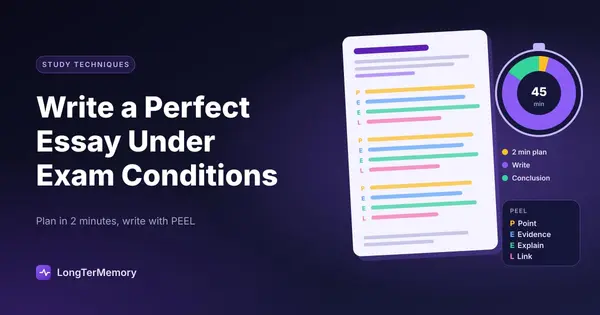
The best essays in timed exams are planned in under two minutes, not because the writers are geniuses, but because they know that planning is where the essay is won or lost. Spending those first two minutes organizing your thoughts will produce a better result than spending them writing a rambling introduction you will have to abandon halfway through.
Most students skip planning because it feels like wasted time. They want to get words on the page. But unplanned essays meander, repeat themselves, and often miss the core of the question entirely. A two-minute plan prevents all of that.
Here is the exact process:
Step 1: Decode the question (30 seconds)
Read the prompt twice. Underline the command words, words like evaluate, compare, discuss, to what extent, or analyze. These words dictate what your essay needs to do. Then underline the subject or concept being tested. If you misread the command word, you can write a beautiful essay that still scores poorly because it answers the wrong task.
Step 2: Brain dump your best points (45 seconds)
On a scrap piece of paper or in the margin, jot down every relevant argument, example, or piece of evidence that comes to mind. Do not organize yet. Just get it out. Aim for four to six solid points. If you cannot think of four, two strong ones plus a counterargument will work.
Step 3: Sequence and select (45 seconds)
Pick your three strongest points and put them in logical order. Usually this means:
- Point one: your strongest, clearest argument
- Point two: a different angle or supporting evidence
- Point three: a counterargument or nuance that shows depth
This sequence gives your essay a natural argumentative arc. It builds momentum rather than jumping around.
Step 4: Draft a one-sentence thesis (30 seconds)
Write a single sentence that answers the question directly and previews your three main points. This is your North Star. Every paragraph you write must connect back to this sentence. If a paragraph does not serve your thesis, cut it, no matter how clever it sounds.
A few quick stats to drive this home:
| What Top-Scoring Essay Writers Do | Percentage Who Do It |
|---|---|
| Spend 1 to 3 minutes planning before writing | 78% |
| Write a clear thesis statement in the introduction | 91% |
| Outline paragraph structure in advance | 84% |
These numbers come from exam board research into what separates grade-A essays from grade-C essays in timed conditions. The difference is almost never raw knowledge. It is organization.
If you want your planning to be even sharper, practice it before the exam. Take past paper questions, give yourself two minutes, and plan an essay you never actually write. Do this ten times and the skill becomes automatic. You can store those plans as active recall prompts in LongTerMemory, turning each practice question into a flashcard that tests whether you can still generate a solid plan weeks later.
Structure Templates That Work Across Humanities Subjects
Every timed essay needs a structure that the examiner can follow without effort. Examiners read hundreds of essays. If yours is hard to follow, they will not work to understand it. They will simply mark it down. The solution is to use a repeatable template that works across history, literature, politics, philosophy, sociology, and almost any other humanities subject.
There are two classic structures that work reliably: the PEEL paragraph model and the thesis-antithesis-synthesis framework. You can adapt either to almost any essay prompt.
The PEEL Paragraph Model
PEEL stands for Point, Evidence, Explanation, Link. Every body paragraph follows this exact sequence:
- Point: A single clear sentence stating what this paragraph is arguing.
- Evidence: A fact, quote, statistic, or example that supports the point.
- Explanation: Your analysis of why this evidence matters and how it supports your argument.
- Link: A sentence that connects this paragraph back to the overall essay question.
This structure keeps paragraphs focused. No wandering. No mixing three ideas in one paragraph. No ending without connecting back to the question.
Here is what it looks like in practice for a history essay:
| Element | Example Sentence |
|---|---|
| Point | ”The Treaty of Versailles was economically punitive rather than purely political.” |
| Evidence | ”Reparations were set at 132 billion gold marks, a figure that exceeded German GDP by multiple times.” |
| Explanation | ”This placed impossible strain on the Weimar economy, creating the hyperinflation crisis of 1923 and undermining public faith in democratic governance.” |
| Link | ”Therefore, the treaty’s economic terms were a direct causal factor in the political instability that followed, supporting the argument that economic punishment drove political collapse.” |
The Thesis-Antithesis-Synthesis Framework
This works brilliantly for questions that ask you to evaluate competing arguments, compare perspectives, or address to what extent prompts.
- Thesis: Present your main argument and the evidence that supports it.
- Antithesis: Introduce the strongest counterargument or alternative interpretation.
- Synthesis: Show why your thesis still holds, but with appropriate nuance, or explain how both views can be partially true depending on context.
This framework demonstrates critical thinking, which is what examiners in humanities subjects are actually marking for. They do not want you to parrot facts. They want you to weigh evidence, acknowledge complexity, and still reach a clear conclusion.
A practical tip for using either template: write your topic sentence last. I know that sounds backwards, but if you draft the evidence and explanation first, you will know exactly what the paragraph actually says, and your topic sentence will be sharper and more accurate.
Also, keep paragraphs to roughly 100 to 150 words in a timed exam. Longer paragraphs lose focus. Shorter ones feel underdeveloped. That word count gives you enough space to make a point and analyze it without drifting.
If you are preparing for essay-based exams, the most efficient study method is not re-reading your notes. It is practicing active recall of your evidence and examples under time pressure. With a tool like LongTerMemory, you can turn your essay evidence bank into automatically scheduled flashcards, so when the exam arrives, the quotes, statistics, and case studies you need are already stored in long-term memory and quick to retrieve.
How to Finish a Strong Conclusion Even if You’re Short on Time
A weak conclusion can undermine an otherwise solid essay, but here is the critical thing: a conclusion does not need to be long to be strong. In fact, a short, focused conclusion scores better than a long, repetitive one. If you are running low on time, you can write an effective conclusion in three to four sentences.
The core job of a conclusion is to answer the question directly, synthesize your main argument, and end with a sentence that feels final. It is not the place to introduce new evidence, make new arguments, or vaguely summarize everything you wrote.
Here is the emergency conclusion formula that works when you have less than five minutes left:
Sentence 1: Direct answer
Restate your thesis in fresh words. Do not copy and paste from the introduction. Show the examiner that you are still in control of your argument.
Sentence 2: Synthesis
Briefly connect your main points together. One line showing how they interrelate is enough.
Sentence 3: Nuance or implication
Add one sentence of broader significance, limitation, or real-world relevance. This elevates the essay from competent to impressive.
Sentence 4: Final statement
A crisp, confident final sentence that leaves no doubt you have answered the question.
For example:
“In conclusion, economic factors were the primary driver of political change in this period, as the evidence from inflation rates, employment data, and electoral outcomes consistently demonstrates. While cultural shifts played a reinforcing role, they operated within constraints set by material conditions. The limitation of this analysis is that regional variation existed, with urban and rural areas responding differently to the same pressures. Ultimately, however, the pattern is clear: economics shaped politics more than politics shaped economics.”
That is four sentences. It answers the question, synthesizes the argument, acknowledges nuance, and ends decisively. An examiner reading that knows this candidate is in command of the material.
What if you have even less time? Say, two minutes? Then write two sentences: a direct answer and a final statement. Something like:
“Ultimately, the evidence supports the argument that X was the decisive factor, through mechanisms A, B, and C. While other interpretations exist, the weight of evidence points clearly in this direction.”
It is not Shakespeare. It is a competent conclusion that protects your score. A missing conclusion costs more than a brief one.
If you want to make conclusion-writing automatic, practice it in advance. Take ten past paper questions, write the body of the essay in your head, and then write only the conclusion. Do this repeatedly and the structure becomes reflexive. Store these as spaced repetition prompts in your study system so the skill stays sharp over time.
Time Management Tactics That Prevent Panic
Even the best-planned essay falls apart if you mismanage the clock. Here is a breakdown of how to allocate time in a standard 45-minute essay exam:
| Phase | Time Allocation | Purpose |
|---|---|---|
| Reading and planning | 5 minutes | Decode the question, brain dump, sequence points, draft thesis |
| Introduction | 5 minutes | Hook, context, thesis statement |
| Body paragraph 1 | 10 minutes | Strongest point with evidence and analysis |
| Body paragraph 2 | 10 minutes | Second point or counterargument |
| Body paragraph 3 | 8 minutes | Third point or synthesis |
| Conclusion | 5 minutes | Direct answer, synthesis, final statement |
| Buffer | 2 minutes | Review, fix errors, check you answered the question |
That buffer is non-negotiable. Use it to read your thesis and the question side by side. Do they match? If not, you have two minutes to adjust a topic sentence or tweak your conclusion so they align.
If you find yourself overrunning on a paragraph, leave it unfinished and move on. A complete essay with one slightly underdeveloped paragraph scores higher than an essay that trails off with no conclusion because you got stuck polishing point two.
Another tactical move: write the introduction last. This only works if you planned properly and know your thesis. But if you struggle with introductions and find they eat your time, skip them, write the body, then come back. You will know exactly what the essay says, so the introduction writes itself in two minutes.
Common Mistakes That Cost Marks in Timed Essays
Even strong students lose marks for avoidable errors. Here are the most common ones:
- Not answering the exact question asked. You spot a keyword and write about the topic generally instead of addressing the specific command word. If the question says evaluate, you must weigh strengths and weaknesses, not just describe.
- No clear thesis. The examiner should know your position after reading the introduction. If they have to hunt for it, you have already lost clarity marks.
- Descriptive rather than analytical paragraphs. Listing facts is not enough. Every fact needs a sentence explaining why it matters to your argument.
- Neglecting the counterargument. Top-band essays engage with alternative views and explain why their own argument still prevails. Ignoring counterarguments looks like you did not consider them.
- Sloppy conclusions. Repeating the introduction verbatim, introducing new evidence, or ending with “so yeah” all damage your score. Conclusions need purpose.
If you are serious about improving your timed essay performance, the single best investment of time is practicing under exam conditions. Not reading about essay technique. Actually writing essays against the clock, then reviewing them critically or swapping with a study partner for feedback.
Use your practice essays to build a personal evidence bank. Every quote, statistic, and case study you deploy in practice is a candidate for flashcard review. Tools like LongTerMemory can automate the scheduling, so your evidence stays accessible and retrievable right when the exam pressure is on.
Building the Confidence to Perform Under Pressure
Technique matters, but so does mindset. Timed essays are as much a test of composure as they are of knowledge. The students who perform best are not always the ones who know the most. They are the ones who have practiced enough that the process feels familiar.
Familiarity reduces anxiety. Anxiety disrupts working memory. Working memory is what you need to hold your plan in mind while you write. So anything that increases familiarity, practice exams, template repetition, timed planning drills, directly improves your cognitive performance on the day.
One practical habit: before every practice essay, simulate exam conditions. Same desk layout, same pen, same time limit, no phone. This builds context-dependent memory. Your brain learns to associate that physical setup with focused essay production, so on exam day, the environment itself cues your concentration.
Another habit: review every practice essay with a checklist. Do not just read it and think “that was okay.” Score yourself against the criteria:
- Did I answer the exact question?
- Was my thesis clear in the introduction?
- Did every paragraph have one point, supported by evidence, with explanation?
- Did I engage with counterarguments?
- Was my conclusion direct and purposeful?
- Did I finish with time to spare?
Track your scores over time. You should see improvement in speed, clarity, and argument depth as the templates become automatic.
Final Thoughts
Writing a perfect essay under exam conditions is not about talent. It is about having a system that works when you are stressed, tired, and short on time. The two-minute plan, the PEEL or thesis-antithesis-synthesis structure, the emergency conclusion formula, these are tools you can learn, practice, and rely on.
The students who walk out of essay exams feeling confident are not magicians. They are simply the ones who rehearsed the process until it became second nature. They planned quickly, wrote with structure, and finished strong, even when the clock was against them.
If you are preparing for essay-based exams right now, the smartest move you can make is to stop reading and start practicing. Pick a past paper question, set a timer, and write. Then review, adjust, and repeat. Build your evidence bank, memorize your key quotes and statistics, and trust the process.
And if you want your study materials, quotes, themes, and evidence, turned into an automated review system that keeps everything fresh without manual scheduling, LongTerMemory handles the flashcard creation and spaced repetition scheduling for you. It means less time managing your study plan and more time building the essay-writing skills that actually earn marks.
The next essay exam is coming. You already have the knowledge. Now build the system that lets you prove it.