How to Use the 12-Week Year Method for Exam Preparation
Apply the 12-Week Year framework to certification and exam prep with focused goals, weekly scorecards, and built-in resilience.
Table of Contents
- Why Twelve Weeks Works for Exam Prep
- Setting Your 12-Week Exam Goal
- Building Weekly Accountability Scorecards
- Avoiding the 12-Week Slump
- Planning Backwards From the Exam Date
- Combining the 12-Week Year With Spaced Repetition
- Handling Disruptions Without Abandoning the Plan
- What to Do After the Exam
- The Bottom Line
Most people plan their exam preparation as if they have unlimited time and willpower. They create a six-month schedule, follow it enthusiastically for two weeks, fall behind, and then abandon the whole thing. The problem is not the goal. The problem is that long timelines trick your brain into thinking there is always tomorrow.
The 12-Week Year, popularized by Brian Moran and Michael Lennington, solves this by compressing an entire year of planning into twelve weeks. Instead of spreading goals across twelve months, you treat each twelve-week block as a complete cycle with its own targets, deadlines, and evaluation. The shorter horizon creates urgency without panic and focus without burnout.
For exam preparation, this approach is especially powerful. Certification exams, professional licensing tests, and major academic exams all have clear endpoints and measurable outcomes. The 12-Week Year gives you a structure to reach those endpoints with discipline and clarity.
Why Twelve Weeks Works for Exam Prep
Twelve weeks is long enough to make real progress and short enough to maintain intensity. In a traditional annual plan, you might set a goal like “pass the PMP by December” and then coast until October. In a 12-Week Year, the exam date is always close enough to matter.
This compression has psychological benefits. Urgent deadlines improve focus. Progress feels visible because the timeline is short. And if something goes wrong, you only lose a few weeks, not a whole year. You can start a new twelve-week cycle immediately after the exam or after a short recovery period.
For exam candidates, the 12-Week Year also aligns well with typical certification timelines. Many major exams, including the PMP, AWS certifications, CPA sections, and bar exams, can be realistically prepared for in focused twelve-week blocks. Even if your actual preparation stretches longer, organizing it into twelve-week sprints keeps each phase purposeful.
Setting Your 12-Week Exam Goal
The first step is to define exactly what success looks like at the end of twelve weeks. Vague goals like “study harder” or “be ready for the exam” do not work. Your goal needs a number, a date, and a standard.
A strong 12-Week goal sounds like this: “Pass the AWS Solutions Architect Associate exam with a score of at least 800 by January 15.” It includes the exam, the target outcome, a measurable threshold, and a deadline.
Once you have the goal, break it into three or four tactics, the specific actions that will get you there. For an AWS exam, your tactics might be: complete the official course, build five hands-on labs, take three full practice exams, and review all missed questions twice.
Here is a template for converting a goal into tactics.
| Goal | Tactic | Weekly target |
|---|---|---|
| Pass AWS SAA | Complete official course | 2 modules per week |
| Pass AWS SAA | Build hands-on labs | 1 lab per week |
| Pass AWS SAA | Take practice exams | 1 full exam every 2 weeks |
| Pass AWS SAA | Review weak areas | 3 hours of targeted review |
The weekly target is what you actually execute. It should be ambitious but realistic. If your weekly targets are too easy, you will not make progress. If they are impossible, you will quit.
Building Weekly Accountability Scorecards
The scorecard is the heartbeat of the 12-Week Year. Each week, you track whether you completed your planned tactics. At the end of the week, you calculate a simple percentage. If you planned ten tactics and completed seven, your score is 70 percent.
This number is uncomfortable in the best way. It removes the stories you tell yourself about how hard you worked and shows you the reality. A low score is not a reason to feel bad. It is data you can use to adjust your plan.
For exam preparation, your scorecard might look like this.
| Weekly tactic | Planned | Actual | Score |
|---|---|---|---|
| Study 6 hours | 6 | 5 | 83% |
| Complete 2 modules | 2 | 2 | 100% |
| Review 50 flashcards | 50 | 40 | 80% |
| Take 1 practice test | 1 | 0 | 0% |
| Weekly average | 66% |
Aim for a weekly execution score of 80 percent or higher. Below that, you are probably falling behind on your plan. Above 90 percent consistently, your plan may be too easy.
Avoiding the 12-Week Slump
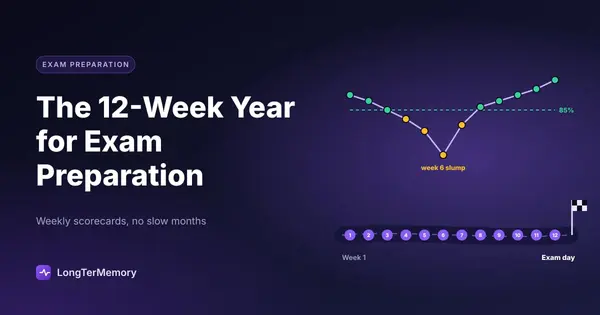
The middle weeks of a 12-Week Year are where most people struggle. The initial excitement has worn off, but the finish line still feels far away. This is the slump zone, and it hits exam preparation hard because the material is often dense and the progress is invisible.
The best defense against the slump is to front-load the hardest work. In the first three weeks, establish your habits and complete the most intimidating topics while motivation is high. Use the middle weeks for consolidation, practice, and review rather than introducing brand-new, difficult material.
Another effective strategy is to schedule mini-milestones every two weeks. These could be practice test scores, chapters completed, or flashcard deck milestones. Mini-milestones give you frequent wins and prevent the goal from feeling too distant.
Planning Backwards From the Exam Date
Start with the exam date and work backwards. If your exam is on week twelve, what needs to be true by week eleven? By week ten? By week six?
A typical backwards plan for a certification exam looks like this.
Weeks 1 to 3: Coverage. Learn the core content. Complete the main course or textbook. Build your first set of flashcards or notes.
Weeks 4 to 6: Application. Start doing practice questions and hands-on labs. Identify weak areas and drill them.
Weeks 7 to 9: Integration. Take full-length practice exams under timed conditions. Review every mistake in detail. Fill remaining knowledge gaps.
Weeks 10 to 11: Consolidation. Focus on spaced repetition review, high-yield topics, and exam strategy. Avoid new material.
Week 12: Final review and exam. Light review, good sleep, and confidence building.
This structure creates natural phase transitions, which help you stay engaged. You are never doing the same thing for too long.
Combining the 12-Week Year With Spaced Repetition
Exam preparation has two components: understanding the material and remembering it. The 12-Week Year helps with the first by giving you a focused plan. Spaced repetition handles the second by scheduling review at optimal intervals.
If you start creating flashcards in week one and review them consistently, by week twelve you will have moved a large portion of the material into long-term memory. This reduces last-minute cramming and makes the final week calmer.
You can build flashcards manually, or you can use a tool like LongTerMemory to generate them automatically from your study materials. Upload your course PDFs, notes, or slides, and the system creates question-and-answer cards that fit into your daily review habit. This is especially useful during weeks four through nine, when you are doing heavy practice and do not want to spend hours making cards.
Handling Disruptions Without Abandoning the Plan
Life does not pause for exam prep. Work deadlines, family obligations, illness, and unexpected events will interrupt your schedule. The 12-Week Year is designed to absorb these disruptions better than rigid long-term plans.
When you miss a week, do not try to catch up by doubling your workload. That usually leads to burnout. Instead, reassess your remaining tactics and adjust. If you lost three study hours, drop one low-priority tactic rather than squeezing six hours into the next week.
The scorecard is your friend here. A single bad week shows up clearly, and you can respond with a small adjustment. In a traditional plan, a bad week is easy to ignore until it becomes a crisis.
What to Do After the Exam
The end of a 12-Week Year is a natural time to reflect, regardless of the exam outcome. If you passed, celebrate the result and identify what worked. If you did not pass, use the same structure for your next cycle, with updated tactics based on what you learned.
Even a successful exam is not the end of learning. Many certifications require continuing education or periodic renewal. You can use twelve-week cycles throughout your career to maintain knowledge, earn CPE credits, or prepare for recertification.
The Bottom Line
The 12-Week Year works because it matches the way your brain actually performs. Long timelines invite procrastination. Short timelines create focus. By compressing your exam preparation into twelve weeks, setting clear tactics, tracking weekly execution, and building in resilience, you give yourself a realistic path to success.
Pair the structure with a retention system like spaced repetition, and you will not only pass the exam but remember the material long after it is over. If you want to automate the flashcard creation side of that system, LongTerMemory can turn your notes into daily review cards so you spend more time learning and less time managing study tools.
Pick your exam. Set your twelve-week goal. Start with this week.