How to Ask for Academic Accommodations for Learning Disabilities
A practical guide to requesting academic accommodations for learning disabilities, covering documentation, common supports, and using them without guilt.
Table of Contents
- What Are Academic Accommodations and Who Qualifies?
- Common Accommodations Available and How to Access Them
- Extended Exam Time
- Distraction-Reduced Testing
- Note-Taking Support
- The Documentation Process for Receiving Academic Accommodations
- Getting Diagnosed or Re-evaluated
- Registering with Disability Services
- Receiving Your Accommodation Letter
- Communicating with Professors
- Using Accommodations Effectively Without Stigma or Guilt
- Reframing Accommodations as Leveling the Playing Field
- Building a Support System
- Tracking What Works
- How Technology Can Support Your Accommodated Study Routine
- Conclusion
If you have a learning disability and you are trying to get through school without accommodations, you are probably working twice as hard as everyone else for the same results. That is not fairness, that is just exhaustion.
Academic accommodations exist so that students with documented learning disabilities can show what they actually know, rather than being penalized by the way information is presented or tested. The process of asking for them can feel intimidating, bureaucratic, and sometimes deeply personal. But it does not have to be a mystery. This guide walks you through exactly what to do, what to expect, and how to use your accommodations with confidence instead of guilt.
What Are Academic Accommodations and Who Qualifies?
Academic accommodations are adjustments to how you learn, test, or access materials. They do not change the academic standards you are expected to meet. If you have a documented learning disability, ADHD, autism spectrum disorder, or certain mental health conditions, you almost certainly qualify for support through your school’s disability services office.
In the United States, roughly 19% of undergraduate students report having a disability, according to the National Center for Education Statistics. Among those, learning disabilities are one of the most common categories. Yet studies suggest that a significant portion of eligible students never register for accommodations, often because they do not know the option exists, or because they worry about being treated differently.
The reality is that accommodations are a legal right under laws like the Americans with Disabilities Act (ADA) and Section 504 of the Rehabilitation Act. Colleges and universities that receive federal funding are required to provide reasonable accommodations to students with documented disabilities. You are not asking for special treatment. You are asking for the environment to be adjusted so your abilities can actually be measured.
Common Accommodations Available and How to Access Them
Most schools offer a standard set of accommodations that address common barriers in testing, note-taking, reading, and time management. The specific options vary by institution, but the core categories are surprisingly consistent across colleges and universities.
Here is a breakdown of the most commonly requested supports and what they actually look like in practice:
| Accommodation | What It Looks Like | Best For |
|---|---|---|
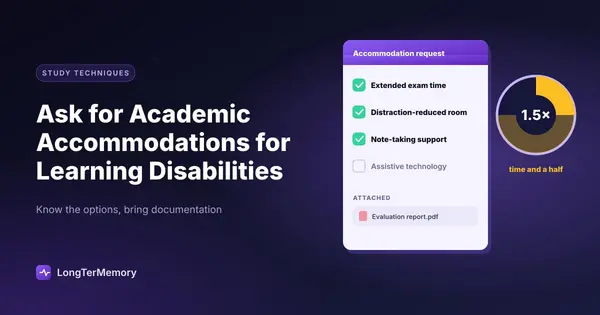
| Extended exam time | Time and a half or double time on tests | Processing speed differences, test anxiety, ADHD |
| Distraction-reduced testing | A quiet room or private testing space | Students easily overwhelmed by noise or movement |
| Note-taking support | Access to a peer note-taker, recorded lectures, or professor-provided notes | Dysgraphia, auditory processing issues, working memory challenges |
| Assistive technology | Text-to-speech, speech-to-text, or screen readers | Dyslexia, visual impairments, writing difficulties |
| Deadline flexibility | Extended due dates for assignments when disability symptoms flare | Mental health conditions, chronic symptoms, executive dysfunction |
| Alternative formats | Oral exams, large-print materials, or digital textbooks | Visual processing issues, reading disabilities |
| Course substitution | Replacing a required course with an equivalent alternative | Specific math or language disabilities |
Getting access to these supports starts with one step: contacting your school’s disability services office. This office might be called Accessibility Services, Student Disability Services, or the Office of Equal Opportunity, depending on your school. Most have websites with clear intake instructions, and you can usually start the process via email.
Extended Exam Time
This is the most widely used accommodation and also the most misunderstood. Extra time does not make the test easier. It removes the time pressure that masks your actual knowledge. Research from the College Board and independent studies consistently shows that students with learning disabilities who receive extended time perform at levels consistent with their demonstrated ability, not artificially above it.
If you suspect you need this, request it early in the semester. Professors need advance notice to reserve a separate testing space or adjust scheduling.
Distraction-Reduced Testing
A standard classroom during an exam is full of subtle distractions. Someone coughing, a chair squeaking, the rustle of papers. For many students with ADHD or sensory processing differences, these small inputs compete for attention in ways that make focused retrieval nearly impossible.
A separate testing room removes that layer of interference. Some schools offer individual rooms, while others provide small-group quiet spaces. Either way, the goal is the same: to let you focus on the material, not the environment.
Note-Taking Support
Taking notes while listening to a lecture requires your brain to do multiple things at once: process spoken language, identify what matters, write it down, and hold the thread of the lecture simultaneously. For students with working memory challenges or dysgraphia, this is genuinely difficult in a way that has nothing to do with intelligence.
Peer note-takers, permission to record lectures, or access to the professor’s slides can free up cognitive resources so you can actually engage with the content during class instead of frantically scribbling.
The Documentation Process for Receiving Academic Accommodations
To receive accommodations, you need documentation from a qualified professional that identifies your disability and describes how it affects you academically. The exact requirements vary by school, but the general process follows a predictable pattern.
Getting Diagnosed or Re-evaluated
If you were diagnosed in high school, your existing evaluation report or Individualized Education Program (IEP) may be enough. Most colleges accept psychoeducational evaluations completed within the last three to five years. If you do not have a recent diagnosis, or if you suspect you have a learning disability but were never formally evaluated, you will need to see a licensed psychologist, neuropsychologist, or other qualified clinician.
Many universities offer low-cost or sliding-scale evaluations through their psychology clinics. This is worth asking about if cost is a barrier. Private evaluations typically range from $1,500 to $5,000 in the United States, though insurance sometimes covers part of the cost if the provider codes it correctly.
The evaluation will usually include cognitive and academic testing, a clinical interview, and a written report with specific recommendations for accommodations. Keep copies of this report. You will need them every semester.
Registering with Disability Services
Once you have documentation, submit it to your disability services office along with their intake form. Most offices have moved this process online. After reviewing your materials, they will schedule an intake meeting with an accommodations coordinator.
This meeting is not an interrogation. It is a conversation about what barriers you experience and what supports might help. Be honest and specific. If you struggle with timed writing because your processing speed is in the 15th percentile, say that. If you need permission to use a laptop for essay exams because your handwriting is illegible, say that. The coordinator uses this information to build your accommodation letter.
Receiving Your Accommodation Letter
After the intake meeting, the disability services office will generate an official accommodation letter. This letter does not disclose your diagnosis. It simply lists the accommodations you are approved for. You then share this letter with each of your professors, usually at the start of the semester.
You are generally not required to disclose your specific disability to your professors, and you should not feel pressured to do so. The letter speaks for itself. Some professors may ask how they can best support you, and you can share as much or as little as you are comfortable with.
Communicating with Professors
Send the accommodation letter early, ideally in the first week of class. Follow up with a brief, professional email that highlights any accommodations requiring advance planning, like separate testing or note-taking support.
Here is a simple template you can adapt:
Subject: Accommodation Letter for [Course Name]
Dear Professor [Name],
I am registered with [Disability Services Office] and have attached my accommodation letter for this semester. I will be using [specific accommodation, e.g., extended time on exams in a separate testing room] for this course. Please let me know if you need any additional information or if there are forms I should complete for scheduling.
Thank you, [Your Name]
This approach is professional, clear, and establishes expectations without over-explaining. Most professors have worked with accommodated students before and will know the routine.
Using Accommodations Effectively Without Stigma or Guilt
The biggest barrier to using accommodations is often not bureaucracy. It is the feeling that you do not deserve them. Many students with learning disabilities internalize the idea that asking for help is cheating, or that accommodations give them an unfair advantage. Neither of these things is true.
Reframing Accommodations as Leveling the Playing Field
Think of it this way: a student who needs glasses is not getting an unfair advantage when they wear them to read an exam. The glasses correct for a visual difference so the student can demonstrate what they know. Accommodations do the exact same thing for cognitive, neurological, or psychological differences.
Research published in the Journal of Learning Disabilities found that students with ADHD who received extended time performed comparably to non-ADHD peers when time limits were removed, suggesting that time pressure creates a false measure of competence rather than a real one. Accommodations remove that distortion. They do not inflate your performance. They reveal it.
If guilt creeps in, remind yourself that you are not asking for a lower standard. You are asking for a fair shot at meeting the same standard through a different path.
Building a Support System
You do not have to navigate this alone. Many schools have peer mentoring programs, support groups, or disability cultural centers where you can connect with other students who understand what you are going through. There is something uniquely validating about sitting in a room full of people who also spent years thinking they were just bad at school before getting diagnosed.
Your support system can also include your academic advisor, a therapist, or a trusted professor. These people can advocate for you if a professor resists implementing accommodations or if you need help navigating a difficult semester.
Tracking What Works
Accommodations are not one-size-fits-all. Extended time might help enormously in your history exams but matter less in your math class. A note-taker might be essential for lecture-heavy courses but unnecessary for seminars. Keep a simple log of which accommodations you use and how they affect your performance. This helps you advocate for yourself more precisely and identify where adjustments might help.
If something is not working, go back to your disability services office. Accommodations can be modified. The goal is not to collect the most accommodations possible. It is to build a setup where your brain can actually function.
How Technology Can Support Your Accommodated Study Routine
Getting accommodations is a huge step, but what you do with your study time outside the classroom matters just as much. Many students with learning disabilities benefit enormously from structured, adaptive study tools that reduce cognitive load and automate the parts of learning that feel hardest.
This is where a tool like LongTerMemory becomes genuinely useful. Instead of manually building flashcard decks or trying to remember when to review material, LongTerMemory handles the scheduling for you using automatic spaced repetition. You can import content directly from PDFs and web articles, which means you spend less time reformatting notes and more time actually learning. For students who get extra time on exams, the time saved on study prep can be substantial.
If you are setting up accommodations for the first time this semester, consider pairing that institutional support with a study system that works with your brain rather than against it. You can start a free trial of LongTerMemory and see how much more manageable exam preparation feels when your tools are doing some of the heavy lifting.
Conclusion
Asking for academic accommodations is not a sign of weakness. It is a practical, legal, and entirely reasonable response to a genuine barrier. The process takes some effort up front, documentation, registration, conversations with professors, but the payoff is that you get to show what you are actually capable of instead of being filtered out by an environment that was never designed for how your brain works.
Know your rights. Gather your documentation. Send that email to disability services. And then use every tool and support available to you, including the ones you build for yourself, without a shred of guilt. You have always been capable of succeeding. Accommodations just remove the obstacles that were hiding it.