
How to Use Spaced Repetition for Pediatrics Board Review
Use spaced repetition for pediatrics board review: high-yield flashcard decks, organization by developmental stage, and SRS plus case reasoning.
Table of Contents
- High-yield pediatrics content for flashcard-based board review
- Organizing pediatric flashcard decks by developmental stage and organ system
- Combining SRS review with clinical case reasoning for pediatric boards
- A realistic daily review schedule
- Conclusion
- FAQ
- How many flashcards do I need for pediatrics board review?
- When should I start spaced repetition for the boards?
- Are Anki or LongTerMemory better for pediatric board prep?
If you’re staring down the pediatric board exam with a review book the size of a brick and a growing sense of panic, take a breath. The pediatricians who pass comfortably aren’t the ones who reread Nelson’s cover to cover three times. They’re the ones who turn that mountain into spaced repetition flashcards and let a smart algorithm schedule their forgetting curve for them.
Pediatrics is a uniquely brutal board specialty. You’re not just memorizing one anatomy or one system. You’re memorizing normal developmental milestones at eight different ages, immunization schedules that change annually, dosage adjustments for every weight and age band, congenital conditions that present completely differently at day 2 versus year 2, plus all the bread-and-butter outpatient and emergency medicine content on top. That’s exactly the kind of high-volume, detail-dense material where spaced repetition (SRS) shines, because the research is clear: distributed practice with retrieval beats massed rereading by a wide margin. Dunlosky and colleagues, in their landmark 2013 review of effective learning techniques, ranked practice testing and distributed practice as the two highest-utility study methods for long-term retention.
In this post I’ll walk you through how I structure a pediatrics board review around SRS: what content deserves a flashcard, how to organize decks by developmental stage and organ system, how to weave in clinical case reasoning, and what a realistic daily review schedule looks like.
High-yield pediatrics content for flashcard-based board review
The core answer: convert facts you must recall cold (numbers, thresholds, sequences, dose limits, criteria, red flags) into short question-and-answer flashcards, and skip anything you’d rather reason through or look up. Boards test recall under time pressure, so your card library should mirror that.
Not every page of your review book earns a card. Here’s my rough rule: if a fact appears in a board-style question where getting it wrong means missing the whole item, it becomes a card. If it’s a concept you understand and can reason to from first principles, it doesn’t.
Content categories that are almost always card-worthy for pediatrics:
- Developmental milestones: ages for head control, sitting, crawling, first words, two-word phrases, drawing shapes, and the classic “loss of milestones equals red flag” distinctions.
- Immunization schedule: the routine schedule by age, catch-up rules, and contraindications. Note the schedule updates yearly, so date-stamp your cards.
- Vital sign normals: heart rate, respiratory rate, and blood pressure percentiles by age group. Boards love an RR of 50 in a newborn being normal but alarming at age 6.
- Lab value shifts: normal WBC ranges in neonates, bilirubin treatment thresholds by age in hours, potassium and calcium normals across childhood.
- Dosing and toxicology: acetaminophen and ibuprofen mg/kg limits, weight-based antibiotic dosing ceilings, toxic ingestion thresholds (iron, aspirin, button battery emergencies).
- Growth parameters: percentiles, failure to thrive definitions, BMI classification cutoffs for children.
- Screening timing: AAP screening schedules for hearing, vision, autism, lead, TB risk, lipid screening windows.
- Red-flag symptom clusters: “must not miss” presentations like non-accidental trauma patterns, Kawasaki criteria, signs of pediatric sepsis.
A few examples of cards that work well:
- Q: “What bilirubin level (mg/dL) in a term infant at 24 to 48 hours old generally meets phototherapy threshold?” A: “Around 15 mg/dL on standard nomograms, always verify against the Bhutani curve for age in hours.”
- Q: “By what age should a child use two-word phrases?” A: “About 24 months. Absence at 2 years warrants expressive language evaluation.”
- Q: “HR above what value at rest in a 4-year-old is tachycardia?” A: “Above roughly 120 bpm (age-based ranges: neonate >160, infant >150, 1 to 5 yrs >130 to 140, school age >100).”
Notice the pattern: one card, one testable fact, phrased as a question you’d actually face on the boards. For a deeper primer on writing cards that actually stick, see my post on active recall techniques.
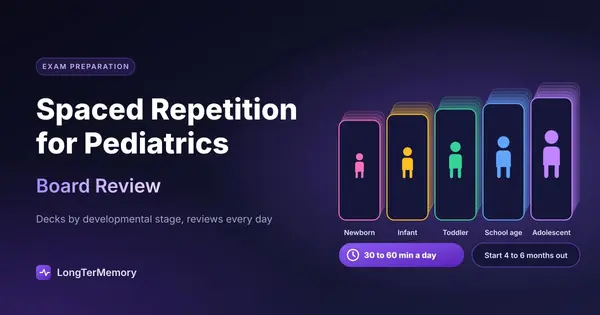
Organizing pediatric flashcard decks by developmental stage and organ system
The core answer: use a two-axis deck structure (stage and system) with a tag or folder convention, and split out high-churn decks like immunizations and milestones that need frequent rewrites.
Pediatrics spans newborns, infants, toddlers, school-aged kids, and adolescents, and many topics repeat across stages with different answers. A cardiac murmur question means one thing in a 2-day-old and something totally different in a 14-year-old. If you dump everything into one giant deck, the algorithm will happily quiz you on adolescent gynecology the morning you’re trying to drill neonatal resuscitation. Structure fixes this.
Here’s the deck skeleton I recommend:
| Deck | Sample content | Card count target |
|---|---|---|
| Neonatology | Resuscitation steps, APGAR, sepsis risk factors, hypoglycemia cutoffs, congenital heart lesions presenting at day 2 to 7 | 250 to 350 |
| Development and milestones | Milestone ages, regression red flags, speech and language timelines | 150 to 200 |
| Immunizations | Routine schedule, catch-up, contraindications, annual updates | 100 to 150 |
| Cardiology | Murmur timing by age, Kawasaki criteria, CHF dosing, cyanotic spells | 200 to 250 |
| Pulmonary | Asthma stepwise therapy by age, croup vs epiglottitis vs foreign body, CF basics | 200 to 250 |
| GI and nutrition | Bilirubin nomogram, dehydration assessment, failure to thrive workup, celiac screening | 200 to 250 |
| Renal and electrolytes | Normal creatinine by age, nephrotic vs nephritic, HUS presentation | 150 to 200 |
| Endocrine and metabolic | Hypoglycemia workup, DKA criteria, thyroid norms, inborn errors red flags | 150 to 200 |
| ID and antimicrobial dosing | Empiric antibiotics by age and source, weight-based dosing ceilings, viral exanthem patterns | 250 to 300 |
| Adolescent medicine | HEADSS screening, growth and puberty timing, confidentiality rules, contraception basics | 150 to 200 |
| Emergency and toxicology | Anaphylaxis dosing, SVT management, button battery, ingestions | 150 to 200 |
Two practical tips. First, keep immunizations and milestones in their own small decks even if you tag them by stage elsewhere. These are the highest-churn content, and the AAP updates recommendations every year. When a new schedule drops, you want to edit 80 cards, not hunt through 2,500. Second, tag every card with its stage (neonate, infant, toddler, school age, adolescent) so you can filter mixed decks by age when you’re doing timed question blocks. Boards love age-bait answer choices, and age tagging trains you to check the patient’s age before anything else.
If you’re coming from Anki and wondering whether it’s worth switching tooling to get this organization with less manual fiddling, my comparison of Anki and LongTerMemory covers the honest trade-offs.
Combining SRS review with clinical case reasoning for pediatric boards
The core answer: cards build the recall foundation, board-style questions build the reasoning, and the two should feed each other daily, not run as separate study tracks.
Karpicke and Roediger showed back in 2008 that retrieval practice produces dramatically better long-term retention than restudying, even when the restudying feels smoother. Board questions are retrieval practice with a reasoning layer on top: they force you to extract the relevant fact from a vignette, weigh distractors, and commit to an answer under time pressure. That’s the exact skill the exam tests. But here’s the catch: if the underlying fact (say, the cutoffs for starting phototherapy) isn’t in long-term memory, you can’t reason with it. You end up guessing between two plausible-sounding options.
So the loop should look like this:
- Do a timed block of 20 to 40 board-style questions in your current organ system.
- Review every question, including ones you got right by luck. For each missed fact or hesitant recall, create or update a flashcard the same day.
- Let SRS schedule those new cards alongside your daily review so the gap gets re-tested at expanding intervals (typically 1 day, 3 days, then roughly doubling, per standard SM-2-style scheduling).
- Once a week, do an untimed “case reasoning” session where you talk through vignettes out loud, narrating why each answer choice is right or wrong, using your card knowledge as ammunition.
For the weekly session, pick sources with pediatric-specific vignettes rather than adult-heavy question banks. The proportion matters: many residents do great on internal medicine-style reasoning but stumble on age-specific presentations, because the boards deliberately test what’s different in kids. Flag every question where your error was “didn’t know the pediatric-specific fact” and card it immediately. If your error was “knew the fact but misread the vignette,” that’s a different fix: practice extracting the patient’s age, vitals, and key negatives in the first ten seconds of reading.
This cards-plus-cases structure is the same backbone I recommend for any high-stakes licensing exam, and I go deeper on the overall architecture in my post on preparing for medical boards and bar exams.
A realistic daily review schedule
The core answer: 30 to 60 minutes of SRS reviews every single day, starting four to six months out, beats any heroic cram plan. The math is unforgiving: a deck of 2,500 cards with an average interval growth rate needs roughly 150 to 250 reviews per day once matured, and that review load compounds if you skip days.
Here’s a schedule that has worked for many residents balancing board prep with clinical duties:
| Timeframe | Daily commitment | Focus |
|---|---|---|
| Months 6 to 4 out | 30 to 45 min SRS + 20 questions | Build decks system by system, start neonatology and ID early |
| Months 4 to 2 out | 45 to 60 min SRS + 30 to 40 questions | All systems built, add cases to weekly rotation |
| Months 2 to 1 out | 60 min SRS + 40 timed questions | Suspended cards reactivated, weekly full mixed blocks |
| Final month | 45 min SRS (maintenance only) + 50 to 60 timed questions | No new cards, pure consolidation and pacing practice |
Two warnings from watching people blow up their prep. First, don’t create more than 30 to 50 new cards per day. You’ll drown in reviews two months later and start suspending cards, which quietly deletes knowledge. Second, never let a single day pass with zero reviews. Ebbinghaus’s forgetting curve isn’t a metaphor; a skipped week can cost you a third of your mature deck’s retention, and rebuilding is far more painful than 40 minutes of maintenance.
This is where tooling choice genuinely matters. Manually scheduling thousands of pediatric cards, keeping immunization cards current, and formatting cases into Q&A takes hours every week. Lately I’ve been using LongTerMemory for exactly this: I drop in my PDF review chapters and lecture notes, and it turns them into Q&A flashcards with spaced repetition scheduling automatically, so my time goes into questions and case reasoning instead of card admin. If that sounds like the bottleneck in your own prep, you can try it free and see whether it shrinks your setup time the way it did mine.
Conclusion
Pediatrics board review rewards the people who respect the forgetting curve. Turn high-yield facts (thresholds, schedules, dose limits, milestone ages, red flags) into focused question-and-answer cards, organize them by developmental stage and organ system with tags that let you filter by age, and run a daily loop where board questions and SRS reviews feed each other. Start four to six months out, cap your new cards, and never skip a review day. Do that consistently and you’ll walk into the exam with 2,500 pediatric facts at instant recall instead of a vague memory of having read about them once.
FAQ
How many flashcards do I need for pediatrics board review?
Most test-takers land between 2,000 and 3,000 cards, with neonatology, ID, and cardiology usually the largest decks. Quality beats quantity: 2,500 sharp, single-fact cards outperform 5,000 bloated ones you start suspending.
When should I start spaced repetition for the boards?
Four to six months before the exam is the sweet spot. Earlier is fine if you’re on a lighter schedule, but starting under three months out usually means either an unsustainable new-card pace or an unmanageable daily review load as the exam approaches.
Are Anki or LongTerMemory better for pediatric board prep?
Both use the same core scheduling science. Anki gives you maximum control at the cost of manual setup and formatting. LongTerMemory skips the card-building work by generating Q&A flashcards from your PDFs and web sources automatically. The right pick depends on whether your scarce resource is time or desire for customization.