Best Studying Methods and Tips Used by Top Students
Discover the best studying methods top students use, from active recall and spaced repetition to the small review habits that make good grades automatic.
Table of Contents
- What High Performers Do in the First 10 Minutes of a Study Session
- The Review Habits That Separate Consistent From Inconsistent Learners
- Active Recall: The Technique That Changes Everything
- Spaced Repetition: Study Less, Remember More
- The Review Habits That Separate Consistent From Inconsistent Learners
- Building a Study Identity That Makes Good Habits Automatic
- The Study Techniques Top Students Combine
- How Top Students Manage Energy and Focus
- The Mindset Difference
- Put the Best Studying Methods Into Practice
Everyone wants to know what top students are doing differently. It is not that they are naturally smarter, sleep less, or have some secret talent for memorizing textbooks. The real difference is usually a collection of small, intentional habits that compound over time. High performers treat studying like a skill they can improve, not a punishment they have to endure.
If you copy the right habits, your results tend to change. This guide covers the best studying methods and practical study tips used by students who consistently score well, understand material deeply, and still manage to have a life outside of school. We will focus on what actually matters, active recall, spaced repetition, deliberate review routines, and the mindset shift that makes all of it stick.
What High Performers Do in the First 10 Minutes of a Study Session
The first ten minutes of a study session usually determine how productive the rest of it will be. Top students do not open their laptops, scroll through notes, and hope focus shows up. They start with a short ritual that tells their brain it is time to work.
Most high performers begin by closing everything unrelated. They put their phone out of reach, close extra browser tabs, and clear the desk so there is only one thing competing for attention. This tiny act removes the most common source of wasted time before it can derail the session.
Then they do a quick preview of what they plan to cover. They ask themselves two questions: what do I need to learn today, and how will I know I have learned it? This is sometimes called intention setting, and it works because vague goals like “study chemistry” almost always lead to vague results. A specific target such as “solve ten stoichiometry problems without looking at the formula sheet” gives the brain a finish line to aim for.
After setting the intention, many top students do a two-minute retrieval warm-up. They close their notes and try to recall the main points from the previous study session. It does not matter if they remember everything. The point is to start the session in active mode instead of passive mode. This brief struggle primes the brain to absorb new information more effectively.
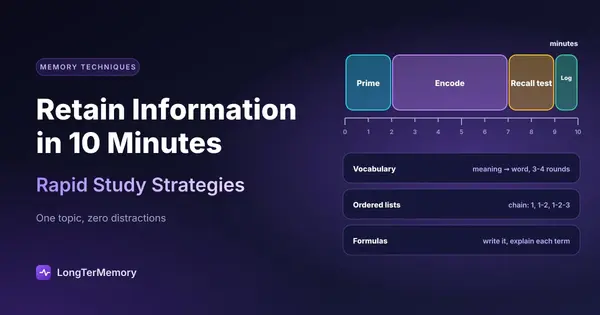
Here is what the first ten minutes typically looks like:
- Minutes 0 to 2: Remove distractions and set up the workspace.
- Minutes 2 to 5: Write down the specific goal for the session.
- Minutes 5 to 10: Retrieve key ideas from the last session without notes.
That routine may sound simple, but simple is the point. High performers know that motivation is unreliable. A repeatable starting ritual removes the need to feel inspired every time they sit down to work.
The Review Habits That Separate Consistent From Inconsistent Learners
The biggest gap between students who remember material and students who forget it is not how hard they study. It is how often they revisit what they have already learned. Consistent learners have a review system. Inconsistent learners rely on cramming and hope.
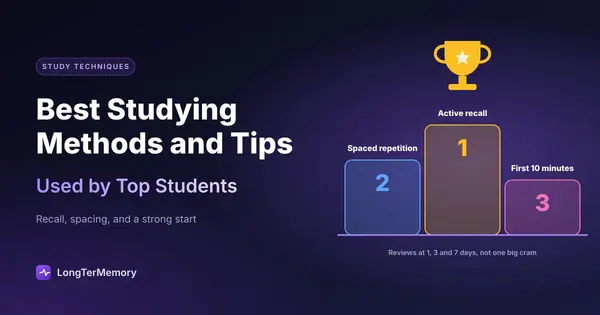
Most forgetting happens quickly. Research on the forgetting curve shows that we lose a large percentage of new information within a day or two unless we actively reinforce it. Top students do not fight this by reviewing everything constantly. They use spaced repetition, which means reviewing a concept at increasing intervals right before they are about to forget it.
A basic spaced repetition schedule might look like this:
| Review Number | When to Review |
|---|---|
| First review | 1 day after learning |
| Second review | 3 days after the first review |
| Third review | 7 days after the second review |
| Fourth review | 14 to 30 days later |
This schedule is far more efficient than re-reading the same chapter five times in one afternoon. Each successful review at the right interval strengthens the memory and makes the next recall easier.
Top students also turn review into active retrieval rather than passive recognition. Instead of re-reading notes, they test themselves. They use flashcards, blank-page summaries, or practice questions. If they cannot produce the answer from memory, they know exactly where their understanding is weak.
Another habit that separates consistent learners is the weekly reset. Once a week, often on a Sunday evening, they spend thirty to sixty minutes looking back at the week. They review what they learned, update their flashcard deck or notes, and plan the most important topics for the coming week. This prevents small gaps from becoming giant holes before an exam.
The pattern is clear. Inconsistent learners study when they feel panic. Consistent learners review on a schedule. Panic produces short bursts of effort. Schedules produce long-term mastery.
Active Recall: The Technique That Changes Everything
If there is one study method that deserves the spotlight, it is active recall. It is the practice of pulling information out of your memory instead of pushing it in. Rather than highlighting, re-reading, or watching videos for the third time, you close the material and try to remember it yourself.
The reason this works so well is that memory is not strengthened by exposure. It is strengthened by retrieval. Every time you successfully recall something, you send a signal to your brain that the information is worth keeping. The small struggle of trying to remember, even when you get it wrong, is what builds durable learning.
There are many ways to practice active recall:
- Flashcards: Write a question on one side and the answer on the other. Commit to an answer before flipping.
- Blank page method: After reading a section, close the book and write everything you can remember.
- Self-quizzing: Ask yourself questions about the material as if you were writing the exam.
- Teaching out loud: Explain the concept to an imaginary audience without notes.
The common mistake students make is peeking too early. They feel the discomfort of not knowing and immediately flip the card or open the book. That converts active recall back into passive review. The rule is to sit with the discomfort for at least ten to thirty seconds before checking. That struggle is where the learning happens.
Studies have shown that students who use active recall retain roughly double the material compared to students who rely on re-reading, even when both groups spend the same amount of time studying. If you are looking for a single change that will improve every subject, start here.
Spaced Repetition: Study Less, Remember More
Active recall helps you encode information. Spaced repetition helps you keep it. Together, they form the most efficient one-two punch in all of learning science.
The idea behind spaced repetition is simple. Instead of reviewing something every day or not at all, you review it at the moment you are just about to forget it. This timing creates a small amount of desirable difficulty. The review is effortful enough to strengthen the memory, but not so difficult that you have to relearn the material from scratch.
Modern spaced repetition tools make this easy. Apps can schedule your flashcards automatically based on how well you answer each one. Cards you find easy appear less often. Cards you struggle with appear more frequently. This personalization means you spend most of your time on the material that actually needs attention.
Top students use spaced repetition for more than just vocabulary. They use it for:
- Formulas and equations in math and science
- Legal cases and definitions in law
- Anatomical terms and drug names in medicine
- Historical dates and events
- Grammar rules and language vocabulary
- Code syntax and programming concepts
The real benefit is consistency over time. Fifteen minutes of spaced repetition every day will outperform several hours of cramming the night before an exam. It also reduces stress, because you walk into the test knowing the material is already in long-term memory.
If you want to save hours of manual scheduling, a tool like LongTerMemory can turn your notes into flashcards automatically and handle the spaced repetition timing for you. Instead of building decks by hand, you can focus on learning while the system decides when each card should come back.
The Review Habits That Separate Consistent From Inconsistent Learners
Consistency is not about willpower. It is about systems. The students who perform well month after month have a few specific review habits that protect them from the natural drift of forgetting.
First, they review within twenty-four hours. The day after learning something new, they spend a few minutes going over it. This first review is the most important one because it interrupts the steep early drop in retention.
Second, they mix old and new material. Inconsistent learners often review only what they just learned and ignore everything else. Top learners interleave older topics into every session. This keeps knowledge fresh across the entire course, not just the most recent chapter.
Third, they track what they get wrong. Every missed question or failed recall is valuable data. Instead of feeling embarrassed, they add that item to their flashcard deck or error log and revisit it on schedule. Weak areas get more attention, while strong areas get less.
Here is a quick comparison:
| Inconsistent Learners | Consistent Learners |
|---|---|
| Study only when exams approach | Review on a weekly schedule |
| Re-read notes passively | Test themselves actively |
| Ignore mistakes | Log errors and revisit them |
| Cram the night before | Spread practice across weeks |
| Hope they remember | Use spaced repetition |
The difference is not talent. It is process. Build the process, and the grades tend to follow.
Building a Study Identity That Makes Good Habits Automatic
The most powerful study tip has nothing to do with flashcards or timers. It is about identity. When you begin to see yourself as “someone who studies consistently,” your behavior starts to align with that image without needing constant motivation.
Top students do not ask, “How do I force myself to study?” They ask, “What would a focused learner do right now?” That subtle shift moves the decision from willpower to self-image. Every time they choose to start a session, review on schedule, or resist a distraction, they reinforce the identity of being a serious student.
Building this identity happens through small wins repeated over time. You do not need to transform overnight. You need to accumulate evidence. Each completed study session, each flashcard reviewed, each practice problem solved becomes proof that you are the kind of person who follows through.
One effective way to build identity is through habit stacking. You attach a new study habit to something you already do. For example:
- After I pour my morning coffee, I will review five flashcards.
- After I finish dinner, I will spend ten minutes on active recall.
- After I close my last class of the day, I will organize my notes for ten minutes.
These small anchors make studying feel automatic rather than optional. They also avoid the trap of waiting until you feel motivated. The habit happens because the trigger happened, not because you feel like it.
Another useful tactic is to shape your environment. Keep your study materials visible and your distractions hidden. If your flashcard app is on your home screen and social media apps are buried in folders, the path of least resistance starts to favor learning. Top students design their surroundings so that good choices become easy choices.
Over time, these small environmental and identity shifts do more than any single motivational speech. They make studying feel like something you simply do, not something you are constantly negotiating with yourself about.
The Study Techniques Top Students Combine
High performers rarely rely on just one method. They combine several techniques depending on the material and the goal. Understanding when to use each one helps you study smarter, not longer.
For memorization-heavy subjects like biology, history, medicine, or languages, the winning combination is active recall plus spaced repetition. Turn facts into questions, test yourself repeatedly, and let the spacing algorithm handle the timing.
For problem-solving subjects like math, physics, or coding, the focus is on worked examples and independent practice. Top students study a solved problem, then close it and solve a similar one from scratch. They also explain each step out loud to check whether they truly understand the logic.
For conceptual subjects like philosophy, literature, or sociology, the best approach is elaboration and the Feynman technique. Students summarize arguments in their own words, connect ideas across readings, and explain theories to someone else. The goal is depth of understanding, not just recall of facts.
Here is a quick reference table:
| Subject Type | Best Studying Methods |
|---|---|
| Memorization-heavy | Flashcards, spaced repetition, self-testing |
| Problem-solving | Practice problems, worked examples, step-by-step explanations |
| Conceptual | Elaboration, Feynman technique, argument mapping |
| Skill-based | Deliberate practice, feedback loops, spaced repetition |
The best students are flexible. They do not try to fit every subject into the same study method. They match the technique to the material.
How Top Students Manage Energy and Focus
Studying well is not only about methods. It is also about managing your mental energy. The sharpest study techniques will not help if your brain is exhausted, distracted, or overloaded.
Top students take sleep seriously. They know that memory consolidation happens during sleep, especially deep sleep. Pulling an all-nighter might create more study hours, but it destroys the very process that turns studying into long-term memory. Most high performers aim for a consistent sleep schedule and protect it like a meeting they cannot miss.
They also use focused bursts with breaks. Rather than sitting for four hours in a haze, they work in concentrated blocks of twenty-five to fifty minutes and then take a real break. During the break, they move, hydrate, or step outside. The brain needs downtime to consolidate and recharge.
Nutrition and hydration matter more than people realize. Dehydration and blood sugar crashes make it harder to concentrate and easier to procrastinate. Top students keep water nearby and avoid heavy, sugary meals right before intense study sessions.
Finally, they manage cognitive load. They do not try to learn ten new concepts at once. They break complex material into smaller pieces, master one piece at a time, and connect the pieces afterward. This keeps working memory from getting overwhelmed and makes progress feel achievable.
The Mindset Difference
Beyond techniques and schedules, top students tend to share a few mental habits that keep them improving.
They view mistakes as feedback, not failure. A wrong answer is not proof that they are bad at the subject. It is information about what still needs work. This growth mindset makes them more willing to take on hard material and less likely to avoid practice tests.
They also focus on progress, not perfection. They understand that learning is messy and that mastery comes from repetition over time. They are not discouraged by a bad session because they know one session does not define the trend.
Perhaps most importantly, they take ownership of their learning. They do not blame the teacher, the textbook, or the exam format for poor results. They look at their own habits and ask what they can change. That sense of agency is what turns average students into top students over the long run.
Put the Best Studying Methods Into Practice
You do not need to adopt every technique tomorrow. The fastest way to improve is to start with one or two changes and build from there.
Begin with active recall. For your next study session, close your notes and try to retrieve the material before you re-read it. Notice how much harder it feels, and remember that the difficulty is a sign that real learning is happening.
Add spaced repetition next. Pick a tool or system that schedules your reviews automatically. If you want to skip the manual work of creating flashcards, LongTerMemory can generate them from your notes and apply spaced repetition so you spend less time organizing and more time remembering.
Then build your review rhythm. Set a weekly time to look back at what you learned, update your deck, and plan the week ahead. Small, scheduled reviews will protect your progress better than any last-minute cram session.
Over time, these habits become part of who you are. You stop forcing yourself to study and start following through because that is what you do. That is the real secret behind top students. Not genius. Not luck. Just better systems, practiced consistently.
Start with the first ten minutes of your next session. Clear the distractions, set one clear intention, and retrieve something from memory. That single choice might be the beginning of a very different semester.