How to Retain Information in 10 Minutes: Rapid Study Strategies
Discover what you can realistically memorize in 10 focused minutes, the maximum encoding intensity method, and an instant recall test that locks it all in.
Table of Contents
- What Can You Actually Memorize in 10 Minutes?
- The One-Topic Rule: Zero-Distraction Encoding
- The High-Intensity 10-Minute Protocol
- Minutes 0-2: Prime
- Minutes 2-7: Encode
- Minutes 7-9: Final recall test
- Minute 9-10: Log the gaps
- The Power of Struggle: Why Difficulty Is the Point
- Stacking 10-Minute Windows
- What to Do in the Final 60 Seconds
- Different Content, Different Tactics
- The Myth of "I Just Don't Have Time to Study"
- Your 10-Minute Session Checklist
Ten minutes. That’s the gap between your current tab and the next meeting, the commute segment before your stop, the dead time between classes. It doesn’t sound like a useful study window. But used correctly, ten focused minutes of deliberate memorization outperform an hour of vague, distracted reviewing.
The key word is correctly. Passive re-reading for ten minutes is nearly worthless. High-intensity, zero-distraction active encoding for ten minutes can be remarkably powerful. Here’s how to use those windows well.
What Can You Actually Memorize in 10 Minutes?
Let’s be honest about this first, because unrealistic expectations are where speed memorization goes wrong.
In 10 genuinely focused minutes, a typical person can:
- Memorize 10-15 new vocabulary words with context
- Learn a list of 7-10 items with their key attributes
- Deeply encode one complex concept with sub-points
- Memorize a short poem, scripture verse, or quotation (50-80 words)
- Fix 5-6 stubborn facts or formulas that keep slipping
- Review and solidify 20-30 flashcards already in progress
What you can’t do in 10 minutes:
- Memorize a full chapter of content
- Master a skill that requires practice over time
- Deeply encode material you don’t yet understand at all
The most common mistake is trying to cover too much. People sit down with 30 pages of notes and expect to “memorize” them in 10 minutes. That’s not memorization , it’s scanning. The 10-minute window works when you have a specific, defined target and you attack it with full intensity.
The One-Topic Rule: Zero-Distraction Encoding
For a 10-minute memory session to actually work, you need to apply what learning scientists call maximum encoding intensity , and that requires one thing above all else: a single topic, with zero distractions.
This sounds obvious. It’s harder than it sounds.
“Zero distractions” means:
- Phone in airplane mode (or in another room)
- Music off, or at most white noise or binaural beats , no lyrics
- One tab open, or your physical notes in front of you
- No interruptions, and you know there won’t be any for the next 10 minutes
Why does this matter so much? Because memory encoding requires working memory capacity, and every partial distraction , a notification sound, a background conversation, the temptation to check something , eats into that capacity. A “mostly focused” 10 minutes might give you 50% of the encoding depth that a truly focused 10 minutes provides.
Pick one concept, one list, one passage. Set a timer. Go all in.
The High-Intensity 10-Minute Protocol
Here’s the exact structure to use:
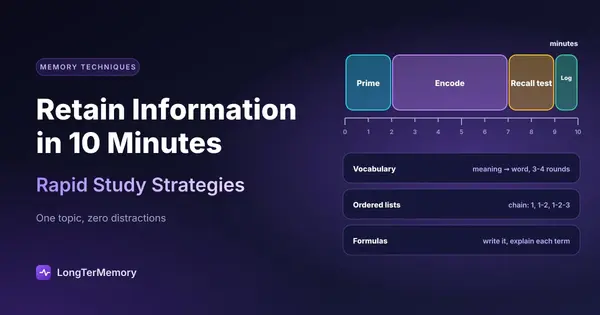
Minutes 0-2: Prime
Read through your target material once, slowly and deliberately. Don’t try to memorize yet. Just understand it. For a list of vocabulary: read each word and its meaning. For a concept: read the main idea and its sub-points. For a formula: understand what each variable represents.
This priming phase loads the material into working memory without the pressure of immediately trying to retain it.
Minutes 2-7: Encode
This is where the work happens. Close or flip over your material , don’t let yourself see it , and try to reproduce it from memory. Write it down or say it out loud. For vocabulary: go meaning → word. For a concept: reproduce the main idea and as many sub-points as you can. For a formula: write it out and explain what each term means.
When you get stuck (and you will), resist the urge to check immediately. Stay with the blank moment for at least 5-10 seconds. The effort of struggling to retrieve is precisely what creates durable encoding , cognitive scientists call this the generation effect or the testing effect.
After your attempt, check what you got right and what you missed. Note the misses specifically. Then close the material again and try to reproduce it one more time, focusing extra effort on what you missed.
For a list, repeat this 3-4 times within this 5-minute window.
Minutes 7-9: Final recall test
Without looking at anything, do a complete recall from scratch. Write or say everything you just worked on, from the beginning. This final test is your quality check and your final encoding event.
Minute 9-10: Log the gaps
Write down (or star, or highlight) the specific things you couldn’t reproduce in the final recall test. These are your gaps, and they’ll be your starting point for the next 10-minute session on this material.
The Power of Struggle: Why Difficulty Is the Point
There’s a counterintuitive principle at the heart of speed memorization: the harder you have to work to retrieve something, the better you’ll remember it.
When you struggle to pull a word or fact out of your memory and finally manage it , or even when you try hard and fail before checking , your brain registers that this piece of information is important and difficult to access. It responds by strengthening the memory trace.
This is called desirable difficulty, and it’s one of the most replicated findings in educational psychology. Easy, fluent reviewing doesn’t create strong memories. Effortful retrieval does.
This is why the 10-minute protocol is structured around retrieval (trying to produce from memory) rather than review (reading or watching). Every minute you spend forcing yourself to recall is worth several minutes of passive review.
The discomfort is the mechanism. Lean into it.
Stacking 10-Minute Windows
Ten minutes isn’t enough to learn everything you need to learn. But here’s the magic: ten focused minutes every day compounds dramatically over time.
If you use one 10-minute session daily on a specific topic, reviewing and building incrementally:
- After 1 week: You’ll have a solid foundation of 70-100 core items deeply encoded
- After 1 month: You’ll have mastered a substantial body of material in tiny, sustainable chunks
- After 3 months: The material you first encountered in those early sessions will feel permanent
The key to making this work is tracking what you’ve covered so each 10-minute session builds on the last. Use a simple notebook, a running list in your phone, or a spaced repetition app. Don’t re-cover everything every session , move forward while spacing reviews of older material.
A spaced repetition app is ideal for this because it automatically schedules which items need review and which you already know solidly. You arrive at each 10-minute session with a pre-curated list of exactly what to work on. No planning overhead, no wasted time reviewing things you already know.
What to Do in the Final 60 Seconds
The last minute of a 10-minute memory session matters more than most people realize.
In that final 60 seconds, do one thing: mentally recall the hardest items once more.
Not everything , just the 3-4 things you struggled with most during the session. Give each one a final retrieval attempt: what is it? Say it or write it. This brief final pass targets your weakest memories at the exact moment when they’re still “warm” and most reinforceable.
Then stop. Close everything. Let your brain rest.
Research shows that consolidation begins almost immediately after a learning session ends. The rest period after intense memorization isn’t wasted time , it’s when your brain begins transferring what you just encoded into longer-term storage. Jumping immediately into another intensive cognitive task interferes with this.
If possible, follow a 10-minute session with a few minutes of light activity , a walk, a stretch, mindless household tasks , rather than immediately diving into another screen-intensive task.
Different Content, Different Tactics
Not all content benefits from exactly the same approach within the 10-minute framework.
| Content Type | Best 10-Minute Approach |
|---|---|
| Vocabulary lists | Meaning → word active recall, 3-4 rounds |
| Formulas or equations | Write from memory + explain each term out loud |
| Ordered lists | Chain method: 1, then 1-2, then 1-2-3 |
| Concepts with sub-points | Blank page dump, then check gaps |
| Names / terms | Keyword image + say each name-definition pair aloud |
| Short text (verse, quote) | Chunk-and-chain with out-loud recitation |
For especially unfamiliar material, it’s fine to spend 3 of your 10 minutes on the priming phase. For material you’ve seen before (a review session), you can skip priming and go straight to retrieval.
The Myth of “I Just Don’t Have Time to Study”
This section is worth addressing directly because it’s something a lot of people believe about themselves.
“I don’t have time to study” usually means “I don’t have a 2-hour block of uninterrupted time.” And in a busy life , work, family, commute, responsibilities , that’s often genuinely true.
But everyone has ten minutes. You have ten minutes before lunch. Ten minutes between meetings. Ten minutes on the train. Ten minutes waiting for something. Ten minutes before sleep.
The issue isn’t time. It’s the habit of using scattered small windows intentionally rather than defaulting to passive scrolling.
If you built one 10-minute active memorization session into your day , just one , and did it consistently, the compound effect over a semester, a certification prep period, or a year of language learning would be significant. You wouldn’t believe the results until you tried it.
The sessions don’t need to be long. They need to be deliberate.
Your 10-Minute Session Checklist
Before you start:
- One specific topic chosen
- Phone silent and face-down (or away)
- Timer set for 10 minutes
- Material open in front of you
During the session:
- Minutes 0-2: Read through once (prime)
- Minutes 2-7: Active retrieval cycles with material closed
- Minutes 7-9: Final complete recall from scratch
- Minute 9-10: Log the items that didn’t come
After the session:
- 5 minutes of light activity (consolidation rest)
- Note what to start with next time (your gaps list)
That’s it. Ten minutes, done right, is a genuinely powerful thing.
If you have a full hour rather than ten minutes, our guide on how to memorize fast in 1 hour scales this protocol into a complete triage-and-recall session.
Want to maximize what you learn in every study session, whether it’s 10 minutes or an hour? LongTerm Memory automatically generates flashcards from your PDFs and notes, with spaced repetition scheduling that tells you exactly what to review and when , so every minute you study counts.