How to Use Binaural Beats for Study Concentration
Learn whether binaural beats actually improve focus while studying, which frequencies work best for different tasks, and how to use them effectively.
Table of Contents
- The Research on Binaural Beats and Cognitive Performance
- What Binaural Beats Actually Are
- What the Research Says (Honestly)
- Choosing the Right Binaural Beat Frequency for Different Study Tasks
- Beta Waves (14, 30 Hz) for Analytical Work
- Gamma Waves (30, 100 Hz) for Memorization and High-Level Processing
- Alpha Waves (8, 13 Hz) for Creative and Conceptual Work
- Theta Waves (4, 8 Hz) for Relaxed Recall and Sleep-Adjacent Review
- How to Use Binaural Beats Without Disrupting Active Recall Sessions
- The Problem: Passive Background vs. Active Retrieval
- When to Use Binaural Beats (And When to Skip Them)
- Practical Setup for Study Sessions
- The Quality of Your Audio Equipment Matters
- Building Binaural Beats Into a Smarter Study Routine
- The Bottom Line
You’ve probably seen them in YouTube playlists with titles like “Alpha waves for deep focus” or “40Hz gamma beats for studying.” Maybe you’ve even tried them. You put on headphones, let the strange pulsing tones wash over you, and wondered whether this was actually doing anything or whether you’d just fallen for a particularly popular study-culture myth.
Here’s what’s interesting: binaural beats sit in that uncomfortable middle ground where there’s real neuroscience behind the concept, some promising research findings, and also a whole lot of exaggerated claims from people trying to sell you meditation apps. Getting the actual story straight takes a little work, but it’s worth doing, because if binaural beats genuinely help even a subset of people focus more effectively, that’s worth knowing about.
Let’s walk through what the research actually says, how to choose the right frequency for what you’re doing, and, critically, how to make sure your use of binaural beats doesn’t accidentally undermine the very study techniques that matter most.
The Research on Binaural Beats and Cognitive Performance
What Binaural Beats Actually Are
Before anything else, it’s worth understanding the mechanism, because a lot of claims about binaural beats either overstate or misrepresent how they work.
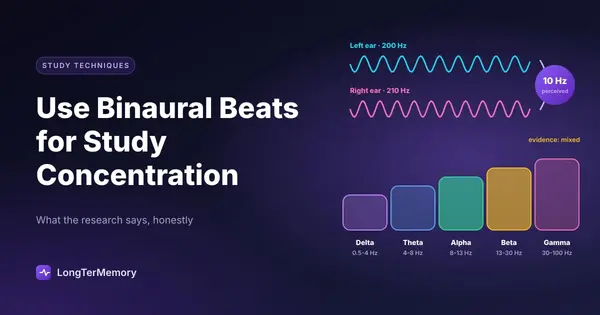
Binaural beats are an auditory illusion. When you play a tone of, say, 210 Hz in your left ear and a tone of 220 Hz in your right ear simultaneously, your brain doesn’t hear two separate tones. Instead, it perceives a third “beat” at the difference frequency, in this case 10 Hz. This perceived beat is the binaural beat.
The theory is that this perceived frequency can nudge your brain toward producing more brainwave activity at that same frequency, a phenomenon called brainwave entrainment. Different brainwave frequencies are associated with different mental states:
| Frequency Band | Hz Range | Associated State |
|---|---|---|
| Delta | 0.5, 4 Hz | Deep sleep |
| Theta | 4, 8 Hz | Light sleep, relaxation, creativity |
| Alpha | 8, 13 Hz | Calm alertness, relaxed focus |
| Beta | 13, 30 Hz | Active thinking, concentration |
| Gamma | 30, 100 Hz | High-level processing, learning |
The reasoning goes: if you want to study and need sustained focus, you’d want to be in a beta or gamma state. If you want to brainstorm or access creative ideas, you might target alpha or theta.
What the Research Says (Honestly)
Here’s where things get nuanced. The research on binaural beats is real, peer-reviewed, and published in credible journals. It’s also inconsistent, limited in scope, and often conducted on small samples. You shouldn’t dismiss it, but you definitely shouldn’t take the YouTube algorithm’s word for it either.
Positive findings: A 2019 meta-analysis published in Psychological Research reviewed 22 studies and found that binaural beats had a measurable effect on anxiety reduction and some aspects of cognitive performance. Studies using 40 Hz gamma beats have shown modest improvements in working memory tasks. Research from the University of Auckland found that alpha frequency beats (around 10 Hz) helped reduce anxiety without impairing cognitive performance.
The caveats: Effect sizes in most studies are small to moderate. A lot of the positive findings are on anxiety and mood rather than direct cognitive enhancement. Studies differ significantly in methodology, which makes comparison difficult. And crucially, many studies don’t control for placebo effects, meaning participants who believe binaural beats help them might perform better simply because they expect to.
The honest conclusion: Binaural beats are probably not a magical focus enhancer, but they’re also not nothing. For some people, in some contexts, they seem to reduce anxiety and improve task persistence. That’s a real, useful effect, even if it’s more modest than the YouTube titles suggest.
Choosing the Right Binaural Beat Frequency for Different Study Tasks
The frequency you choose matters more than most people realize, and the generic “focus beats” playlist isn’t always what you actually need.
Beta Waves (14, 30 Hz) for Analytical Work
Beta frequency binaural beats are the best match for focused, analytical study tasks. This includes:
- Working through math or science problem sets
- Reading dense technical material and taking notes
- Writing essays or structured arguments
- Reviewing flashcards with active retrieval
In the beta range, your brain is in its active thinking mode. Using binaural beats in this frequency may help sustain that state for longer, particularly if you’re fighting off the kind of afternoon mental fog that makes focused work feel hard.
The sweet spot in the beta range for study is roughly 15 to 20 Hz. Higher beta (above 25 Hz) is associated with active stress and anxiety rather than productive focus, so you don’t necessarily want to push into that territory.
Gamma Waves (30, 100 Hz) for Memorization and High-Level Processing
40 Hz gamma beats have attracted the most research attention. Studies from MIT and other labs have explored gamma entrainment in the context of memory and learning, with results suggesting that 40 Hz stimulation may support memory consolidation.
For study purposes, 40 Hz gamma is a reasonable choice when:
- You’re doing intensive flashcard review and want to be in a high-processing mode
- You’re trying to connect new information to things you already know
- You’re in a focused, distraction-free memorization session
The subjective experience of gamma beats is different from alpha or beta. Many people describe it as more intense, almost buzzing. Some find it grating. Test it before you commit to a two-hour session with it.
Alpha Waves (8, 13 Hz) for Creative and Conceptual Work
Alpha frequency beats produce a calm, relaxed alertness. They’re useful when:
- You’re trying to brainstorm connections between ideas
- You’re doing conceptual reading rather than technical memorization
- You’ve had a stressful day and need to settle into a study session before tackling harder material
- You’re doing pre-study journaling or planning your session
Alpha beats are also the best choice if anxiety is getting in your way. If you find yourself procrastinating or feeling overwhelmed before starting, alpha can serve as a kind of mental warm-up before switching to beta for the actual work.
Theta Waves (4, 8 Hz) for Relaxed Recall and Sleep-Adjacent Review
Theta beats are controversial for active studying because the theta state is close to the drowsy, pre-sleep state. They’re not appropriate for high-focus analytical work.
Where theta might actually be useful: the period immediately before sleep. Some evidence suggests that reviewing material in a theta state before sleeping can support the memory consolidation that happens during sleep. If you do a final light review of flashcards just before bed, theta beats in the background may complement that process, though this is speculative territory.
How to Use Binaural Beats Without Disrupting Active Recall Sessions
This is the part that most binaural beat guides skip entirely, and it’s important: there’s a real tension between binaural beats and the study techniques that actually drive learning.
The Problem: Passive Background vs. Active Retrieval
Active recall is the most evidence-backed study technique in existence. It requires you to generate answers from memory, struggle with retrieval, and engage your brain in productive effort. That effort is the whole point.
Here’s the risk: binaural beats, especially in alpha or theta, can nudge your brain toward a more passive, relaxed state. That might feel pleasant, but it can actually work against the effortful retrieval that makes active recall effective.
If you’re sitting back, listening to ambient binaural beats, reading your notes passively, you’ve created a calm, pleasant, and nearly useless study environment. The binaural beats didn’t fail you. You failed to use active recall in the first place.
When to Use Binaural Beats (And When to Skip Them)
Use binaural beats for:
- Getting into a focused state before a study session (alpha, 5 to 10 minutes)
- Sustained analytical reading where you’re actively annotating and questioning
- Low-stakes review of material you largely know already
- Background during written tasks like essay drafts
Consider skipping binaural beats for:
- Active flashcard retrieval (the silence and struggle is part of the process)
- High-effort problem solving in math or science (you don’t want entrainment pulling you out of effortful focus)
- Practice exams (simulate real exam conditions, no binaural beats in most testing rooms)
The general rule: binaural beats are most useful as an environmental tool to set your mental state, not as a replacement for the study techniques themselves.
Practical Setup for Study Sessions
Step 1: Pre-session alpha warm-up (5 to 10 minutes)
Before you start studying, put on 10 Hz alpha beats and do something low-effort: look over your notes briefly, set up your flashcards, plan what you’re going to cover. Let your brain settle from the noise of the day. Don’t study yet.
Step 2: Switch to beta or gamma for active work (25 to 90 minutes)
Once you’re in study mode, switch to 15 to 20 Hz beta beats (or 40 Hz gamma if you’re doing memorization). Keep the volume low enough that it’s almost subliminal. You should barely notice it after a few minutes. It shouldn’t be the focus of your attention.
Step 3: Remove headphones for active recall
When you close your notes and start doing retrieval practice, take the headphones off. Pure silence is fine. The retrieval struggle should happen without any environmental crutches. When you’re checking your answers and reviewing what you got wrong, you can put them back on.
Step 4: Brief alpha break between sessions
A 5-minute alpha beat break between Pomodoro intervals can smooth the transition between focus blocks. It’s a better alternative to scrolling your phone.
The Quality of Your Audio Equipment Matters
This is a practical note that most binaural beat articles ignore: binaural beats require headphones. They literally do not work through speakers because the left and right ear need to receive different frequencies independently. If you’ve been playing binaural beats through laptop speakers and wondering why they don’t seem to do anything, that’s why.
You don’t need expensive audiophile headphones. Any standard closed-back headphone will work. What you want to avoid is ear fatigue from wearing uncomfortable headphones for two hours, so comfort matters more than sound quality in this context.
Also, keep the volume moderate. There’s no evidence that louder binaural beats work better, and listening at high volume for extended periods carries its own risks.
Building Binaural Beats Into a Smarter Study Routine
Let’s be real about expectations. Binaural beats are not going to transform you into a studying machine overnight. They’re a marginal tool, potentially useful for some people in some conditions. If you’re already studying well with spaced repetition and active recall, binaural beats are a possible fine-tuning tool. If you’re not using evidence-based study techniques at all, binaural beats won’t compensate for that.
The students who tend to get the most out of binaural beats are those who:
- Struggle specifically with pre-study anxiety or difficulty settling into focus
- Study in noisy environments where binaural beats mask distracting sounds
- Find that music with lyrics is too distracting but complete silence feels uncomfortable
- Are already doing active recall and spaced repetition, and want to optimize their focus state
If you fit one or more of those descriptions, binaural beats are worth a genuine two-week trial. Track whether your session quality (as measured by performance on active recall, not just how you felt) improves. If it does, great. If not, don’t force it.
The tool that reliably works for everyone is still retrieval practice. Binaural beats are for the students who’ve already nailed the fundamentals and want to squeeze a bit more out of every session.
Try the LongTerMemory platform to build active recall into your daily study routine automatically, and experiment with binaural beats alongside it to find your own optimal focus environment.
The Bottom Line
Binaural beats have a real neurological mechanism, modest but genuine research support, and a tendency to be marketed with far more confidence than the evidence warrants. They’re worth trying, not worth paying a lot for, and definitely not worth using as a substitute for the study techniques that actually drive retention.
If you put them in the right place, as a mental warm-up tool, an anxiety buffer, and a background aid for analytical work, they can genuinely improve your study session quality. Just don’t let the headphones be a reason to avoid doing the hard, effortful retrieval work that makes everything actually stick.