How to Use Body Doubling to Improve Study Focus
Learn how body doubling boosts study focus, where to find virtual study partners, and how to combine it with proven learning techniques.
Table of Contents
- What body doubling is and why it works for focus
- The psychology behind social presence and productivity
- How body doubling helps with task initiation
- Virtual body doubling: platforms and communities for study partners
- Focusmate and structured co-working sessions
- Discord study servers and live study streams
- How to choose the right virtual body doubling format
- Using body doubling alongside other focus techniques
- Body doubling and the Pomodoro Technique
- Combining body doubling with active recall
- Integrating spaced repetition into partner sessions
- Building a sustainable body doubling habit
- When body doubling is not the right tool
- The bottom line
You sit down at your desk, open your laptop, and tell yourself you are going to study. Two minutes later, you are rearranging your pen collection. Three minutes after that, you suddenly need to know the weather forecast for next Thursday. Five minutes in, you have convinced yourself that the real problem is your desk setup, and if you just reorganized everything, studying would finally become easy. You have not studied. You have performed an elaborate ritual of productive procrastination, and you are exhausted.
If this feels uncomfortably familiar, you are not alone. The ability to sit down and actually start working, what psychologists call task initiation, is one of the hardest parts of studying for a huge number of people. It is not a discipline problem. It is a neurological and environmental one. And one of the most effective, underappreciated solutions is something called body doubling.
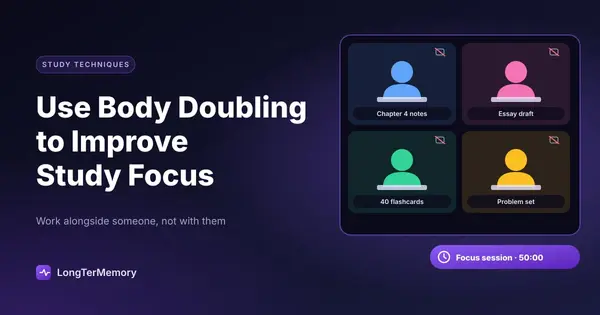
Body doubling is the practice of working alongside another person, either physically or virtually, to increase focus and accountability. It sounds almost too simple to work. But for many students, especially those with ADHD or those who struggle with sustained concentration, it transforms study sessions from a battle of willpower into something genuinely manageable.
This post covers exactly what body doubling is, why the research supports it, where to find virtual body doubling partners and communities, and how to combine body doubling with the study techniques that actually produce retention.
What body doubling is and why it works for focus
Body doubling means having another person present while you work, creating ambient social pressure that makes starting and continuing tasks easier. The term comes from the ADHD community, where it has been used informally for years before spreading into mainstream productivity culture. The core idea is straightforward: when someone else is working alongside you, even silently, your brain treats the activity as more legitimate and harder to abandon.
You do not need to interact with the other person. You do not even need to be studying the same subject. The presence itself is the active ingredient. This is why coffee shops can be surprisingly productive environments. The ambient presence of other people working creates a low-level social accountability that your brain responds to automatically.
The psychology behind social presence and productivity
The scientific foundation for body doubling comes from a well-established body of research on social facilitation. In 1965, psychologist Robert Zajonc published foundational work showing that the mere presence of others enhances performance on simple or well-learned tasks. While the original research focused on physical co-presence, modern virtual body doubling platforms produce a similar effect through video presence.
More recent research on accountability adds another layer. A study by the American Society of Training and Development found that people are 65% more likely to complete a goal after committing to another person. That number jumps to 95% when they build in ongoing accountability check-ins, like regular study sessions with a partner.
| Mechanism | How Body Doubling Uses It | Source |
|---|---|---|
| Social facilitation | Presence of others increases task seriousness and effort | Zajonc, 1965 |
| Accountability commitment | Committing to another person raises follow-through rates | ASTD accountability study |
| Reduced task initiation cost | Shared environment lowers the psychological barrier to starting | ADHD clinical literature |
| Mirror neuron activation | Seeing others work primes your own work-related neural circuits | Rizzolatti & Craighero, 2004 |
The mirror neuron research is particularly relevant here. When you watch another person engaged in focused work, your brain partially simulates that same focused state. This is not woo-woo neuroscience. It is a measurable, replicable effect. Your brain is literally being primed for concentration by the visible concentration of another person.
How body doubling helps with task initiation
For people who struggle with executive function, especially those with ADHD, the hardest part of studying is rarely the material itself. It is the transition from “not studying” to “studying.” This transition has a name in clinical psychology: task initiation. And it is where body doubling shines.
When you book a body doubling session with someone, you have made a pre-commitment. You have an appointment. Someone is expecting you to show up and work. That external structure does the heavy lifting that willpower would otherwise have to do, and willpower is a finite resource that depletes over the course of a day.
Research on ADHD and executive function consistently shows that external scaffolding, timers, schedules, visible reminders, and social accountability, outperforms internal motivation for sustaining difficult tasks. Body doubling is one of the simplest forms of external scaffolding available.
The effect is not limited to people with ADHD. Even neurotypical students show measurable improvements in sustained attention and reduced mind-wandering when working in the presence of others compared to working alone. The difference is that for people with strong executive function, the effect is a nice bonus. For people with weaker executive function, it can be the difference between a productive session and no session at all.
If you want to understand the broader mechanics of how focus works and how to protect it once you have it, our guide on how to enter a flow state for studying covers the conditions that make deep absorption possible.
Virtual body doubling: platforms and communities for study partners
The most accessible way to start body doubling is through virtual platforms like Focusmate, Discord study servers, and livestream study communities, which connect you with study partners without requiring anyone to leave home. The pandemic normalized remote work, and a side effect was the explosive growth of online spaces designed specifically for parallel work and study. You no longer need a library or a coffee shop. You just need an internet connection and a webcam.
Focusmate and structured co-working sessions
Focusmate is arguably the most structured platform for body doubling. You book a 25-minute or 50-minute video session with a randomly matched partner. At the start, you each state what you will work on. Then you work in silence, cameras on, for the duration of the session. At the end, you briefly check in on how it went.
The format is deliberately minimal. There is no chat during the session. No discussion of your work. Just the quiet presence of another human being working alongside you. For many students, this is exactly the right level of social pressure. It is enough to prevent you from opening TikTok. It is not so much interaction that it becomes a social event instead of a study session.
Focusmate offers three free sessions per week, with unlimited sessions available through a paid subscription. The platform reports that users complete over 1 million sessions per month, which gives you a sense of how widely adopted this practice has become.
Discord study servers and live study streams
Discord has become one of the largest hubs for informal body doubling. Servers like The Study Hall (formerly StudyTogether) host thousands of members who join voice or video channels to study together in parallel. Unlike Focusmate, these environments are group-based rather than one-on-one, which some people find more comfortable and others find more distracting.
The typical structure in a Discord study server looks like this:
- You join a “study room” voice channel
- You announce what you are working on in a text channel
- A bot starts a Pomodoro timer for the group
- Everyone works in silence during the focus period
- The bot announces break times, during which people can chat
This structure combines body doubling with the Pomodoro Technique, creating a powerful dual-layer accountability system. The group presence keeps you from abandoning the session, and the timed intervals keep you from burning out.
StudyStream is another major platform, originally built for medical students but now open to all subjects. It uses a “virtual library” format where you study on camera alongside hundreds of other students. The visibility creates ambient social pressure, and the leaderboard-style engagement adds gamification for people who respond to that kind of motivation.
How to choose the right virtual body doubling format
Not every format works for every person. The right choice depends on your personality, your distraction triggers, and what you are trying to accomplish.
| Format | Best For | Potential Drawback |
|---|---|---|
| One-on-one video (Focusmate) | People who need strong, direct accountability | Can feel intense or awkward for introverts |
| Small group Discord | People who want community plus structure | Group chat during breaks can derail focus |
| Large virtual library (StudyStream) | People motivated by visible collective effort | Less personal accountability; easier to fade into the background |
| Silent livestreams | People who want ambient presence without interaction | No reciprocal accountability; you can leave unnoticed |
If you are unsure where to start, begin with Focusmate or a small Discord group. Both formats create reciprocal accountability, which means your partner is counting on your presence as much as you are counting on theirs. That mutual expectation is what makes body doubling effective.
For a deeper dive into finding and evaluating study partners specifically, our guide on how to find a study buddy online covers the compatibility factors that make partnerships last beyond the first session.
Using body doubling alongside other focus techniques
Body doubling amplifies other study techniques rather than replacing them, and it works best when paired with structured methods like the Pomodoro Technique, active recall, and spaced repetition. The social presence gets you started and keeps you in your seat. The study techniques ensure that the time you spend actually produces learning.
Body doubling and the Pomodoro Technique
The Pomodoro Technique is one of the most natural partners for body doubling. A standard Pomodoro is 25 minutes of focused work followed by a 5-minute break. When you combine this with body doubling, you get both the time-bound structure of the Pomodoro and the social accountability of a partner expecting you to stay focused for the full interval.
Here is a simple protocol that works well:
- At the start of the session, tell your body doubling partner what you will cover in the next 25 minutes
- Set a visible timer that both of you can see
- Work silently until the timer ends
- Take a 5-minute break together, or switch to independent breaks if conversation derails your momentum
- Repeat for four cycles, then take a longer 20 to 30 minute break
The verbal commitment at step one is important. Saying your goal out loud creates what psychologists call an implementation intention, a specific plan that links a situation (the next 25 minutes) to a behavior (working through a specific set of problems or pages). Research shows that implementation intentions significantly increase follow-through compared to vague intentions like “I will study.”
Combining body doubling with active recall
Active recall, or retrieval practice, is the single most evidence-backed study technique available. It means testing yourself on material rather than passively re-reading it. Body doubling pairs with active recall in two distinct ways.
First, during parallel work sessions, you can use your body doubling partner as a quiz source. After you have both studied a section independently, spend ten minutes quizzing each other. The act of generating questions for your partner is itself a form of active recall, and answering your partner’s questions provides retrieval practice on material you might not have thought to test yourself on.
Second, even without direct quizzing, the social presence of body doubling makes active recall feel less effortful. Retrieval practice is cognitively demanding. It feels harder than re-reading because it is harder, and that difficulty is what makes it effective. But the extra cognitive load can be demotivating when you are alone. Having someone else in the room, even silently, reduces the subjective feeling of effort. The task still requires the same brain work, but the social context makes it feel more bearable.
If you want a full breakdown of retrieval practice and how to build it into every study session, our guide on active recall techniques covers the research and the practical methods in detail.
Integrating spaced repetition into partner sessions
Spaced repetition is the practice of reviewing material at progressively increasing intervals to counteract the natural forgetting curve. It is the foundation of long-term retention, and it is especially important for students preparing for professional certifications or cumulative final exams.
Body doubling and spaced repetition fit together naturally in a daily routine. Your spaced repetition review, whether you use physical flashcards or a digital system, is an ideal task for a body doubling session. It is discrete, time-bound, and requires consistent daily execution, which is exactly where accountability helps most.
If you are still creating flashcards manually, you are spending a significant portion of your study time on formatting and organization rather than on actual learning. LongTerMemory eliminates that overhead by generating flashcards automatically from your PDFs, web articles, and uploaded notes. You upload your material, and the system extracts key concepts into review-ready cards, then schedules them using an optimized spaced repetition algorithm.
The time savings are substantial. Students who switch from manual flashcard creation to automated ingestion typically report saving 3 to 5 hours per week on card production alone. Those hours go back into actual study, actual retrieval practice, or actual rest, all of which produce better outcomes than formatting cards.
You can run your LongTerMemory review session during a body doubling block the same way you would run any other focused task. The accountability keeps you from skipping reviews, and the automated scheduling ensures you are always reviewing the right material at the right interval. If you have not tried it, the free trial is worth running alongside your next week of body doubling sessions to see how the combination feels.
For a deeper look at why spaced repetition outperforms cramming and massed practice, read our article on the science of spaced repetition.
Building a sustainable body doubling habit
The students who get the most out of body doubling are not the ones who do it once and expect a miracle. They are the ones who build it into a consistent routine. Here are the habits that make body doubling sustainable over weeks and months:
- Schedule sessions in advance. Spontaneous body doubling rarely happens. Book your sessions at the start of each week, the same way you would schedule classes or meetings.
- Use the same partner when possible. Repeated sessions with the same partner build social rapport and mutual expectation, which strengthens accountability over time.
- Match session length to your task. Use 25-minute sessions for dense memorization or problem sets. Use 50-minute sessions for extended reading or writing tasks.
- Protect the silence. The power of body doubling comes from parallel presence, not conversation. Agree upfront that discussion happens during breaks, not during focus periods.
- Track your consistency. Note which days you body double and which days you do not. Most people find that their productive output correlates strongly with their body doubling consistency.
When body doubling is not the right tool
Body doubling is powerful, but it is not universal. There are situations where it can backfire or simply not fit.
If you are doing deep creative work that requires extensive internal visualization or free association, the presence of another person can actually interfere with the cognitive process. Similarly, if you are highly sensitive to social evaluation, knowing that someone can see you work might increase anxiety rather than focus.
Body doubling is also less effective for tasks that are already highly engaging and intrinsically motivating. If you are already in a state of deep flow while coding or writing, adding a body doubling partner is unnecessary and potentially disruptive.
The sweet spot for body doubling is moderate-difficulty, moderately aversive tasks that you struggle to initiate or sustain alone. Studying for exams, reviewing flashcards, working through problem sets, and processing reading assignments all fit this category perfectly.
The bottom line
Body doubling works because humans are social learners, and stripping all social context out of studying makes it harder than it needs to be. The presence of another person, even silently, even virtually, creates the external scaffolding that many brains need to transition into focused work and stay there.
You do not need to overhaul your entire study system. You just need to try one 25-minute body doubling session this week. Book it on Focusmate, join a Discord study room, or ask a friend to sit on a video call with you while you both work. Notice what happens to your ability to start, to sustain, and to finish.
Then combine that social accountability with study methods that actually produce retention. Use the Pomodoro Technique to structure your time. Use active recall to engage your brain. Use spaced repetition, ideally with a tool like LongTerMemory that handles the scheduling and card generation for you, to lock the material into long-term memory.
Body doubling gets you to the desk. The right study techniques make sure the time at the desk actually counts. Together, they are one of the most reliable combinations for students who want to study less, learn more, and stop fighting their own brain every time they open a textbook.