How to Recover Your Focus After a Distracted Study Session
Practical techniques to reset your focus after a distracted study session and build an environment that keeps you locked in next time.
Table of Contents
- Why Distraction Happens in the First Place
- The 5-Minute Focus Reset
- The Role of Specificity in Sustained Focus
- Environmental Changes That Prevent the Next Distracted Session
- Your Phone
- Browser and Notifications
- Your Physical Space
- Behavioral Strategies for Staying Focused Mid-Session
- The Parking Lot Technique
- Intention Declaration Before Sessions
- Self-Compassion After Drift
- When Distraction Is Actually Anxiety
- Cognitive Fatigue vs. Resistance: Knowing the Difference
- Rebuilding After a Lost Session
- The Bottom Line
You sit down to study. You open your notes. You tell yourself today is the day you’ll finally get on top of the material. Then somehow, 90 minutes pass and you’ve accomplished almost nothing. Maybe you were on your phone. Maybe you kept drifting to other browser tabs. Maybe your mind just circled the same anxious thoughts about how much you have to do, which paradoxically made it impossible to do any of it.
The distracted study session is one of the most demoralizing experiences in a student’s life, especially when an exam is close and you genuinely needed that time. The frustration is real. But here’s something important to understand before you give up on the day entirely: the way you respond to a distracted session in the next ten minutes determines whether the rest of your day is salvageable.
This guide gives you both the immediate reset and the longer-term fixes.
Why Distraction Happens in the First Place
Before you can fix distracted studying, it helps to understand what’s actually causing it. Distraction during studying is not a character flaw. It has specific, identifiable causes, and each one has a different solution.
Cognitive fatigue: your brain is depleted from prior mental effort, poor sleep, or simply an extended focus demand. When cognitive resources are low, the brain gravitates toward lower-effort stimulation, which is exactly what scrolling social media provides.
Anxiety about the material: this one is underappreciated. When you’re studying something that feels overwhelming or where you’re falling behind, avoidance is a natural psychological response. The distraction isn’t random; it’s the brain steering away from something that feels threatening.
Environmental triggers: phone notifications, open browser tabs, ambient noise, a cluttered desk. These aren’t minor factors. Research on attentional interruption shows that a single notification pulls your focus even if you don’t act on it, and full recovery to deep focus can take 15 to 25 minutes after a meaningful interruption.
Lack of task specificity: when you sit down to “study,” your brain doesn’t have a clear target. Without a defined task and endpoint, it defaults to whatever is most immediately accessible. “Study for the exam” is not a task. “Complete 15 practice questions on the cardiovascular system before the 25-minute timer ends” is a task.
Understanding which of these is driving your distraction points you toward the right solution.
The 5-Minute Focus Reset
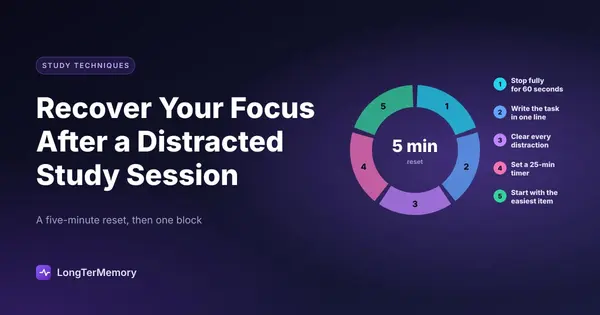
When you’ve realized a session has gone sideways, don’t try to muscle through by extending the session or punishing yourself with extra time. Instead, stop completely and run this reset:
Step 1: Fully stop for 60 seconds. Not to check your phone, not to scroll anything. Just sit quietly. You’re clearing the mental residue of the distraction, not feeding it.
Step 2: Write down your specific task in one sentence. Not “study marketing” or “review for Thursday.” Write something like: “In the next 25 minutes I will complete 10 practice questions on Porter’s Five Forces and write a brief answer to one case scenario.” Specificity creates a target the brain can orient toward.
Step 3: Remove every distraction from your physical environment. Phone in another room or in a drawer (not face-down on your desk, not on silent nearby). Close every browser tab except what you need. If you need the internet, close social media and news sites specifically.
Step 4: Set a 25-minute timer and commit only to that block. Not the whole study session. Not the rest of the day. Just 25 minutes. The Pomodoro technique works partly because a finite time block is less psychologically daunting than an open-ended study session.
Step 5: Start with the easiest item on your task. Inertia is the enemy of refocusing. Don’t begin with your hardest concept right after a distracted hour. Begin with something manageable to rebuild momentum, then work toward harder material.
This reset takes less than five minutes to execute. Most people who use it consistently find that a clean 25-minute session after the reset produces more retention than the 90 distracted minutes that preceded it.
The Role of Specificity in Sustained Focus
Research on implementation intentions (popularized by psychologist Peter Gollwitzer) shows that “when-then” planning dramatically increases follow-through on intentions. Vague commitments (“I’ll study more”) fail to compete with the pull of distractions. Specific situational commitments (“When I sit down at my desk at 4pm, I will immediately close all browser tabs before opening my notes”) are far more resistant to avoidance behavior.
Before each study session, write one sentence with this structure: “For the next [time], I will [specific task] until [completion criterion].”
Examples:
- “For the next 25 minutes, I will work through 15 insurance licensing practice questions without checking my phone.”
- “For the next 30 minutes, I will read and annotate sections 4.1 through 4.3 of the pharmacology chapter.”
- “For the next 20 minutes, I will turn all my chemistry notes from Chapter 12 into flashcard questions.”
The completion criterion is key. It gives you a clear moment of success rather than an open-ended task that could continue indefinitely.
Environmental Changes That Prevent the Next Distracted Session
The most durable fix for distracted studying is making distraction structurally harder to access.
Your Phone
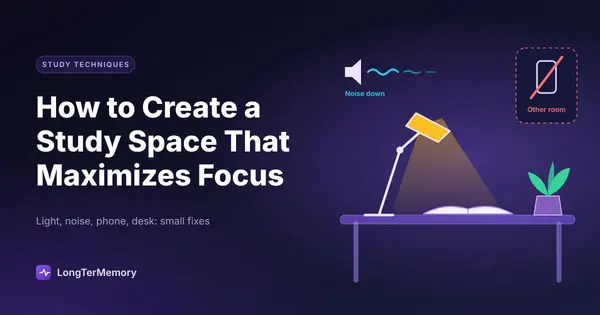
This is the single most effective environmental change you can make. The research on smartphone presence and cognitive performance is unambiguous: even a phone on the desk face-down, with sound off, reduces available working memory because part of your brain is monitoring it.
The fix is physical distance. Put your phone in a different room while you study. If that’s not possible, put it in a drawer or bag out of your line of sight. The resistance of having to get up and retrieve it is often enough to break the automatic reach.
Browser and Notifications
Install a site blocker for the duration of your study sessions. Tools like Freedom, Cold Turkey, and others can block specific websites or categories (social media, news, video platforms) for a set period. The key is that these blocks are harder to override in the moment than willpower alone, which is precisely why they work.
Turn off all desktop notifications. Not just on your phone but on your computer. Email, messaging apps, calendar alerts, all of it. Even notifications you don’t act on cost you attention.
Your Physical Space
A dedicated study space, used only for studying, conditions your brain to shift into focus mode when you sit there. This is a form of context-dependent memory: your brain associates the space with a particular type of activity. A bed or a couch, where you also watch TV and scroll, sends a mixed signal.
If you don’t have a dedicated study space, create the study context through ritual: clear the desk, make a drink, put on headphones (with or without music), open only your study materials. The ritual signals to your brain that focus mode is beginning.
Noise is individual. Some people focus better with ambient sound (coffee shop noise, lo-fi music without lyrics). Most people focus better with silence or instrumental music when doing reading and writing tasks, while some light background noise is acceptable for repetitive tasks like flashcard review. Experiment deliberately to find what works for you, rather than assuming music is always fine.
Behavioral Strategies for Staying Focused Mid-Session
Even with a good environment, your mind will wander. That’s not a failure. Research on mind-wandering suggests the average person’s attention drifts every few minutes even under good conditions. The skill isn’t eliminating drift; it’s catching it quickly and returning without spiral.
The Parking Lot Technique
When an unrelated thought appears during a study session (you need to text someone back, you remember an errand, you think of something you forgot to do), don’t try to suppress it and don’t act on it immediately. Instead, keep a small notepad nearby and write the thought down briefly, then return to your work.
This technique satisfies the brain’s need to capture important information without fracturing your focus. The thought is no longer competing for attention because it’s safely recorded. You can address it after your session.
Intention Declaration Before Sessions
Before you start, write or say aloud: “For the next 25 minutes, my only job is to complete these 10 practice questions.” Research on this kind of advance intention-setting shows it significantly improves follow-through.
Telling yourself what you’re doing before you start it primes your attention in a way that silently opening your notes does not.
Self-Compassion After Drift
When you catch yourself drifting, avoid the temptation to self-criticize. Research on attention restoration consistently shows that harsh self-criticism after distraction leads to more distraction, not less. It adds emotional arousal that further disrupts the calm state that focused studying requires.
The functional response to catching drift is simple: notice it, note what you were thinking if it’s useful, and return to your task. No judgment. No lengthy internal negotiation. Just redirect.
When Distraction Is Actually Anxiety
Sometimes distraction is a symptom of something more specific: anxiety about the material you’re studying. This is particularly common when you feel behind, when a topic is genuinely difficult, or when the stakes of the exam feel very high.
Anxiety-driven distraction looks different from fatigue-driven distraction. You’re not just drifting; you’re actively avoiding. The avoidance feels urgent, even though part of you knows you should be studying.
The fix here isn’t to try harder. It’s to make the task smaller.
Instead of “study thermodynamics,” the next task becomes “read and understand one paragraph of the thermodynamics section and write down one thing it explains.” The micro-task creates a foothold. Once you complete it, the next micro-task becomes a little easier.
LongTerMemory is genuinely useful here. When a topic feels overwhelming as a block of textbook text, converting it into structured Q&A flashcards breaks it into small, discrete review units. Each question is a self-contained task you can accomplish in 30 seconds. The mountain of material becomes a sequence of manageable steps.
Cognitive Fatigue vs. Resistance: Knowing the Difference
Not all difficulty focusing is the same, and treating them differently matters.
Cognitive fatigue is genuine mental depletion. Signs include difficulty tracking sentences you’ve just read, making simple errors on problems you know how to solve, and feeling physically heavy or slow. Cognitive fatigue is a signal to rest, not to push through.
Resistance is the psychological friction of starting or continuing a difficult or unpleasant task. It often shows up in the first few minutes of a study session or when transitioning to a harder topic. It feels uncomfortable, but it doesn’t reflect actual incapacity.
Cognitive fatigue calls for a real break: a 20-minute walk, a nap, food, or genuine downtime. Trying to study through actual fatigue produces very little.
Resistance calls for a small commitment and a first step. The first three minutes of working through resistance are usually the hardest. After that, momentum often builds.
When you’re not sure which one you’re experiencing, ask: could I do something cognitively easy right now (simple flashcard review, reading without note-taking) without difficulty? If yes, you’re probably dealing with resistance, not fatigue. If even easy cognitive tasks feel hard, rest.
Rebuilding After a Lost Session
When a session is genuinely gone, don’t try to extend it indefinitely out of guilt. A clean 25-minute Pomodoro after a reset is worth more than three more hours of half-focused drift.
A few practices that help rebuild after a lost session:
End on a completion. Before you stop, finish one specific small task: answer three practice questions, summarize one paragraph in your own words, complete one flashcard set. The sense of completion creates a psychological close that makes it easier to return next time.
Track what distracted you. In a notebook, briefly note: what time the session started, what triggered the distraction (phone notification, anxiety spiral, fatigue), and roughly how long you lost. Over a week, patterns appear. If you’re always distracted after 60 minutes, build a break at 50. If social media is always the trigger, make it structurally inaccessible.
Don’t add extra sessions as punishment. If you study from 6pm to 8pm but only focused for 40 minutes, adding an extra session at 10pm out of guilt often produces a second distracted session rather than a productive one. Better to end at 8pm, sleep adequately, and return fresh at 8am.
The Bottom Line
Distracted study sessions are not a character flaw and they’re not evidence that you can’t do the work. They’re feedback. They tell you something about your environment, your energy state, your relationship to the material, or the specificity of your tasks.
The five-minute reset is your immediate tool. Environmental fixes are your medium-term protection. Understanding the specific cause of your distraction is your long-term strategy.
One clean, focused 25-minute session is worth more than an afternoon of distracted presence at your desk. Build toward consistent, quality sessions rather than simply logging hours. Once you’ve reset, a 30-minute focused session is often the right next step. See our guide on how to memorize fast in 30 minutes for the full framework.
The work is hard enough. Don’t let a bad hour define the rest of the day.