How to Use Body Language to Improve Study Performance
Posture, power poses, and study positions: what the research says about body language and learning, and how to sit, stand, and move for alertness.
Table of Contents
- How Physical Posture Affects Cognitive Performance and Confidence
- What We Know
- Quick Summary Table
- Confidence vs Competence
- The Power Pose Research and What It Actually Means for Studying
- The Original Study and the Backlash
- What Remains
- A Better Approach to Exam Nerves
- Study Positions That Support Alertness vs Those That Trigger Sleepiness
- Alertness-Friendly Positions
- Sleepiness Traps
- Match Position to Task
- The Sit-Stand-Move Rhythm
- A Simple Ergonomic Setup for Long Study Sessions
- Quick Self-Check
- Using Your Body to Aid Memory
- Common Mistakes
- A 5 Minute Pre-Study Routine
- Frequently Asked Questions
- Does good posture improve concentration?
- Do power poses help before an exam?
- Is it bad to study lying down?
- Are standing desks better for studying?
- How often should I take movement breaks?
- The Bottom Line
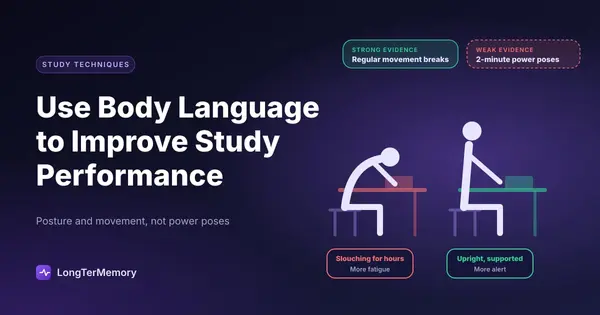
Your body language affects studying mainly through alertness, comfort, and energy, not through magic confidence tricks. An upright but relaxed posture, regular movement, and a study position that matches the task can help you stay awake and focused. Standing in a superhero pose before an exam, however, has far weaker evidence than the internet suggests.
Let me be upfront about something. When I started studying cognitive psychology, I loved the idea that a two minute pose could change my exam performance. Then I read the replication studies. The honest story is more interesting and more useful, so let me walk you through what actually helps.
How Physical Posture Affects Cognitive Performance and Confidence
Posture influences how you feel and how alert you are, with modest effects that add up over long study sessions. The mechanisms are mostly practical: breathing, blood flow, comfort, and the cues your body sends your brain.
What We Know
- Embodied cognition. Psychologists have found that body states can influence thinking and emotion. For example, a well-known study by Briñol, Petty, and Wagner (2009) found that people sitting upright rated their own thoughts as more valid and confident than people slouching. The effect was on self-confidence in thoughts, not on knowledge itself.
- Breathing. Slumping compresses your chest and diaphragm, which can make breathing shallower. Fuller breathing supports alertness and helps manage stress.
- Discomfort drains attention. Neck and back pain are a constant background distraction. The more your body complains, the less attention is left for the material.
- Energy and mood. A 2014 review in the journal Health Psychology and a 2016 study on posture and mood suggested that upright posture can improve mood and reduce fatigue in some people, though results vary.
Quick Summary Table
| Body factor | Likely effect on studying | Strength of evidence |
|---|---|---|
| Upright, supported posture | Slightly higher alertness and comfort | Moderate |
| Slouching for hours | More fatigue, back and neck pain | Moderate |
| Regular movement breaks | Better focus and energy | Strong |
| Power posing | Feels good, hormone claims did not replicate | Weak |
| Nervous fidgeting | Can signal stress, may drain focus | Limited |
| Lying down to read | Higher risk of drowsiness | Practical, anecdotal |
Confidence vs Competence
One caution: feeling confident does not make your answers correct. Confidence from good posture is useful for staying calm and persistent, but it cannot replace actually knowing the material. Think of posture as a helper, never the main strategy.
The Power Pose Research and What It Actually Means for Studying
Power posing is the claim that standing in expansive poses for a couple of minutes boosts testosterone, lowers cortisol, and makes you act more boldly. The hormone claims have not held up in replications. Here is the short history.
The Original Study and the Backlash
In 2010, Dana Carney, Amy Cuddy, and Andy Yap published a study suggesting that two minutes of “high-power” poses changed hormone levels and increased risk-taking. It became hugely popular after a widely viewed TED talk.
Later, large replication attempts, including a 2015 study by Ranehill and colleagues with a much bigger sample, failed to reproduce the hormone changes and behavioral effects. In 2016, Dana Carney publicly stated that she no longer believed the original effects were real.
What Remains
| Claim | Status |
|---|---|
| Power poses change testosterone or cortisol | Not supported |
| Power poses change actual behavior or risk-taking | Not supported |
| Power poses make people feel more powerful | Some support, modest and inconsistent |
So if a two minute stance helps you feel a little calmer before an exam, that is fine, as long as you treat it as a relaxation ritual, not a performance upgrade. A better pre-exam routine might include slow breathing (for example, inhaling for four seconds and exhaling for six), a short walk, and a quick look at your formula sheet.
A Better Approach to Exam Nerves
- Reappraise anxiety as excitement. Research by Alison Wood Brooks (2014) found that telling yourself “I am excited” improved performance on stressful tasks compared with trying to calm down.
- Breathe slowly. Long exhales activate the calming branch of your nervous system.
- Do a brief movement. A 5 minute walk can reduce tension.
Study Positions That Support Alertness vs Those That Trigger Sleepiness
Positions that keep you upright and slightly active support alertness, while reclining, warm, and cozy positions invite sleep. Match the position to the type of task.
Alertness-Friendly Positions
| Position | Best for | Tips |
|---|---|---|
| Sitting upright at a desk | Writing, problem solving, flashcards | Feet flat, back supported, screen at eye level |
| Standing desk | Reading, review, flashcards | Alternate with sitting, avoid locking your knees |
| Walking | Audio review, reciting, memorizing lists | Safe route, hands free |
| Pacing while explaining aloud | Feynman technique, rehearsal | Great for oral exams |
| Sitting on a firm chair | Long focus blocks | Avoid sinking into soft cushions |
Sleepiness Traps
- Studying in bed. It teaches your brain to link bed with studying, which can hurt sleep too.
- Deep couch slouch. A reclined body and a warm room are a recipe for yawning.
- Heavy meals before a session. Digestion and posture both pull energy down.
- Dim, warm rooms. Light and temperature matter. Slightly cool and well lit helps most people.
Match Position to Task
Not all studying is the same. Some tasks reward a relaxed position:
- Light review or first-pass reading can be done in a comfortable chair.
- Hard problem solving and writing need an upright, desk-based setup.
- Memorization by recitation works well while standing or walking.
- Recorded lectures can be watched upright with a notebook.
If you are curious about the broader connection between lifestyle and learning, our post on active recall techniques shows how to make sure the time you do spend studying is actually effective.
The Sit-Stand-Move Rhythm
A useful rule of thumb many ergonomics specialists suggest is to change position roughly every 30 to 45 minutes. A simple rhythm:
- Sit for a focused block of 30 to 45 minutes.
- Stand or stretch for 2 to 5 minutes.
- Walk during longer breaks, ideally outside.
- Repeat.
Short movement breaks are among the best-supported ways to maintain attention. Studies on classroom movement and on desk workers report better focus and mood after brief activity.
A Simple Ergonomic Setup for Long Study Sessions
A good setup reduces pain and distraction so your attention goes to the material. Use this checklist.
- Chair: feet flat on the floor, knees around 90 degrees, lower back supported.
- Screen: top of the screen at or just below eye level, about an arm’s length away.
- Keyboard and mouse: elbows close to your body and bent around 90 degrees, wrists neutral.
- Light: bright, indirect lighting, with no glare on the screen.
- Table height: forearms parallel to the floor when typing.
- Books and notes: use a stand to avoid craning your neck.
If you study on a laptop, raise it on a stack of books and add an external keyboard. It costs little and saves your neck.
Quick Self-Check
| Ask yourself | If the answer is yes |
|---|---|
| Is my head pushed forward? | Raise the screen and tuck your chin slightly |
| Are my shoulders up near my ears? | Drop them, breathe out |
| Are my feet dangling? | Use a footrest or a stack of books |
| Have I been still for over an hour? | Stand up and move now |
Using Your Body to Aid Memory
Movement and gesture can directly help learning and recall, not just alertness. This is one of the more interesting areas of the research.
- Gesturing while explaining. Studies by Susan Goldin-Meadow and colleagues found that gesturing can help people think through problems and remember explanations.
- Learning by doing. Acting out vocabulary or procedures can boost recall, especially in language learning.
- Walking and thinking. A well-known Stanford study (Oppezzo and Schwartz, 2014) found that walking boosted creative idea generation compared with sitting.
- Context cues. Studying in varied positions and places may help recall hold up in different settings, though evidence is mixed.
Pair this with spaced repetition and you get a powerful combination. If you use LongTerMemory, for example, you can turn your notes into flashcards automatically, then review them while standing or walking to combine physical activity with scheduled retrieval.
Common Mistakes
- Believing power poses replace studying. They do not.
- Sitting for hours without breaks. Fatigue and pain build up.
- Studying in bed. It hurts both studying and sleep.
- Ignoring pain. Chronic neck or back pain is a signal, so adjust your setup or see a professional.
- Over-engineering your setup. An expensive chair will not do the studying for you.
- Mistaking comfort for productivity. Very comfortable positions often lead to low attention.
A 5 Minute Pre-Study Routine
A short ritual can cue your brain that it is time to focus and get your body ready. Try this before each session.
- Stand up and roll your shoulders back three times.
- Take five slow breaths, exhaling longer than you inhale.
- Sit with your feet flat and your back supported.
- Place your phone out of sight.
- Write down your single goal for the session.
Do it daily and the routine itself becomes a cue. After a couple of weeks, you may find it easier to slip into focus.
Frequently Asked Questions
Does good posture improve concentration?
It can help modestly, mainly by reducing discomfort and supporting alertness. Effects are small, so treat posture as support for good study strategies.
Do power poses help before an exam?
The evidence is weak. They may help you feel slightly calmer, but they do not change hormones or performance in a reliable way. Slow breathing and reframing nerves as excitement have better backing.
Is it bad to study lying down?
It is not harmful in a medical sense, but it raises the odds of drowsiness. Save reclined positions for easy review, and use an upright position for demanding work.
Are standing desks better for studying?
They can help with energy and comfort, especially for review tasks. The ideal is to alternate between sitting, standing, and moving.
How often should I take movement breaks?
Every 30 to 45 minutes works for many people. Short breaks of 2 to 5 minutes are usually enough.
The Bottom Line
Body language will not do your studying for you, and power poses are better left as a fun story than a strategy. But how you sit, stand, and move shapes your comfort, energy, and attention, and over a long semester those small effects add up.
Choose an upright, supported position for demanding tasks, move every half hour, save the couch for easy review, and keep your sessions free of pain. Pair that with active recall and spaced repetition, and your body becomes an ally in learning instead of a drag on it.