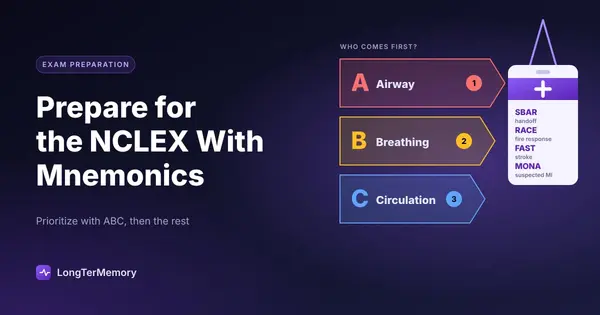
How to Prepare for the NCLEX With Mnemonics
The best NCLEX mnemonics for high-yield topics, how to build your own clinical memory aids, and how to combine them with spaced repetition for exam day.
Table of Contents
- Why Mnemonics Work for Nursing Content
- The NCLEX at a Glance
- The Most Useful Mnemonics for High-Yield NCLEX Topics
- Prioritization and safety
- Emergencies and assessment
- Fluids, electrolytes, and acid-base
- Systems and concepts
- Creating Your Own Clinical Mnemonics
- A five-step method
- Example: building a mnemonic for signs of digoxin toxicity
- Pitfalls to avoid
- Integrating Mnemonics Into an NCLEX Spaced Repetition System
- How to turn a mnemonic into flashcards
- Letting software do the card creation
- A 4-Week Mnemonic-Based NCLEX Study Plan
- Practice Questions: Where Mnemonics Meet Clinical Judgment
- Common Mistakes When Using NCLEX Mnemonics
- Frequently Asked Questions
- Are mnemonics enough to pass the NCLEX?
- How many mnemonics should I learn?
- Should I make my own or use existing ones?
- When should I start studying with mnemonics?
- Do mnemonics work for pharmacology?
- The Bottom Line
Mnemonics help you pass the NCLEX by compressing long lists, such as symptoms, drug effects, and priority steps, into short cues you can recall under pressure. They work best for memorizing facts, but the exam mostly tests clinical judgment, so use mnemonics for the facts and practice questions for the thinking.
The NCLEX asks you to recognize a deteriorating patient, pick the safest next action, and know your lab values and drug side effects without a reference sheet. That is a huge amount of detail. Mnemonics are not a shortcut around learning, they are a way to make the details stick long enough to apply them. This guide gives you the most useful ones, shows you how to build your own, and explains how to keep them alive until test day.
Exam rules and formats can change, so always confirm the current test plan on the official NCSBN website.
Why Mnemonics Work for Nursing Content
Mnemonics work because they give your brain a structure to hang unrelated facts on. Instead of memorizing eight separate symptoms, you memorize one word or one sentence and let it unfold the rest.
The research is striking. In a classic 1969 experiment, Gordon Bower and Michael Clark asked people to learn lists of words. Those who linked the words into a story recalled roughly 93% of them, versus about 13% in the control group. Nursing content, which is full of lists, is nearly ideal for this kind of encoding.
There are three situations where mnemonics pay off most on the NCLEX:
- Lists that must be complete, like signs of a condition or steps of a procedure.
- Look-alike concepts you tend to confuse, like left-sided versus right-sided heart failure.
- Priority frameworks that tell you what to do first when several answers look right.
The NCLEX at a Glance
Before choosing what to memorize, know what you are up against.
| Detail | What to know |
|---|---|
| Exam | NCLEX-RN or NCLEX-PN |
| Format | Computer adaptive testing (CAT) |
| Question styles | Multiple choice plus Next Generation NCLEX item types, such as case studies and select-all-that-apply |
| Number of items (RN) | Between 85 and 150 |
| Time limit (RN) | 5 hours |
| Focus | Clinical judgment, prioritization, safety, pharmacology, physiological integrity |
Source: NCSBN. The exam is built around client needs categories, and many questions are really asking “what do you do first?” That is why prioritization mnemonics matter as much as fact-based ones.
The Most Useful Mnemonics for High-Yield NCLEX Topics
These mnemonics cover frequently tested material, from prioritization to emergencies and electrolytes. Treat them as a starter set and always verify the underlying facts in your nursing textbook or review resource.
Prioritization and safety
| Mnemonic | Stands for | Use it when |
|---|---|---|
| ABC | Airway, Breathing, Circulation | Deciding which patient or problem comes first |
| Maslow | Physiological needs before safety, then love and belonging, esteem, self-actualization | Two answers are both safe, one meets a more basic need |
| SBAR | Situation, Background, Assessment, Recommendation | Communicating with the provider or handing off |
| RACE | Rescue, Alarm, Contain, Extinguish | Fire response |
| PASS | Pull, Aim, Squeeze, Sweep | Using a fire extinguisher |
A reliable rule many nursing instructors teach: airway first, then breathing, then circulation, then everything else, with the exception of certain emergencies that follow updated guidance, like CPR sequences.
Emergencies and assessment
| Mnemonic | Stands for | Topic |
|---|---|---|
| FAST | Face drooping, Arm weakness, Speech difficulty, Time to call emergency services | Stroke recognition |
| MONA | Morphine, Oxygen, Nitroglycerin, Aspirin | Initial measures for suspected myocardial infarction |
| APGAR | Appearance, Pulse, Grimace, Activity, Respiration | Newborn assessment |
| SAMPLE | Signs and symptoms, Allergies, Medications, Past history, Last intake, Events | Quick focused history |
| The 6 Ps | Pain, Pallor, Pulselessness, Paresthesia, Paralysis, Pressure | Compartment syndrome and limb ischemia |
Note on MONA: the sequence is for recall of the components, and modern protocols may vary the order or the specifics. Your exam prep material and local protocols are the authority.
Fluids, electrolytes, and acid-base
ROME (Respiratory Opposite, Metabolic Equal) is one of the most popular ABG tricks. In respiratory problems, pH and CO2 move in opposite directions. In metabolic problems, pH and HCO3 move in the same direction.
For hyperkalemia, MURDER is a classic:
- Muscle weakness
- Urine production decreased
- Respiratory depression or failure
- Decreased cardiac contractility
- ECG changes, such as peaked T waves
- Rhythm changes
For hypokalemia, the 7 Ls are a common list: Lethargy, Leg cramps, Limp muscles, Low shallow respirations, Lethal cardiac dysrhythmias, Lots of urine, Low blood pressure.
Systems and concepts
- Left-sided heart failure: think Lungs (crackles, dyspnea, cough). Right-sided heart failure: think Rest of the body (edema, JVD, hepatomegaly).
- Cranial nerves: the old favorite “On Old Olympus’ Towering Top A Finn And German Viewed Some Hops” gives you the first letters in order (Olfactory, Optic, Oculomotor, Trochlear, Trigeminal, Abducens, Facial, Auditory/Vestibulocochlear, Glossopharyngeal, Vagus, Spinal accessory, Hypoglossal).
You do not need all of these. Pick the ones that match your weak areas and ignore the rest.
Creating Your Own Clinical Mnemonics
The mnemonics you build yourself will usually stick better than borrowed ones, because creating them forces you to process the material. Pre-made lists are a good start, but your brain trusts what it made.
A five-step method
- Choose a list that you keep forgetting. Do not make mnemonics for things you already know.
- Extract the key words. Aim for the most distinctive term per item, not full sentences.
- Pick a format. An acronym (first letters form a word), an acrostic (first letters form a sentence), a rhyme, or a visual story.
- Make it vivid, personal, or slightly ridiculous. Silly and emotional sticks. Boring does not.
- Test it the next day. If you can’t unpack the mnemonic back into the full list, adjust it.
Example: building a mnemonic for signs of digoxin toxicity
Say you keep forgetting the classic signs. You could build a sentence from the main categories: GI upset (nausea, vomiting, anorexia), visual changes (yellow-green halos), and arrhythmias (bradycardia). Turn it into a mini story: “Dig the yellow halo, sick to your stomach, heart slowing down.” Whatever you create, check the actual clinical facts against a reliable source before adding it to your deck.
Pitfalls to avoid
| Pitfall | Why it hurts | Fix |
|---|---|---|
| Memorizing the mnemonic without the meaning | You can recite letters but not apply them | After recalling, explain each item in your own words |
| Too many mnemonics at once | They blur together | Add a few per day and review them |
| Using look-alike acronyms | Interference | Make each one distinct, with its own image |
| Skipping the “why” | The NCLEX tests reasoning | Pair every list with the pathophysiology |
Integrating Mnemonics Into an NCLEX Spaced Repetition System
A mnemonic you learned once will fade. A mnemonic you review on a schedule becomes permanent. This is where spaced repetition turns your memory aids into exam-day tools.
Hermann Ebbinghaus’s forgetting curve showed that without review, we lose most new information within days. Reviewing at expanding intervals, say 1 day, 3 days, 7 days, then 2 weeks, interrupts that decay. For the NCLEX, which draws on a very wide body of knowledge, this is the most efficient way to keep thousands of facts alive. If you want the full background, see our guide to the science of spaced repetition.
How to turn a mnemonic into flashcards
Don’t put the whole mnemonic on one card. Split it so that each card forces retrieval:
| Card front | Card back |
|---|---|
| What does MURDER stand for in hyperkalemia? | Muscle weakness, Urine decreased, Respiratory depression, Decreased contractility, ECG changes, Rhythm changes |
| Which ECG change is typical of hyperkalemia? | Peaked T waves |
| A patient with K+ 6.5 mEq/L has new weakness. What should you do first? | Assess, place on cardiac monitor, notify provider (follow your exam prep source for details) |
Notice the third card. Always add an application card so you practice using the fact, not just reciting it.
Letting software do the card creation
Writing hundreds of cards is time-consuming. LongTerMemory lets you upload your nursing PDFs, lecture notes, or review book chapters and automatically generates question and answer pairs, then schedules reviews with spaced repetition. You can then add your own mnemonics as extra cards on top. If you are comparing tools, our Anki vs LongTerMemory comparison explains the trade-offs honestly.
For a broader plan aimed at practical nursing candidates, see our NCLEX-PN preparation guide.
A 4-Week Mnemonic-Based NCLEX Study Plan
| Week | Focus | Daily routine (about 90 min) |
|---|---|---|
| 1 | Prioritization frameworks, safety, electrolytes | 30 min learn mnemonics, 30 min flashcards, 30 min practice questions |
| 2 | Cardiovascular, respiratory, endocrine | Same, adding application cards |
| 3 | Pharmacology, maternal-child, mental health | Same, plus 10 min of mixed review of older cards |
| 4 | Mixed practice and weak areas | 60 to 100 practice questions, review rationales, then update cards |
Adjust the length to your timeline. Most candidates need more than four weeks, but the pattern holds: learn, test, repair, and re-schedule.
Practice Questions: Where Mnemonics Meet Clinical Judgment
Memory aids get you the facts. Practice questions teach you how the exam uses those facts. Spend at least half of your study time answering questions and reading rationales, especially for select-all-that-apply and case-study items.
A good habit is the error log:
- Write the question topic.
- Note why you missed it: knowledge gap, misread the question, or poor prioritization.
- If it’s a knowledge gap, create a flashcard or mnemonic.
- If it’s a reasoning error, write the rule you will follow next time.
Over a few weeks, this log shows you where your real weaknesses are, and they are rarely where you expect.
Common Mistakes When Using NCLEX Mnemonics
- Relying on mnemonics alone. The exam rewards reasoning. Use them for recall, not as your whole strategy.
- Using unverified mnemonics. Some circulating online lists are wrong or outdated. Cross-check with your textbook or an official source.
- Never testing application. Knowing what the letters stand for is only step one.
- Learning them all in the last week. Spacing matters. Begin early.
- Ignoring the “why”. If you do not understand the pathophysiology, a mnemonic won’t help you answer a scenario question.
Frequently Asked Questions
Are mnemonics enough to pass the NCLEX?
No. They help you recall facts quickly, but the exam also tests clinical judgment, prioritization, and application. Combine mnemonics with practice questions and rationales.
How many mnemonics should I learn?
Quality over quantity. A set of 30 to 60 well-chosen mnemonics for your weakest topics is more useful than hundreds you never review.
Should I make my own or use existing ones?
Both. Start with common mnemonics for standard lists, then build your own for the items that keep slipping.
When should I start studying with mnemonics?
As early as possible. Spaced repetition needs time to work, so begin at least several weeks before the exam and review a little every day.
Do mnemonics work for pharmacology?
Yes, especially for side effects, antidotes, and drug class patterns. Always pair them with the mechanism, so you can reason about drugs you haven’t memorized.
The Bottom Line
Use mnemonics to lock in the lists and patterns, and use practice questions to learn how to think like the exam. Build your own for the content that fights back, split them into flashcards, and review them on a spaced schedule so they are still there on test day.
Start small: pick three topics you keep forgetting, make one memory aid for each, and put them into your review system tonight. A few minutes a day, repeated over weeks, is what turns a pile of facts into a passing score.