How to Make Studying Stick When You're Exhausted
Learn how to study effectively when exhausted using task hierarchy, energy management, and strategic rest to protect your exam prep.
Table of Contents
- The Hierarchy of Study Tasks from Low-Energy to High-Energy Requirements
- Why Passive Review Gets a Bad Name
- What to Study When Exhausted vs. When to Rest Instead
- The 10-Minute Test
- Protecting Your Lowest-Energy Self from Making Choices That Hurt Your Study Plan
- The Danger of All-or-Nothing Thinking
- Practical Tactics for Making Low-Energy Study Actually Work
- Building a Study System That Accounts for Energy Reality
- The Bottom Line
You get home from work at 8:00 PM. Dinner is done. The dishes are in the sink. You open your laptop because your certification exam is in three weeks and you promised yourself you would study tonight. Your brain feels like it has been wrung out. The idea of learning new material seems physically impossible.
Most study advice assumes you are operating at something close to full capacity. It tells you to use active recall, build a spaced repetition schedule, and do deep focused work. All of that is excellent advice, and we cover plenty of it elsewhere on this blog. But what about the nights when you are running on fumes? Should you push through? Should you rest? And if you do study, what actually works when your cognitive resources are depleted?
The short answer is this: exhausted studying can still be productive if you match the right task to your energy level. The mistake most people make is trying to perform high-energy study tasks when they only have low-energy capacity available. That mismatch produces guilt, frustration, and near-zero retention.
The Hierarchy of Study Tasks from Low-Energy to High-Energy Requirements
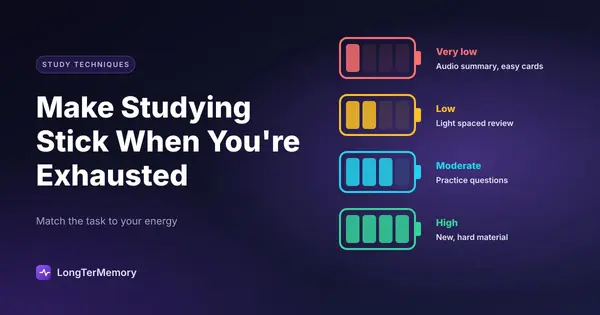
Not all studying demands the same cognitive load. Some tasks are genuinely hard and require deep focus. Others are lighter maintenance work that keeps your memory fresh without demanding intense concentration. The key to studying while exhausted is knowing which task lives at which level of the hierarchy.
Here is a practical breakdown of common study activities, ranked from lowest to highest energy requirement:
| Energy Level | Study Tasks | Typical Retention Value |
|---|---|---|
| Very Low | Listening to audio summaries, reviewing flashcards you already know well, organizing notes | Moderate maintenance value |
| Low | Light flashcard review with spaced repetition, re-reading highlighted sections, watching review videos | Solid for reinforcement |
| Moderate | Practice questions with immediate feedback, summarizing notes in your own words, mapping concepts | High value for understanding |
| High | Learning entirely new material, solving complex novel problems, writing practice essays under timed conditions | Very high, but requires full capacity |
| Very High | Deep elaboration, teaching material to others, creating new study resources from scratch | Excellent, but exhausting |
Research on cognitive load theory, pioneered by educational psychologist John Sweller, confirms that different learning tasks impose different demands on working memory. When your working memory is already compromised by fatigue, attempting a high-load task is like trying to run software on a computer with 90% of its RAM already consumed. It technically runs, but it runs badly.
The practical implication is simple but powerful. When you are exhausted, drop down the hierarchy. Do not try to learn a brand-new chapter from your textbook. Do not attempt timed practice exams. Instead, perform maintenance tasks that keep your existing knowledge warm. Review flashcards you have already created. Listen to a summary of material you have already read. Organize your study schedule for the week ahead.
This is not a cop-out. It is strategic energy allocation. A 2017 meta-analysis published in the journal Psychological Bulletin found that distributed practice, even in shorter and lower-intensity sessions, produces stronger long-term retention than cramming in a single high-intensity block. Your tired 20-minute review session is doing more than you think it is.
Why Passive Review Gets a Bad Name
You have probably heard that passive review is ineffective compared to active recall. That is true at the population level, but it is not the whole story. Passive review, when used strategically at low energy moments, serves a different purpose. It maintains familiarity and prevents the decay of recently learned material.
Think of it this way: active recall is how you build memory strength, but maintenance review is how you prevent memory loss. On a night when you genuinely cannot generate answers from scratch, simply re-exposing yourself to correct information still slows forgetting. It is not optimal learning, but it is far better than skipping the session entirely.
If you want to go deeper on how active learning physically changes your brain, check out our article on how active learning changes your brain. The core idea, that effortful retrieval strengthens neural pathways, still applies even when you are tired. You just need to calibrate the level of effort to what you can actually sustain.
What to Study When Exhausted vs. When to Rest Instead
This is the decision that separates productive tired studying from self-destructive burnout. The wrong choice here does not just waste an evening. It can set you back days by deepening fatigue and creating negative associations with your study material.
Study lightly if you meet these conditions:
- You slept at least five hours the previous night
- You can concentrate for 10 to 15 minutes without your mind wandering every 30 seconds
- The task you have chosen is low on the energy hierarchy
- You have a specific endpoint, not an open-ended session
- You do not feel physically unwell
Rest instead if any of these are true:
- You are running on fewer than five hours of sleep
- You have been studying intensively for seven or more consecutive days without a full day off
- You feel physically ill, even mildly
- You cannot read a paragraph and summarize it immediately afterward
- You are making simple errors on material you already know
- You feel emotionally overwhelmed or anxious to the point where studying would increase distress
Sleep researcher Matthew Walker, in his book Why We Sleep, notes that sleep deprivation reduces hippocampal function by roughly 40%. The hippocampus is the brain structure responsible for consolidating new memories. Studying while severely sleep-deprived is not just inefficient. It is neurologically compromised.
A useful rule of thumb comes from the research on decision fatigue. Psychologist Roy Baumeister’s work, while debated in recent replication attempts, still offers a practical framework: willpower and self-control draw on a shared pool of mental resources that depletes with use. If your day has been full of demanding decisions, meetings, or emotional labor, your pool is likely empty by evening. Adding a demanding study session on top of that does not produce learning. It produces resentment.
The 10-Minute Test
When you are unsure whether to study or rest, try this: set a timer for 10 minutes and attempt your lowest-energy study task. Flashcard review is ideal here.
- If you can complete the 10 minutes with reasonable focus, continue for another 15 to 20 minutes, then stop.
- If you cannot get through the 10 minutes without intense distraction, frustration, or drowsiness, stop immediately and go to bed.
This test respects your body’s signals without letting laziness masquerade as fatigue. Most people who genuinely care about their exam can tell the difference between resistance and depletion if they are honest with themselves. For more on pushing through resistance when it is not genuine exhaustion, our guide on how to study when you have no motivation offers behavioral strategies that actually work.
Protecting Your Lowest-Energy Self from Making Choices That Hurt Your Study Plan
Here is a subtle but critical point: your lowest-energy self cannot be trusted to make good decisions about studying. Decision-making quality degrades predictably as energy declines. When you are exhausted, you are more likely to choose the path of immediate relief over the path of long-term benefit. That might mean skipping a planned session entirely, or it might mean defaulting to a low-value activity like re-reading notes for the tenth time because it feels easy.
The solution is to pre-commit your decisions while you are still at moderate energy. Do your study planning when you are relatively fresh, not at 9:00 PM when you are already drained.
Here are specific pre-commitment strategies:
Pre-select your low-energy tasks. During your weekly planning session, identify exactly what you will do on low-energy nights. Write it down. For example: “If I am exhausted on Tuesday, I will review 30 flashcards in LongTerMemory and listen to the 15-minute summary of Chapter 4. I will not open new material.” This removes the decision from the moment of exhaustion.
Use environmental design to reduce friction. Leave your study space set up before you leave for work. Have your flashcard app open to the right deck. Queue up the audio summary. The fewer steps between you and the task, the less likely your tired brain will find an excuse.
Set a hard stop. Exhausted studying should always be time-capped. Decide in advance that your tired session will last exactly 20 minutes, or exactly one Pomodoro. The hard stop prevents the session from dragging into ineffectiveness and also makes starting psychologically easier, because you know the end is near.
Block your highest-distraction apps before fatigue sets in. If you use website blockers, schedule them to activate during your typical study hours. A decision made at 7:00 AM to block social media until 10:00 PM is far more effective than a decision made at 8:30 PM to “just check something real quick.”
Research from the American Psychological Association suggests that pre-commitment strategies increase follow-through rates by 30 to 40% compared to situational decision-making. The exhausted version of you is not a moral failure. They are simply running on depleted hardware. Pre-commitment is how you protect them from themselves.
The Danger of All-or-Nothing Thinking
One of the most damaging patterns in exam prep is the belief that a session only counts if it meets some ideal standard of intensity and duration. Under this belief, a 20-minute flashcard review on a tired night “doesn’t count,” so you might as well not do it. Or worse, you skip it and then feel guilty, which makes starting the next day harder.
The reality is that consistency beats intensity in long-term retention. A 2013 study by Dunlosky et al. in Psychological Science in the Public Interest rated distributed practice as one of the highest-utility learning techniques precisely because small, repeated exposures produce durable memory. Your tired 20-minute session is not a replacement for a high-energy deep-learning session. It is a bridge that keeps your knowledge warm until your next high-energy session arrives.
If you find yourself stuck in cycles of intense study followed by complete collapse, our article on study burnout signs may help you recognize the warning signals before they derail your preparation.
Practical Tactics for Making Low-Energy Study Actually Work
Knowing the theory is helpful, but you also need concrete tactics you can deploy tonight. Here are five that work reliably.
1. The Audio Ingestion Method
If you cannot read another page, listen instead. Record yourself summarizing key concepts, or use text-to-speech on your notes. Listening is cognitively less demanding than active reading, and it still provides valuable exposure. Some research suggests that auditory rehearsal can improve recall for verbal material by 10 to 15% compared to no exposure at all.
2. The Micro-Quiz Approach
Instead of trying to learn new flashcards, review cards you have already mastered. The goal is not to struggle. The goal is to reinforce existing pathways with minimal cognitive load. Set a timer for 15 minutes and aim for high accuracy on familiar material. The success experience itself is motivating and keeps your study habit alive.
3. The Pre-Sleep Review
If you are exhausted in the evening, do a brief 10-minute review right before bed. Sleep plays a critical role in memory consolidation, and studies show that material reviewed shortly before sleep is better retained. A 2012 study published in PLOS ONE found that sleep following learning enhanced retention by approximately 20% compared to an equivalent period of wakefulness.
4. Physical Position Changes
If you have been sitting at a desk all day, try reviewing flashcards while standing, walking slowly, or even stretching. Light physical movement increases blood flow and can temporarily boost alertness without requiring additional mental effort. Just keep the task simple enough that movement does not compromise it.
5. The Two-Session Split
On low-energy days, split your planned study into two micro-sessions: one in the morning before work, and one tiny session in the evening. Even 10 minutes in the morning, when cortisol levels are naturally higher and alertness is better, can offset the need for a long evening session. This is particularly useful for professionals preparing for certification exams while working full-time.
Building a Study System That Accounts for Energy Reality
The ultimate goal is not to white-knuckle through exhaustion. It is to build a study system that assumes energy fluctuation and plans for it.
That means your weekly study plan should include three categories of sessions:
- Peak sessions: scheduled for times when you typically have the most energy, reserved for learning new material and solving hard problems
- Maintenance sessions: scheduled for lower-energy times, reserved for review and reinforcement
- Rest sessions: scheduled deliberately, with no study activity at all
Most exam prep schedules fail because they treat every day as identical. They are not. Your energy varies with sleep, work demands, social obligations, and even the weather. A rigid schedule that does not bend will break.
This is where tools can make a genuine difference. LongTerMemory is built around the reality that your energy and time are limited. Instead of forcing you to decide what to study when you are already exhausted, LongTerMemory automatically prioritizes your review queue based on what you are most likely to forget. You open the app, and the decision is already made for you.
Even better, LongTerMemory can ingest PDFs, web articles, and lecture notes and convert them into structured flashcards automatically. That saves you the hours of manual card creation that often becomes a hidden source of study burnout. The spaced repetition scheduling is handled automatically too, so your maintenance reviews happen at optimal intervals without you having to track them.
For exam candidates and certification seekers, the time saved on flashcard creation and scheduling often amounts to 5 to 10 hours per week. Those are hours you can redirect into rest, exercise, or high-quality deep learning sessions when your energy is actually available.
If you want to understand why spaced repetition works so powerfully for long-term retention, read our deep dive on the science of spaced repetition. The underlying research, going back to Ebbinghaus’s forgetting curve, explains why short, strategically timed reviews beat marathon cramming every time.
The Bottom Line
Exhaustion is not a moral failing, and it is not a reason to abandon your study plan. But it does require a different strategy than the one you use when you are fresh.
Match your task to your energy level. Perform maintenance and review when you are tired. Save new learning and deep problem-solving for when you are alert.
Know when to rest. Sometimes the most productive thing you can do for your exam preparation is go to sleep. A well-rested brain learns dramatically better than a sleep-deprived one.
Pre-commit your decisions. Your exhausted self makes poor choices. Make the important ones in advance, when your judgment is still intact.
Protect consistency over intensity. A 15-minute review on a bad night is infinitely more valuable than skipping the session entirely and letting your habits unravel.
The goal is not to become a machine that studies perfectly regardless of circumstance. The goal is to become a sustainable learner who keeps moving forward, even on the hard days. That is what gets you to exam day prepared, not burned out.
If you are ready to take the friction out of your review schedule and let automation handle the heavy lifting, try LongTerMemory free today. Your future self, the one sitting for that exam, will thank you for every smart decision you made along the way.