How to Study Alone vs. in Groups: Which Is Better?
Solo study or study group? Learn when each wins, how to run a group that actually helps, and how to combine both for better retention and exam results.
Table of Contents
- Studying Alone vs. in a Group at a Glance
- When Solo Study Outperforms Group Study
- Learning new material for the first time
- Memorizing facts, definitions, and formulas
- Deep work and complex problems
- When you have a very different pace or goal
- When Group Study Outperforms Solo Study
- Explaining concepts out loud
- Finding blind spots
- Practicing oral exams, case discussions, and debates
- Staying consistent
- What the Research Says
- How to Run a Study Group That Actually Works
- 1. Keep it small and committed
- 2. Everyone prepares first
- 3. Give every session an agenda
- 4. Rotate roles
- 5. Write down the gaps
- 6. Know when to stop
- Combining Individual Study and Group Review
- Phase 1: Learn and memorize alone
- Phase 2: Test together
- Phase 3: Repair alone
- A sample weekly rhythm
- Which One Should You Choose? A Quick Decision Guide
- Common Mistakes to Avoid
- Frequently Asked Questions
- Is it better to study alone or with others?
- How many people should be in a study group?
- How often should a study group meet?
- Can online study groups work?
- What if I study better alone but my course expects group work?
- The Bottom Line
Neither is better in every situation. Studying alone is better for building knowledge and memorizing material, while studying in a group is better for testing, explaining, and fixing gaps. The strongest approach is to learn and memorize on your own first, then use a group to check your understanding and practice retrieval out loud.
I have watched students swear by one or the other for years. The lone wolves say groups are social hours with a textbook open. The group fans say studying alone is lonely and slow. Both camps are partly right, and that is exactly why the question deserves a real answer instead of a vibe. Let’s work it out.
Studying Alone vs. in a Group at a Glance
Here is the short version before we go deeper.
| Factor | Studying alone | Studying in a group |
|---|---|---|
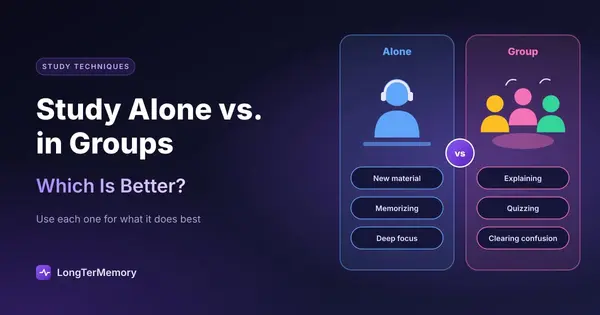
| Best for | Learning new material, memorizing, deep focus | Explaining, quizzing, clarifying confusion |
| Pace | Fully yours | Set by the group |
| Distraction risk | Low to medium (phone, mind wandering) | Medium to high (chatting, tangents) |
| Accountability | Depends on your own discipline | Built in |
| Spots your gaps | Only if you test yourself honestly | Yes, other people ask questions you did not think of |
| Time efficiency | High, no coordination needed | Lower, unless well structured |
| Cost to set up | None | Scheduling, finding the right people |
If you only remember one row, make it the first one: alone to learn, together to test.
When Solo Study Outperforms Group Study
Solo study wins whenever the task is to get new information into your head. Encoding and memorization are individual jobs. Nobody else can build your memory for you, and a group moves at the speed of its slowest or loudest member, not yours.
Learning new material for the first time
When you meet a topic for the first time, you need quiet concentration and the freedom to pause, reread, and struggle. Working through a hard chapter in a group usually means one person talks and everyone else nods along, which creates a fluency illusion: it feels like you understood because the explanation sounded clear. You did not do the thinking.
Memorizing facts, definitions, and formulas
Memorization is a retrieval-and-repetition problem. Your own flashcards, your own schedule, and your own weak spots matter far more than group energy. The research on active recall and spaced practice is about what happens in a single brain, and that is where you should invest the bulk of your hours.
Deep work and complex problems
Anything that needs sustained attention, such as solving a multi-step physics problem or drafting an essay outline, suffers from interruptions. Studies on task switching suggest it can take over 20 minutes to fully regain focus after a disruption (a figure often cited from Gloria Mark’s research at UC Irvine). A chatty group can easily cost you that.
When you have a very different pace or goal
If you are aiming for a top mark and the others just want to pass, or the reverse, a group will quietly pull everyone toward the middle. In that case, your solo hours are your competitive edge.
When Group Study Outperforms Solo Study
Group study wins when the goal is to check, challenge, and apply what you already know. Other people are a free source of feedback, and feedback is hard to generate alone.
Explaining concepts out loud
Teaching is one of the best ways to find out what you really understand. Research on the protege effect shows that people who prepare to teach material learn it more deeply than people who prepare only to be tested. In a group you get a live audience, which is far more demanding than explaining to your wall. If you want to push this idea further, read our guide on teaching as a study technique.
Finding blind spots
You cannot see what you do not know you do not know. A groupmate asks “but why does that happen?” and suddenly you realize you memorized the answer without grasping the logic. That moment is gold.
Practicing oral exams, case discussions, and debates
Some formats are social by nature: vivas, interviews, clinical reasoning, moot court, seminars. You cannot rehearse a conversation in isolation. For those, group study is not a nice extra, it is the actual training.
Staying consistent
For many people the biggest benefit is simple: someone expects you to show up. Accountability turns “I’ll study later” into “I’m meeting Sam at 6.” If procrastination is your main enemy, a group can be worth more than any technique.
What the Research Says
The evidence is more nuanced than either camp admits:
- Retrieval practice beats rereading by a wide margin. In the well-known 2008 Karpicke and Roediger work, students who used retrieval practice recalled around 80% of the material a week later versus about 33% for rereaders. That effect works alone or in a group, but you need to actually retrieve.
- Collaborative learning tends to help most on conceptual and problem-solving tasks. Meta-analyses of cooperative learning in higher education, including work by Springer, Stanne and Donovan, found small-group learning in STEM improved achievement and persistence compared with traditional lecture-only study.
- Groups can create “social loafing.” The classic finding is that individual effort drops as group size rises, because people assume others will carry the load.
- Group size matters. Most practitioners and education researchers land on 3 to 5 people as the sweet spot: enough diversity of thinking, not enough room to hide.
In plain language: groups are powerful when each person comes prepared, and weak when they are used as a substitute for preparation.
How to Run a Study Group That Actually Works
A study group is a tool, and like any tool it works only when it is set up well. Here is a structure I recommend.
1. Keep it small and committed
Aim for 3 to 5 people who share your exam or course. Agree on a regular time. A group that meets “whenever” meets never.
2. Everyone prepares first
The rule is simple: no one comes to learn the material for the first time. Each person reviews the topic alone beforehand and brings questions or a short explanation. Without this rule, you have a very expensive reading club.
3. Give every session an agenda
Ninety minutes is plenty. Here is a template:
| Time | Activity |
|---|---|
| 0 to 10 min | Set the goals: which topics, which questions |
| 10 to 40 min | Rotating mini-teach: each person explains one concept without notes |
| 40 to 70 min | Quiz round: practice questions or flashcards, answered aloud |
| 70 to 85 min | Fix the gaps: dig into everything that was missed |
| 85 to 90 min | Assign homework and the next topics |
4. Rotate roles
Rotate who is the explainer, who is the questioner, and who is the timekeeper. This keeps one dominant person from running the show and makes quieter members participate.
5. Write down the gaps
Whatever the group could not answer goes on a shared list. That list is your solo study agenda for the next few days. It is also the most valuable output of the meeting.
6. Know when to stop
If the group drifts into complaining about the professor or comparing screenshots of group chats, call time. A productive 60 minutes beats an unfocused 3 hours. For more tips on keeping a session on track, see our guide to a productive study group session.
Combining Individual Study and Group Review
The best results come from a cycle: learn alone, test together, repair alone. Think of it as three phases.
Phase 1: Learn and memorize alone
Read, annotate, build flashcards, and do your first rounds of retrieval practice by yourself. This is where spaced repetition does its work. If you want to save time on this stage, a tool like LongTerMemory can generate question and answer cards from your PDFs and notes, and schedule each review for you, so you arrive at the group already carrying a solid base.
Phase 2: Test together
At the group meeting, don’t re-teach the whole chapter. Use the time for the things you cannot do alone: explain topics out loud, challenge each other with tricky questions, and compare how you would answer an exam prompt.
Phase 3: Repair alone
Take the gap list home. Turn each missed item into a new flashcard or practice question, and feed it back into your spaced repetition schedule. That is how a group session becomes long-term memory and not just a nice evening.
A sample weekly rhythm
| Day | Format | Focus |
|---|---|---|
| Monday to Thursday | Solo | New material, flashcard reviews, practice problems |
| Friday | Group (60 to 90 min) | Explain, quiz, discuss hard questions |
| Saturday | Solo | Repair gaps found on Friday |
| Sunday | Solo (short) | Light review and plan the week |
Adjust it to your timetable, but keep the order: solo first, group second, solo again.
Which One Should You Choose? A Quick Decision Guide
Ask yourself these questions:
- Am I seeing this material for the first time? Study alone.
- Do I need to memorize lots of details? Study alone, with flashcards.
- Do I think I understand it but I’m not sure? Go to a group and explain it.
- Will the exam be oral, discussion-based, or case-based? Use a group.
- Do I keep postponing studying? A group can supply accountability.
- Do I get distracted easily around others? Keep groups short and structured.
Your personality matters a little, but your task matters more. An introvert still benefits from explaining to peers, and an extrovert still has to sit down and memorize alone.
Common Mistakes to Avoid
- Using the group as your main learning method. You end up passively listening to one person.
- Studying with friends you chat with too much. Choose people for seriousness, not just for fun.
- Never studying alone because the group feels more productive. It feels productive because it is social, not because you retained more.
- Comparing yourself with the group’s smartest member. Use them as a resource, not a scoreboard.
- Skipping the follow-up. Without solo repair after the group, gaps stay gaps.
Frequently Asked Questions
Is it better to study alone or with others?
It depends on the task. Study alone to learn and memorize, and study with others to explain, quiz, and find blind spots. Combining both gives the best results.
How many people should be in a study group?
Three to five is the usual recommendation. Smaller groups lack diversity of thinking, and larger ones make it easy for people to disengage.
How often should a study group meet?
Once or twice a week for 60 to 90 minutes is enough for most courses. Meet more often only in the final weeks before an exam.
Can online study groups work?
Yes, as long as they follow the same rules: preparation beforehand, an agenda, and an active retrieval format. Video calls with a shared document work well. If you are looking for partners, our guide to finding a study buddy online can help.
What if I study better alone but my course expects group work?
Do the heavy learning alone and use group time only for the collaborative parts. You can also bring a prepared question list so the meeting stays short and useful.
The Bottom Line
Studying alone builds the knowledge, and studying in a group pressure-tests it. One without the other leaves a hole: solo study without testing gives you the fluency illusion, and group study without preparation gives you pleasant conversation.
So this week, try the cycle. Learn and make your flashcards alone, meet two or three classmates for one structured session where you explain and quiz each other, then take the gap list home and fix it. It is a small change, and it often makes the difference between “I think I know this” and “I can prove I know this.”