How to Study with Autism: Strategies for Focus and Organization
Practical sensory modifications, structured routines, and special-interest leverage to help autistic learners build effective, sustainable study habits.
Table of Contents
- Sensory and environmental modifications for autistic learners
- Lighting, sound, and tactile adjustments
- Creating a sensory-friendly study kit
- The role of movement and proprioceptive input
- Structured routines and predictability as study support tools
- Time blocking and visual schedules
- Transition rituals and task initiation
- Externalizing organization with checklists and body doubling
- Building in recovery time
- Special interest leverage: connecting study material to areas of passion
- Identifying connection points between interests and curriculum
- Using special interests as rewards and anchors
- Deep dives as a study technique
- The social and emotional value of special interests
- Building a sustainable study system as an autistic learner
You open your textbook, ready to finally make progress on that chapter. Five minutes later, the fluorescent light above your desk is the loudest thing in the room. The tag on your shirt has become an emergency. The ticking clock, which you never noticed before, now sounds like a drum solo. You have not absorbed a single sentence. You are not being difficult, lazy, or dramatic. You are experiencing the sensory and cognitive reality that many autistic learners navigate every time they try to study.
Studying with autism is not about a lack of intelligence or motivation. Autistic students often bring intense focus, pattern recognition, and analytical depth to their work. The barrier is not capability. It is the mismatch between standard study environments and the way an autistic brain processes sensory input, manages executive function, and sustains attention. When you adjust the environment and the approach to fit the neurology, studying becomes not just possible, but genuinely effective.
This post covers three of the most impactful areas for autistic learners: sensory and environmental modifications, structured routines and predictability, and special interest leverage. Each section includes concrete, actionable strategies you can implement today, plus realistic examples of how they work in practice.
Sensory and environmental modifications for autistic learners
The single most effective change you can make is to design a study environment that reduces sensory overload, because an autistic brain often processes light, sound, texture, and smell with greater intensity than a neurotypical brain. Standard classrooms and libraries are built for the statistical average, not for sensory diversity. What reads as neutral to one person can be unbearable to another. The good news is that small environmental tweaks often produce dramatic improvements in focus and endurance.
Lighting, sound, and tactile adjustments
Lighting is one of the most commonly overlooked study variables. Fluorescent overhead lights flicker at a frequency that many autistic individuals perceive consciously or subconsciously, and that flicker can trigger headaches, eye strain, and cognitive fatigue within minutes. The fix is usually simple: turn off the overhead lights and use a warm-toned desk lamp positioned to illuminate your workspace without creating glare. Aim for a color temperature around 2700K to 3000K, which is softer and less taxing than the cold blue-white light of most institutional bulbs.
Sound is equally critical. Some autistic learners need total silence. Others need predictable, controllable background noise to mask the unpredictable sounds of a household or dormitory. If you fall into the silence camp, noise-canceling headphones are worth the investment. A decent pair reduces ambient noise by 20 to 30 decibels, which can mean the difference between a productive hour and a shutdown. If you prefer background audio, consider brown noise or instrumental music with no lyrics, played at a consistent volume. The key is predictability. Sudden changes in volume or unexpected vocals pull attention away from the material.
Tactile input is the third pillar. Clothing tags, rough fabrics, tight waistbands, or even the texture of a chair can become all-consuming distractions. There is no universal fix here because sensory preferences are individual. Some students study best in loose, soft clothing. Others benefit from weighted lap pads or compression garments that provide deep pressure, which has been shown to reduce anxiety and improve focus in autistic individuals. Experiment with what your body tolerates, and treat tactile comfort as a non-negotiable part of your study setup, not a luxury.
Creating a sensory-friendly study kit
A sensory-friendly study kit is a portable collection of tools that let you modify any environment quickly. Whether you are studying at home, in a library, or in a campus common area, having these items on hand gives you control over your sensory input.
| Item | Purpose | Approximate Cost |
|---|---|---|
| Noise-canceling headphones | Block or control auditory input | $50 to $300 |
| Blue-light blocking glasses | Reduce eye strain from screens and harsh lighting | $15 to $50 |
| Fidget tool (silent) | Channel restless energy without auditory distraction | $5 to $20 |
| Scent-free hand lotion | Prevent skin discomfort from dry air | $5 to $10 |
| Small desk lamp with warm bulb | Replace fluorescent overhead lighting | $20 to $40 |
| Textured fabric sample or soft cloth | Provide calming tactile input | $0 to $10 |
One student I spoke with, a junior studying computer science, described her kit as “the difference between surviving a study session and actually learning something.” She keeps her headphones, a small LED lamp, and a silicone fidget ring in her backpack at all times. When she arrives at the library and the lighting is wrong, she does not force herself to adapt. She adapts the environment.
The role of movement and proprioceptive input
Sitting still for long periods is difficult for many autistic learners, not because of a deficit, but because proprioceptive input, the awareness of where your body is in space, often helps with regulation. A wobble cushion on your chair, a standing desk setup, or even permission to pace while reading can improve focus. Some students retain information better while gently rocking or using a stationary bike with a book stand. The traditional image of studying as a statue-like activity is a cultural norm, not a biological requirement.
Research supports this flexibility. A 2021 review in the Journal of Autism and Developmental Disorders found that sensory integration strategies, including movement breaks and environmental modifications, were associated with measurable improvements in academic engagement for autistic students. The effect sizes were moderate to large, suggesting that these are not minor tweaks but genuine interventions.
If you want a broader look at how environment shapes learning for neurodivergent students, our guide on how to create a study environment that works for your brain covers additional layout and distraction-management strategies.
Structured routines and predictability as study support tools
Predictability reduces cognitive load, and for autistic learners, a structured routine does not just help with organization, it frees up mental resources that would otherwise be spent managing uncertainty. Executive function, the set of mental skills that includes planning, initiating tasks, and switching between activities, often works differently in autistic individuals. This is not a matter of willpower. It is a neurological difference in how the brain sequences actions and manages transitions. Routines and external structure compensate for this difference by making the next step obvious before you have to think about it.
Time blocking and visual schedules
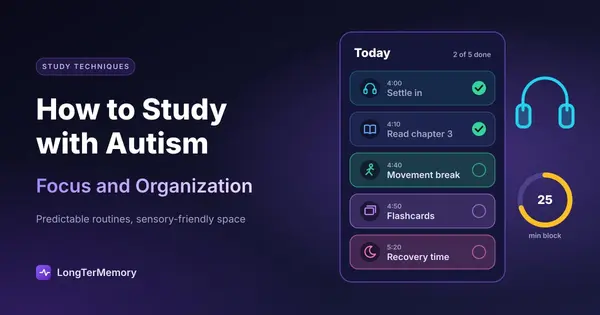
Time blocking is the practice of assigning specific activities to specific time slots. For autistic learners, it works best when the blocks are consistent from day to day and when the schedule is visible. A digital calendar can work, but many students find that a printed weekly schedule posted near their desk is more effective because it provides constant, passive visual reinforcement.
Here is a simple time-blocked study schedule for a college student:
| Time | Monday | Tuesday | Wednesday | Thursday | Friday |
|---|---|---|---|---|---|
| 9:00 to 10:30 | Biology reading | Biology problem set | Biology review | Biology problem set | Biology practice exam |
| 11:00 to 12:00 | Spaced repetition review | Spaced repetition review | Spaced repetition review | Spaced repetition review | Spaced repetition review |
| 2:00 to 3:30 | Essay drafting | Research and notes | Essay drafting | Peer review | Essay revision |
| 4:00 to 4:30 | Email and admin | Email and admin | Email and admin | Email and admin | Email and admin |
Notice that biology is always in the morning slot, spaced repetition is always at 11:00, and administrative tasks are confined to a single predictable window. This removes the daily decision of “what should I work on now?” which is often the point where executive function stalls out.
Transition rituals and task initiation
The hardest part of studying is often the transition from one activity to another. Autistic learners frequently experience what clinicians call transition difficulty, a genuine neurological lag in shifting cognitive sets. A transition ritual is a short, repeatable sequence that signals to your brain that it is time to change modes.
A typical transition ritual might look like this:
- Set a timer for 5 minutes
- Close all non-study browser tabs and put your phone in a drawer
- Put on noise-canceling headphones
- Open your study materials to the exact page you will start on
- Write down the single task you will complete in the next block
- Start the timer and begin
The specificity matters. “Study biology” is vague and leaves room for avoidance. “Read pages 87 to 94 and answer the three review questions” is a clear command that your brain can execute without further negotiation. Research on implementation intentions shows that specific, pre-planned actions are significantly more likely to be followed through than general intentions.
Externalizing organization with checklists and body doubling
External scaffolding means putting organizational systems outside your brain so your brain does not have to hold them. Checklists are the simplest form of external scaffolding. A daily study checklist with checkboxes provides visual evidence of progress and reduces the working memory load of remembering what comes next.
For students who struggle with task initiation even when the plan is clear, body doubling can be transformative. Body doubling means working alongside another person, either physically or virtually, to create ambient accountability. The presence of another person reduces the psychological friction of starting. Our detailed guide on how to use body doubling to improve study focus explains the research and the best platforms for finding virtual study partners.
Another powerful form of external scaffolding is automated scheduling. If you are using a spaced repetition system to review material, manually deciding what to review and when adds a layer of executive function demand that can derail the habit entirely. LongTerMemory handles this automatically. You upload your notes, PDFs, or web articles, and the system generates flashcards and schedules them according to an optimized spaced repetition algorithm. You do not have to decide what to review today. You simply open the app and do what it shows you. Students who switch from manual flashcard management to automated scheduling typically save 3 to 5 hours per week on organization alone, and they miss fewer review sessions because the decision fatigue is gone.
Building in recovery time
One mistake many autistic students make is building a schedule that looks efficient on paper but does not account for recovery time. Sensory regulation, social interaction, and sustained attention all consume energy. A schedule with no buffer between demanding tasks is a schedule that leads to burnout.
A better approach is to build regulation breaks into your day. These are not rewards for finishing work. They are structural components of your routine, just like the study blocks themselves. A regulation break might be 15 minutes in a dimly lit room, a short walk, time with a special interest activity, or any repetitive sensory activity that restores your baseline. The goal is to prevent overload before it happens, not to recover from it after it has already derailed your day.
Special interest leverage: connecting study material to areas of passion
One of the most powerful cognitive strengths in autism is the capacity for deep, sustained focus on areas of interest, and the smartest study strategy is not to fight this tendency but to use it as a bridge to required material. Special interests are often misunderstood as distractions or obsessions. In reality, they are concentration engines. When an autistic learner is engaged with a topic of genuine interest, they can sustain attention, retain complex information, and make connections that others miss. The trick is to build a deliberate link between the special interest and the material you need to learn.
Identifying connection points between interests and curriculum
Start by listing your current special interests. These might be narrow, like 19th-century railway timetables, or broad, like video game design, molecular biology, or a particular musical genre. Then, for each subject you need to study, ask: what concept, historical figure, mechanism, or application connects to this interest?
For example:
- A student obsessed with video games might study probability through loot-drop mechanics, economics through in-game marketplaces, and narrative structure through game writing
- A student fascinated by trains might approach physics through locomotive engineering, history through the expansion of rail networks, and geography through route planning
- A student passionate about music might study mathematics through rhythm and frequency, psychology through the effects of sound on emotion, and sociology through music subcultures
These connections are not forced metaphors. They are genuine structural overlaps. When you study probability through a context you already care about, you are not just making the material more fun. You are leveraging an existing neural network of knowledge and motivation, which accelerates both understanding and retention.
Using special interests as rewards and anchors
Even when a direct intellectual connection is hard to find, special interests can function as behavioral anchors. A behavioral anchor is a reliable source of motivation that you attach to a less preferred task. The structure is simple: complete a defined unit of required work, then engage in a defined unit of special interest activity.
The key is precision. “Study for a while, then do what you want” is too vague and often leads to either procrastination or guilt. “Complete one Pomodoro of biology reading, then spend 10 minutes researching your special interest” is specific, measurable, and neurologically fair. Your brain knows exactly what to expect, and the special interest time becomes a genuine restoration rather than a stolen distraction.
Some students also use special interests as mnemonic anchors. If you need to memorize a list of chemical elements, historical dates, or vocabulary words, embedding them in a narrative framework drawn from your special interest can make them stick. A student who loves mythology might assign each element to a different god. A student who loves coding might construct a logic puzzle where each fact is a variable. The method is personal, but the principle is universal: meaningful context produces better memory than rote repetition.
Deep dives as a study technique
Autistic learners often excel at deep dives, extended periods of intense focus on a single topic. While standard study advice emphasizes variety and frequent switching, some autistic students perform better with the opposite approach: a 2 to 4 hour block dedicated entirely to one subject, explored in depth. This works because it reduces the transition cost of switching tasks and allows the brain to enter a state of sustained engagement.
If you know you function best in deep dives, build your schedule around them rather than forcing yourself into 25-minute Pomodoros that constantly interrupt your flow. The Pomodoro Technique is an excellent tool for many learners, but it is not universally optimal. Your schedule should match your neurology, not the other way around.
To support deep dive sessions with long-term retention, pair them with a spaced repetition system. After a deep dive session, the material is fresh and well understood. That is the ideal moment to create review items. LongTerMemory can generate these items automatically from your notes or from PDFs you upload, so you do not lose the momentum of your deep dive to flashcard formatting. The system then schedules reviews at the optimal intervals, ensuring that the detailed knowledge you gained during your focused session is still accessible weeks or months later.
The social and emotional value of special interests
Special interests are not just study tools. They are also regulation tools and sources of genuine joy. Studying in a world not built for your brain is tiring. Special interests provide a space where competence, curiosity, and comfort overlap. Protecting time for them is not indulgent. It is a maintenance requirement, like sleep or nutrition.
When you respect your special interests as legitimate and valuable, you also build a more sustainable relationship with studying. You are no longer trying to become a generic productive student. You are building a study system that uses your actual strengths, accommodates your actual needs, and leaves room for the things that make you feel like yourself.
Building a sustainable study system as an autistic learner
There is no single right way to study, and there is certainly no universal standard that autistic learners should be measured against. The goal is not to mask your neurology or force yourself through environments and methods that drain you. The goal is to build a study system that fits your brain.
That system will almost certainly include sensory modifications to reduce environmental overload, structured routines to support executive function, and special interest leverage to activate your natural capacity for deep focus. It may also include tools that automate the organizational overhead, like LongTerMemory for flashcard generation and spaced repetition scheduling, so your energy goes into learning rather than administration.
The research is clear: autistic students who receive appropriate environmental and instructional supports perform at levels comparable to their neurotypical peers. The gap is not in ability. It is in accommodation. When you give yourself the accommodations you need, whether that means a pair of noise-canceling headphones, a printed visual schedule, or a 3-hour deep dive into a subject connected to your favorite topic, you are not cutting corners. You are studying intelligently.
Start with one change this week. Adjust your lighting. Print a weekly schedule. Connect one boring assignment to something you genuinely care about. Notice what happens to your focus, your endurance, and your retention. Then build from there. The most effective study strategy is the one you can actually sustain, and sustainability begins with designing for the brain you have, not the brain the world assumes you should have.