How to Use Anki Effectively for Language Learning
The best Anki settings for language learning, how to choose between your own decks and shared decks, and how to fit Anki into a complete study routine.
Table of Contents
- Why Anki Fits Language Learning So Well
- Optimal Anki Settings for Language Learning
- The settings that matter
- Do the numbers add up?
- FSRS vs. the classic scheduler
- Settings that quietly cause problems
- Building Your Own Decks vs. Using Shared Decks
- Where shared decks shine
- Where your own cards win
- How to Design Good Language Cards
- The principles
- Card types for languages
- Sentence mining
- Integrating Anki Into a Complete Language Routine
- A sample daily routine (about 90 minutes)
- A sample weekly rhythm
- Keep the habit alive
- Common Mistakes (and Fixes)
- A Note on Time: Creating Cards Is the Real Cost
- Frequently Asked Questions
- How many new Anki cards a day is best for language learning?
- Should I use pre-made decks or make my own?
- Can Anki replace a language course or tutor?
- How long until I see results?
- Is Anki good for Japanese, Chinese, and Korean?
- The Bottom Line
Anki works very well for language learning when you use it for vocabulary and sentence recall, keep your daily new-card limit realistic, and build cards from real sentences instead of isolated words. It will not teach you to speak by itself, but it makes sure the words and patterns you meet stay in your memory.
I have seen learners use Anki to reach a working vocabulary in a second language in a year or two, and I have seen just as many quit after three weeks because their review pile exploded. The difference is almost never talent. It is settings, card design, and routine. This guide covers all three.
Anki’s menu names and defaults change between versions, so check the current manual at docs.ankiweb.net if something looks different on your screen.
Why Anki Fits Language Learning So Well
Language is mostly a memory problem: thousands of words, forms, and patterns that must be recalled quickly. Spaced repetition, the scheduling method behind Anki, is built exactly for that.
| Language skill | How Anki helps | Where you also need something else |
|---|---|---|
| Vocabulary | Excellent: spaced review of thousands of words | Real usage to confirm meaning |
| Grammar patterns | Good, through example-sentence cards | Explanations and practice |
| Listening | Good with audio cards | Lots of real listening |
| Pronunciation | Moderate: audio on cards helps | Speaking with feedback |
| Speaking and writing | Limited | Conversation, tutors, writing practice |
The underlying science is the spacing effect: reviewing information just before you forget it makes the memory last longer. A foundational study by Cepeda and colleagues in 2006 reviewed hundreds of experiments and confirmed that spaced practice beats massed practice for long-term retention. If you want a refresher, read our overview of spaced repetition for language learning.
Optimal Anki Settings for Language Learning
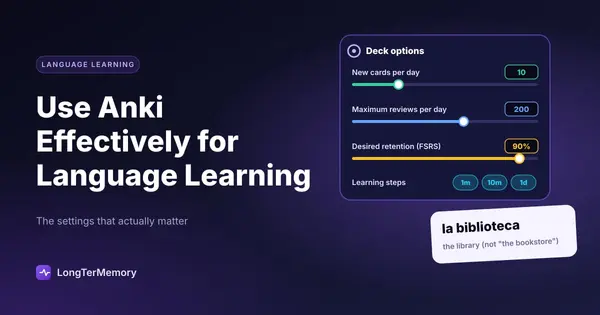
Most people should leave the defaults mostly alone and change only a few things: new cards per day, maximum reviews, and the learning steps. Over-tuning settings is a common form of procrastination.
The settings that matter
| Setting | Typical default | Suggested for language learners | Why |
|---|---|---|---|
| New cards per day | 20 | 10 to 20 (start at 10) | Each new card creates many future reviews |
| Maximum reviews per day | 200 | 200 to 300 | A safety cap, not a target |
| Learning steps | 1m 10m | 1m 10m or 1m 10m 1d | Keeps new cards from being forgotten the same day |
| Graduating interval | 1 day | 1 day | Fine for most people |
| Desired retention (FSRS) | 90% | 85 to 90% | Higher means more reviews, lower means more forgetting |
| Show answer timer | Off | Optional, 15 to 20 seconds | Prevents staring too long |
Do the numbers add up?
A quick way to estimate workload: each new card you add per day will cost you roughly 7 to 10 reviews per day in steady state, over the following weeks. Add 20 new cards a day and, after a month, you may be doing 150 to 200 reviews daily. That is manageable at about 10 to 20 seconds per card, but it adds up to roughly an hour.
So the real question is: how many minutes per day can you protect for the next 12 months? Choose your new-card limit from that answer, not from your motivation on day one.
FSRS vs. the classic scheduler
Recent versions of Anki include FSRS, a newer scheduling algorithm that predicts the probability of recall for each card and tends to require fewer reviews for the same retention than the older SM-2 style scheduler. If your version supports it and you have a few weeks of review history, it is worth enabling and letting it optimize on your own data. Leave “desired retention” at the default to begin with.
Settings that quietly cause problems
- Setting new cards to 50 or more. You will burn out within a month.
- Never suspending bad cards. If a card is confusing or wrong, suspend or fix it. Do not keep failing it.
- Turning on “easy” too often. If you press Easy whenever you recognize a word, you push intervals too far. Use Good as your default answer.
- Skipping days. Anki is forgiving, but a backlog of 800 reviews feels like punishment. Return gradually, and use a daily review cap.
Building Your Own Decks vs. Using Shared Decks
Use shared decks to get started fast, and build your own cards for anything you personally encounter. Cards you made from your own reading and conversations are remembered better, because creating them is already a form of studying.
| Factor | Your own decks | Shared community decks |
|---|---|---|
| Setup time | High | Almost none |
| Relevance to your goals | Perfect | Generic |
| Memorability | Higher (you chose the context) | Lower |
| Quality control | You control it | Varies a lot, some have errors |
| Audio and images | You add them | Often included |
| Best for | Personal vocabulary, specialized terms | Frequency lists, core grammar, alphabets |
Where shared decks shine
- Frequency-based decks covering the most common 1,000 to 5,000 words of a language, which give you the biggest return early on.
- Alphabet and character decks, such as kana for Japanese or Hangul for Korean.
- Exam decks for official tests like DELF or JLPT.
Before downloading, check the deck’s ratings and comments, preview several cards, and confirm that it fits your level. Poor shared decks teach incorrect translations or odd words nobody uses.
Where your own cards win
When you hear a word in a podcast or read it in an article and add it, you are attaching it to a real memory. That context is exactly the elaborative encoding that makes retention stronger. Use shared decks for scaffolding, and your own for the vocabulary that makes the language yours.
How to Design Good Language Cards
Good cards are small, specific, and based on real sentences. Most Anki failures come from bad card design, not bad settings.
The principles
- One idea per card. Do not cram three meanings into one card.
- Use sentences, not only isolated words. A word in a sentence shows grammar, collocations, and register at the same time.
- Cloze deletions for grammar and collocations. For example, “I {{c1::would have}} gone if I had known” practices a structure in context.
- Add audio. Hearing the word each review builds listening and pronunciation.
- Target language on both sides when you can. A definition in the target language is better than a translation once you’re past beginner level.
- Keep the answer short. If you need a paragraph to answer, split the card.
Card types for languages
| Card type | Front | Back | Use for |
|---|---|---|---|
| Basic | Word or phrase | Meaning (plus audio) | Early vocabulary |
| Cloze | Sentence with a gap | Missing word | Grammar and usage |
| Reversed | Meaning | Word in the target language | Active production (speaking, writing) |
| Audio-first | Audio only | Text and meaning | Listening comprehension |
A tip I like: start with recognition cards, and once a word is comfortable, add a production card in the opposite direction. It is slower, but it is what you need to actually speak.
Sentence mining
Sentence mining means collecting sentences from content you actually enjoy: shows, books, articles, conversations. Each time you find one sentence that has exactly one unknown word, you turn it into a card. This keeps the cards at the right difficulty (what linguists call “i+1”) and ties vocabulary to something you’ve experienced.
Integrating Anki Into a Complete Language Routine
Anki should be about 15 to 25% of your language study time. The rest should be input and output. A language is a skill, not just a database, so the cards support the real work.
A sample daily routine (about 90 minutes)
| Block | Time | Activity |
|---|---|---|
| Anki reviews | 20 to 25 min | Clear reviews, add 5 to 10 new cards |
| Input | 30 min | Listen or read content at your level (podcasts, graded readers, videos) |
| Mine cards | 5 min | Add 3 to 5 cards from what you just consumed |
| Output | 20 to 30 min | Speak, shadow, or write, ideally with a partner or tutor |
| Grammar or lessons | 10 min | Course, textbook, or notes |
A sample weekly rhythm
- Mon to Fri: Anki first thing, then input and output blocks.
- Saturday: Longer conversation session or tutor class, with a list of mistakes turned into cards.
- Sunday: Light review, prune bad cards, and plan next week’s topics.
Keep the habit alive
The best deck is the one you open tomorrow. Attach your reviews to an existing habit, like coffee or your commute. If you want ideas for building consistency, our post on building a language learning habit goes deeper.
Common Mistakes (and Fixes)
| Mistake | Why it happens | Fix |
|---|---|---|
| Memorizing words without context | Single-word cards are fast to make | Use sentences and cloze cards |
| Too many new cards | Early enthusiasm | Cap at 10 to 15 and increase slowly |
| Giant shared deck of 10,000 cards | Feels comprehensive | Start with the top 1,000 to 2,000 words |
| Leech cards | Card is badly designed or confusing | Rewrite it, add an image or mnemonic, or delete |
| Anki as the only study method | It feels productive | Add listening, speaking, and writing |
| Skipping your errors | Corrections feel boring | Turn recurring mistakes into cards |
A Note on Time: Creating Cards Is the Real Cost
Anki is free and powerful, but building good cards takes effort, and that effort is where many learners stall. If your study material comes from PDFs, textbook chapters, or lesson notes, LongTerMemory can generate question and answer cards from those files automatically and schedule them with spaced repetition. That doesn’t replace sentence mining from content you love, but it saves hours on the structured material. For a deeper look at the trade-offs, read our Anki vs LongTerMemory comparison, or start with our guide to using Anki effectively from day one. If card creation is the part that keeps stopping you, our roundup of the best Anki alternatives compares easier options.
Frequently Asked Questions
How many new Anki cards a day is best for language learning?
Most learners do well with 10 to 20 new cards per day. Start at 10, and raise it only if your reviews stay under about 30 minutes.
Should I use pre-made decks or make my own?
Use both. Pre-made frequency decks give you a fast start, and your own sentence cards make vocabulary personal and memorable.
Can Anki replace a language course or tutor?
No. Anki helps you remember vocabulary and patterns, but you still need meaningful input, grammar explanations, and speaking practice.
How long until I see results?
Many learners notice faster recognition of words within 3 to 4 weeks of consistent daily reviews. A solid working vocabulary of a few thousand words usually takes many months.
Is Anki good for Japanese, Chinese, and Korean?
Yes. It is especially popular for those languages because of the large number of characters and words. Audio and example sentences matter even more there.
The Bottom Line
Use Anki as the memory engine of your language routine: a modest daily new-card limit, sentence-based cards, audio when possible, and a stable review habit. Then surround it with real listening, reading, and conversation.
Open Anki today, set your new cards to 10, and add five sentences from something you actually enjoy reading or watching. A small deck you review every day will outperform a huge one you abandon.