How to Build Accountability Into Your Study Schedule
Discover proven accountability structures that help you follow through on study goals, from study partners to public commitments that match your personality.
Table of Contents
- Different Accountability Structures and Which Fits Different Personalities
- Using Public Commitment to Increase Study Follow-Through
- How to Hold Yourself Accountable Without Harsh Self-Judgment
- Building Accountability Into Your Environment
- Study Partnerships: How to Make Them Work
- Professional Accountability: Coaches, Tutors, and Mentors
- Tracking and Gamification: The Data Layer of Accountability
- When Accountability Becomes Counterproductive
- Building an Accountability Ecosystem
Most people do not fail exams because they are unintelligent. They fail because they do not do the work. Not the hard work, not the complex work, just the consistent daily work of showing up, reviewing, and testing themselves. Accountability is the bridge between knowing what to do and actually doing it.
The problem is that accountability is often misunderstood. It is not about guilt, shame, or punishing yourself for missed sessions. Effective accountability is a structural support system that makes follow-through easier than avoidance. This article explains the different types of accountability structures, how to choose one that fits your personality, and how to implement it without turning study into a source of anxiety.
Different Accountability Structures and Which Fits Different Personalities
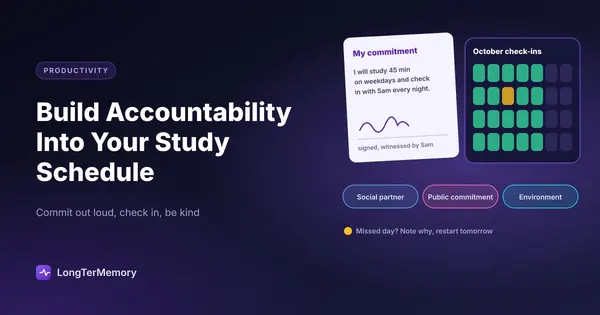
Accountability is not one-size-fits-all. What works for an extroverted student who thrives on social pressure might backfire for an introverted learner who finds external scrutiny stressful. Understanding your own motivational psychology is the first step in choosing the right structure.
Here are the four major accountability archetypes and the personalities they serve best.
| Accountability Type | How It Works | Best For | Potential Drawback |
|---|---|---|---|
| Social partner | Regular check-ins with a study buddy or group | Extroverts, competitive personalities | Scheduling conflicts, social drift |
| Public commitment | Announcing goals publicly on social media or to friends | People sensitive to social reputation | Anxiety from public failure, pressure to perform |
| Financial stakes | Betting money on completing sessions via apps like Beeminder or StickK | Loss-averse individuals | Can create stress that impairs learning |
| Coach or mentor | Regular sessions with a tutor, advisor, or mentor | Students who need guidance and external structure | Cost and availability of quality mentors |
Most students benefit from a primary and secondary structure. Your primary structure is the one you rely on daily. Your secondary structure kicks in when the primary fails. For example, your primary structure might be a study partner you text every morning. Your secondary structure might be a weekly check-in with a mentor if you missed more than two sessions that week.
If you are unsure which type fits you, start with a self-assessment. Do you find it easier to let yourself down or to let others down? If the answer is others, social or public accountability will work well. If the answer is yourself, you may need stronger external structures like coaching or financial stakes.
Using Public Commitment to Increase Study Follow-Through
Public commitment is one of the most powerful and accessible accountability tools. When you tell others about your goals, you create a reputation cost for abandoning them. This sounds manipulative, but it is simply how human social psychology works. We are wired to care about consistency in the eyes of our peers.
The key is to make the commitment specific and verifiable. Vague announcements like “I am going to study harder” create no real accountability. Specific commitments like “I will complete fifty USMLE practice questions every day for the next thirty days and post my accuracy scores each Sunday” create clear standards that others can observe.
Choose your audience carefully. Close friends and family are supportive but often too forgiving. A public forum related to your exam, such as a subreddit or Discord server for your certification, provides both support and gentle social pressure. Colleagues or classmates who are taking the same exam are ideal because they understand the stakes and the difficulty.
Document your progress publicly. A simple weekly post with what you completed, what you struggled with, and what you plan to do next week is enough. The act of writing the update forces reflection, and the expectation of the update creates a deadline you are motivated to meet.
Research on commitment devices shows that public commitments increase follow-through by 30 to 40 percent compared to private goals alone. The effect is strongest in the first few weeks and then decays slightly, which is why combining public commitment with other structures is usually more effective than relying on it alone.
How to Hold Yourself Accountable Without Harsh Self-Judgment
External accountability is powerful, but you also need an internal system for the moments when no one is watching. Self-accountability is the skill of keeping your own commitments without descending into self-criticism.
The first principle is separation of behavior from identity. Missing a study session is a behavior. It does not mean you are lazy, undisciplined, or doomed to fail. When you conflate behavior with identity, one missed session spirals into abandonment of the whole plan. When you treat it as a discrete event, you can analyze it and return to the schedule.
Use a non-judgmental tracking system. Record what you planned to do, what you actually did, and why any gap exists. No moral language. If you planned to study for two hours and studied for thirty minutes, the entry reads: “Planned 2 hours, completed 0.5 hours. Reason: unexpected work deadline. Adjustment: move tomorrow’s lighter topic to tonight and split the missed topic across Thursday and Friday.” This is problem-solving. It is not self-flagellation.
Build in recovery protocols for missed sessions. Decide in advance what happens when you fall behind. For example: “If I miss one session, I will complete a shortened version the next morning before breakfast. If I miss three sessions in one week, I will schedule a thirty-minute planning call with my study partner to diagnose the problem.” Pre-deciding the response prevents the emotional spiral that usually follows a lapse.
Building Accountability Into Your Environment
The most reliable accountability is the kind you do not have to think about. Environmental design makes productive behavior the path of least resistance and makes avoidance slightly harder.
If you study at home, remove distractions from the study space. Leave your phone in another room. Use website blockers during study hours. Prepare your materials the night before so the friction of starting is minimal. These are not willpower strategies. They are accountability structures built into the physical world.
If you study in a library or coffee shop, the simple act of going to that location creates accountability. You are less likely to browse social media in a public space where others can see your screen. The social environment does the monitoring for you.
For digital study, use apps that track your time and block distractions. Tools like Freedom, Cold Turkey, or Forest make avoidance slightly harder and studying slightly easier. The effect of each individual intervention is small, but the cumulative effect of a well-designed environment is substantial.
Study Partnerships: How to Make Them Work
A study partner is the most common accountability structure, and also the one most likely to fail. Two people agree to check in daily, and within two weeks the messages have stopped. To avoid this collapse, design the partnership with intention.
Choose a partner with similar goals and similar schedules. If one of you is preparing for the MCAT and the other is writing a novel, the shared context is too thin to sustain motivation. If one of you studies at 6 AM and the other at midnight, the check-ins will never align.
Define the check-in protocol explicitly. What time? What format? What content? A good protocol looks like this: “Every morning at 8 AM, we text each other the three tasks we will complete that day. Every evening at 9 PM, we text whether we completed them and one thing we learned. If either of us misses two check-ins in a week, we schedule a fifteen-minute call to troubleshoot.”
Use the partnership for active study, not just accountability. Quiz each other on flashcards. Explain difficult concepts to each other. Grade each other’s practice essays. The social interaction makes studying more engaging, which reduces the willpower required to maintain the habit.
If you cannot find a local partner, online communities work well. Discord servers, Reddit study groups, and dedicated accountability apps connect you with people preparing for the same exam. The principles are the same: similar goals, explicit protocols, and active collaboration rather than passive reporting.
Professional Accountability: Coaches, Tutors, and Mentors
For high-stakes exams where the cost of failure is significant, professional accountability may be worth the investment. A tutor or coach provides expertise, structure, and the knowledge that someone is monitoring your progress.
The value of a coach is not just in the content they teach. It is in the regular schedule they enforce. When you have a weekly session, you have a deadline to complete the assigned work. That external deadline is often more motivating than any internal goal.
When choosing a coach, look for someone who emphasizes active recall and practice testing rather than passive content review. A coach who lectures you for an hour is less valuable than a coach who quizzes you, identifies your weak areas, and assigns targeted practice. The best coaches function like personalized diagnostic machines, not talking textbooks.
If cost is a barrier, consider group coaching or peer mentoring. Many certification communities have experienced members who volunteer to mentor new candidates. The accountability is less intensive than one-on-one coaching, but it is often sufficient and free.
Tracking and Gamification: The Data Layer of Accountability
What gets measured gets managed. A tracking system provides objective feedback on whether your accountability structures are actually working.
The simplest effective tracker is a weekly scorecard. List your planned study hours, actual study hours, topics covered, and practice question accuracy. Calculate a completion percentage. Over time, you will see whether your accountability structures are producing consistent follow-through or merely creating the illusion of discipline.
For students who respond to gamification, apps like Habitica or Streaks turn study sessions into points, levels, and achievements. The research on gamification is mixed, some people find it motivating, others find it childish, but for the subset of learners who enjoy it, the effect on consistency can be dramatic.
The key with any tracking system is to review the data weekly, not just collect it. Data without reflection is trivia. Use your Sunday review to ask: Which accountability structures worked this week? Which failed? What will I change next week? This meta-level review is where accountability systems improve over time.
When Accountability Becomes Counterproductive
Not all accountability is healthy. If your accountability structure produces chronic anxiety, shame, or avoidance, it is doing more harm than good. Performance pressure activates the sympathetic nervous system, which impairs the hippocampal memory formation you are trying to achieve.
Signs that your accountability system has become toxic include: dreading the check-in, lying about your progress, feeling nauseous before study sessions, or abandoning the plan entirely after one missed day. If you notice these patterns, the solution is not to push harder. It is to redesign the structure.
Reduce the frequency of check-ins. Lower the public visibility of your goals. Shift from competitive accountability to supportive accountability. Replace financial stakes with social connection. The goal is consistent progress, not suffering.
Building an Accountability Ecosystem
The most effective approach is not to choose one accountability structure, but to build an ecosystem of overlapping supports. Your environment makes studying the default. Your study partner provides daily check-ins. Your public commitment provides weekly reputation pressure. Your coach provides monthly expert guidance. Your tracker provides objective feedback.
When one layer fails, the others hold. If your study partner gets sick, your public commitment still creates pressure. If you skip the public update, your coach asks about it in the next session. If you miss the coaching session, your tracker shows the gap. The redundancy is the point.
If you are looking for a digital layer to add to your accountability ecosystem, LongTerMemory provides built-in progress tracking, performance analytics by topic, and scheduled review reminders that function like a private coach. The system shows you exactly where your accuracy is dropping and adjusts your review schedule accordingly. For students who need data-driven accountability without the social pressure, this can be the perfect complement to human support structures.
Accountability is not about being perfect. It is about being consistent enough to reach your goal. Build the structures, adjust them as you learn, and trust the process. The exam will take care of itself if you take care of the daily work.