How to Prepare for the CAPM Certification as a New Project Manager
Planning to earn your CAPM? Here's everything a new project manager needs to know about study resources, prep time, and passing exam strategy.
Table of Contents
- What the CAPM Tests and How It Differs from the PMP
- The CAPM at a Glance
- CAPM vs. PMP: The Key Differences
- Study Resources and Recommended Prep Time for CAPM Certification
- How Long Does CAPM Preparation Take?
- The Primary Study Resource: PMBOK Guide
- Recommended Prep Resources
- Flashcards for Terminology Density
- Practice Question Strategy for CAPM Exam Readiness
- The Character of CAPM Questions
- How to Use Practice Questions Effectively
- Good Practice Question Sources
- Scheduling and Managing the Exam Application
- The Application Process
- Day-of Logistics
- After the CAPM: Where It Takes You
- The Bottom Line
If you’re relatively new to project management and you want to establish your credentials, the Certified Associate in Project Management (CAPM) is the natural first certification to pursue. It’s issued by the Project Management Institute (PMI), which is the most recognized body in the project management field globally. It signals that you understand project management fundamentals and have invested time in formal study, which matters whether you’re looking for your first PM role, trying to move into project work from another function, or supporting experienced project managers and want to speak the same language.
What the CAPM is not is a shortcut. It requires real preparation, it tests conceptual knowledge at a meaningful depth, and the exam has been updated in recent years to reflect a modern, hybrid approach to project management that blends traditional waterfall methodologies with agile principles. If you studied a CAPM guide from a few years ago without checking what’s current, you might find exam day full of surprises.
This guide will walk you through exactly what you need to know: what the exam covers, how it differs from the PMP, what preparation timeline is realistic, and how to approach practice questions to maximize your chances of passing.
What the CAPM Tests and How It Differs from the PMP
The CAPM at a Glance
The CAPM exam consists of 150 multiple-choice questions, of which 15 are pre-test questions that don’t count toward your score. You have 3 hours to complete it. The exam is administered through Pearson VUE testing centers or online through the proctored at-home option.
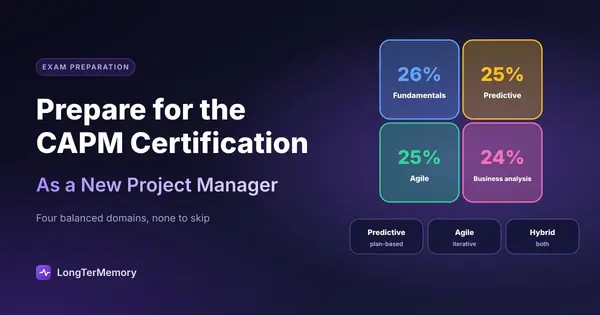
The content of the CAPM exam is organized around the following domains:
| Domain | Approximate Weight |
|---|---|
| Project Management Fundamentals and Core Concepts | 26% |
| Predictive Plan-Based Methodologies | 25% |
| Agile Frameworks and Methodologies | 25% |
| Business Analysis Frameworks | 24% |
The significant inclusion of agile content (25% of the exam) reflects PMI’s shift toward recognizing that real-world project management isn’t purely traditional or purely agile. Many projects use hybrid approaches, and the CAPM now tests whether candidates understand both worlds.
CAPM vs. PMP: The Key Differences
The Project Management Professional (PMP) is the senior credential. It requires 36 months of project management experience (or 24 months if you have a four-year degree) plus 35 hours of project management education. The CAPM has no experience requirement, though it does require 23 hours of project management education.
| Criteria | CAPM | PMP |
|---|---|---|
| Work experience required | None | 24 to 36 months PM experience |
| PM education required | 23 hours | 35 hours |
| Exam questions | 150 | 180 |
| Time limit | 3 hours | 4 hours |
| Renewal | 15 PDUs every 3 years | 60 PDUs every 3 years |
| Audience | Early-career or aspiring PMs | Experienced project managers |
The CAPM tests knowledge: do you understand the principles, frameworks, and terminology of project management? The PMP tests application: can you navigate real, complex situations that require judgment developed through years of experience?
For a new PM, the CAPM is the right starting point. Many people use it as a stepping stone, earning the CAPM early in their career and then upgrading to the PMP after they’ve accumulated the required experience.
Study Resources and Recommended Prep Time for CAPM Certification
How Long Does CAPM Preparation Take?
Most candidates spend 8 to 12 weeks preparing for the CAPM if they study consistently. That typically means 1 to 2 hours per day on weekdays, with longer sessions on weekends. If you can only study on weekends, extend your timeline to 16 to 20 weeks rather than rushing.
The 23 hours of project management education required for CAPM eligibility can be completed through a wide range of options:
- PMI’s own CAPM exam prep course
- Online courses on platforms like Udemy, LinkedIn Learning, or Coursera
- Project management bootcamps
- Academic courses that count toward the requirement
If you’re taking a prep course to meet the 23-hour requirement, time it so you’re taking it shortly before you begin intensive exam prep, not a year in advance.
The Primary Study Resource: PMBOK Guide
The foundational document for the CAPM exam is the Project Management Body of Knowledge (PMBOK Guide), published by PMI. The current edition (7th) represents a significant shift from previous editions. The 7th edition is principles-based rather than process-based, which catches some candidates off guard.
Here’s the nuance: the CAPM exam still includes questions based on process-group and knowledge-area content from the 6th edition’s framework (domains, tasks, and enablers). Most CAPM prep courses address both editions, and you’ll want a resource that explicitly covers the current exam content outline published by PMI on their website.
Get the current exam content outline from PMI directly before you begin. It’s free and tells you exactly what the exam tests at the domain and task level. That document is more valuable than any third-party study guide’s table of contents.
Recommended Prep Resources
PMI’s Authorized CAPM Prep Course: Expensive but comprehensive, and it satisfies the 23-hour education requirement. Good choice if you want an all-in-one solution.
Udemy CAPM Courses: Joseph Phillips’s CAPM course has been a popular option for years. Affordable, detailed, and frequently updated. Strong for visual learners.
The PMBOK Guide 7th Edition: Read it, don’t just skim it. It’s not a page-turner, but the concepts in it are the concepts the exam tests. Take notes as you read.
Agile Practice Guide: This is the companion document PMI publishes specifically to address agile approaches. Given that 25% of the CAPM exam covers agile, this is not optional reading.
Andrew Ramdayal’s materials: Ramdayal is widely recommended in the PMI certification community for understanding the situational judgment questions that appear in modern PMI exams.
Flashcards for Terminology Density
The CAPM involves memorizing a meaningful volume of specific terminology. Project management has a vocabulary that is precise and specific: the difference between a risk and an issue, the difference between a milestone and a deliverable, the structure of a WBS, the inputs and outputs of major processes.
Flashcards are well-suited to this content. Create cards for:
- Process group definitions and relationships
- Knowledge area content
- Key project documents and what goes in them (project charter, project management plan, communications management plan, etc.)
- Agile vocabulary (sprint, backlog, velocity, Kanban, Scrum roles)
- Business analysis terms (business requirement, stakeholder need, elicitation)
You don’t need 500 cards. A focused deck of 200 to 300 high-yield terms, reviewed daily through spaced repetition, will serve you better than an exhaustive deck that you can’t maintain.
Practice Question Strategy for CAPM Exam Readiness
The Character of CAPM Questions
Modern CAPM questions are increasingly situational and judgment-based rather than purely definitional. Instead of asking “What is the definition of scope creep?”, the exam might present a scenario:
“A project manager is three weeks into a six-week project. A key stakeholder requests an additional feature that wasn’t in the project scope. The project manager updates the project scope document and begins work on the new feature. What mistake did the project manager make?”
Questions like this test whether you can apply project management concepts to realistic situations, not just recall them. Candidates who prepare only by memorizing definitions and process inputs/outputs will struggle with this format.
Correct thinking for scenario questions: ask yourself “What would a PMI-certified project manager do in this situation?” PMI has a specific worldview that values:
- Proactive risk management over reactive problem-solving
- Formal change control processes
- Stakeholder communication and engagement
- Ethical behavior and professional responsibility
- Following the plan while being adaptable
When in doubt, choose the answer that follows formal process, communicates proactively, and manages risk systematically.
How to Use Practice Questions Effectively
The most effective practice question strategy for the CAPM involves deep error review, not just high question volume.
After every practice session:
-
For each wrong answer, write down why you got it wrong. Was it a knowledge gap? Did you misread the question? Did you eliminate the right answer too early?
-
For each right answer that you were unsure about, write down what reasoning you used to get there. Reinforce the logic, not just the result.
-
Look for patterns in your wrong answers. Are you consistently missing questions about agile? About scope management? About procurement? Patterns tell you where to focus your review.
Target 300 to 400 practice questions before your exam, spread across your study period. Do them in sets of 25 to 50 at a time, simulating the paced thinking of an actual exam.
Do at least two full-length timed practice exams in the final two weeks before your exam date. This is partly knowledge review and partly conditioning, you need to train your attention to stay focused and your pacing to stay controlled for the full 3-hour duration.
Good Practice Question Sources
- PMI’s official practice exam (available through their prep resources)
- PrepCast CAPM simulator (very high-quality, updated to current exam format)
- RMC Learning Solutions
- Any Udemy course that includes a question bank with current content (check reviews and update dates)
Avoid question banks from resources that haven’t been updated to reflect the current exam content outline. An outdated question bank can actively mislead you about what the exam tests.
Scheduling and Managing the Exam Application
The Application Process
The CAPM application is submitted through PMI’s online portal. You’ll need to provide:
- Your contact and professional information
- Documentation of your 23 hours of project management education
- Agreement to PMI’s ethics policy
PMI audits a percentage of applications, which means some candidates are required to submit additional documentation. Build extra time into your timeline to allow for this possibility.
Once your application is approved, you have one year to schedule and sit for the exam. Schedule early, within the first 60 days of your eligibility window, even if your exam date is months away. This creates a fixed deadline that sustains your study momentum.
Day-of Logistics
For an in-person Pearson VUE exam:
- Arrive at least 30 minutes early
- Bring a government-issued photo ID
- The testing center will provide scratch paper and pencils; use them for notes and process of elimination work during the exam
For the online proctored option:
- Test your technical setup thoroughly in advance (webcam, microphone, internet speed, approved testing space)
- Clear your testing area of books, notes, second monitors, and other prohibited items
- Do a dry run of the ProctorU or Pearson OnVUE check-in process
After the CAPM: Where It Takes You
Earning the CAPM doesn’t end your professional development, it starts a more defined path. The designation is valid for five years, with a renewal option via 15 Professional Development Units (PDUs). In practice, most CAPM holders are accumulating experience toward the PMP during those five years.
Use the period after passing the CAPM to pursue real project work, even informally. Volunteer to coordinate team projects at work. Shadow experienced PMs. Take on coordination responsibilities in any capacity. The PMP experience requirement isn’t just a bureaucratic threshold, it’s recognition that project management is learned by doing, and the CAPM is the beginning of that learning, not the end.
With LongTerMemory, you can upload your CAPM study materials and let the platform generate spaced practice questions automatically, making sure the vocabulary and frameworks stay sharp throughout your preparation rather than fading between study sessions.
The Bottom Line
The CAPM certification is an achievable, valuable credential for new project managers. It requires real preparation, focused on both the foundational knowledge of project management frameworks and the judgment required to navigate scenario-based questions. The exam is not a knowledge-dump test, and candidates who study that way tend to struggle.
Understand what the current exam tests. Use the PMBOK Guide and Agile Practice Guide as primary sources. Build a terminology flashcard deck. Do 300 to 400 practice questions with deep error analysis. Take full-length timed practice exams before the real thing.
The CAPM doesn’t make you an experienced project manager. But it demonstrates that you’ve taken the fundamentals seriously, and that matters to employers, clients, and the experienced PMs who will decide how much responsibility to hand you.