How to Study for the PMP Exam While Working in Project Management
Balancing PMP exam prep with a full-time project management job? Learn a realistic study plan, schedule tactics, and situational question strategies.
Table of Contents
- How your real-world PM experience helps, and where it can mislead you
- Fitting PMP study into a project manager's busy schedule
- Prioritizing situational practice questions over content memorization
- Building your PMP study plan around process groups and knowledge areas
- The best study resources for busy project managers
- Protecting your energy: sleep, boundaries, and momentum
- A technology boost: turning PMBOK and study PDFs into spaced repetition flashcards
- The bottom line
If you are a working project manager preparing for the PMP (Project Management Professional) exam, you already have the hardest credential in the room: a real job running projects. The challenge is not whether you can understand the material. The challenge is finding enough focused hours while status meetings, stakeholder emails, and deadlines keep coming.
The good news is that your daily experience is one of the best PMP exam prep assets you can have. The exam is built around the same processes you already live, even if the PMBOK Guide frames them more formally than your workplace does. This guide will show you how to turn that experience into exam points, how to protect study time without quitting your job, and why situational practice questions matter far more than memorizing definitions.
How your real-world PM experience helps, and where it can mislead you
Your project management background gives you a head start, but only if you learn where PMI language differs from your office vocabulary.
Working project managers already understand the rhythm of initiation, planning, execution, monitoring, and closure. You have lived charter approvals, scope changes, risk escalations, and stakeholder conflicts. That lived context is powerful because the PMP exam rarely asks you to recite inputs and outputs in isolation. It asks what a project manager should do next when a vendor misses a deadline, a sponsor changes scope, or a team conflict threatens a milestone.
That said, experience can also work against you. Many organizations run projects with informal processes, customized templates, or terminology that diverges from PMI standards. If your company calls a risk register a “risk log,” treats change control as optional, or skips formal procurement documents, you may answer PMP questions based on habit rather than on the PMI framework.
The fix is to treat your experience as evidence, not authority. When a practice question surprises you, ask why PMI prefers a different answer. Usually the difference comes down to process sequence, stakeholder priority, or formal governance. Use your real projects as mental case studies, but let the PMBOK Guide, Seventh Edition, and the PMI process groups shape your final answer.
Common traps where experience misleads:
- Skipping the charter. In the real world, some projects start with an email. On the exam, a project should not proceed without an approved project charter.
- Mixing change control with execution. The exam rewards clear separation: evaluate the change, decide through the Change Control Board, then update baselines before doing the work.
- Communicating directly instead of following the plan. You may know the right person to call, but the exam often wants the action that follows the communications management plan first.
- Prioritizing schedule over process. Crashing or fast-tracking can look correct, but only after you have verified scope, risk, and change impacts.
Fitting PMP study into a project manager’s busy schedule
The only realistic PMP study plan is one that fits inside your existing calendar, not one that assumes you will suddenly gain twenty free hours a week.
Most working project managers need 10 to 15 hours of focused study per week for roughly 10 to 14 weeks to reach exam readiness. That estimate assumes you already understand project basics. If you are newer to formal project management, budget closer to 150 to 200 total hours. The key is consistency: four short sessions during the workweek plus one longer weekend block beats two marathon days that leave you exhausted.
Here is a schedule template that works for full-time project managers:
| Day | Study block | Focus |
|---|---|---|
| Monday | 45 to 60 minutes after work | Review one knowledge area or process group |
| Tuesday | 45 to 60 minutes after work | 30 to 40 practice questions with full review |
| Wednesday | 45 to 60 minutes after work | Weak-area deep dive from missed questions |
| Thursday | 45 to 60 minutes after work | 30 to 40 practice questions, mixed domain |
| Friday | Off or 20 minutes of flashcards | Light review only |
| Saturday | 2.5 to 3 hours | New content reading or simulation exam |
| Sunday | 1 to 1.5 hours | Review notes, plan the week ahead |
Treat these blocks like project tasks. Put them on your calendar, set a status, and defend them the way you would defend a critical path milestone. If a stakeholder meeting appears during your Tuesday study block, reschedule the block rather than deleting it.
Micro-sessions are also valuable. A 20-minute commute review of flashcards, a lunch quiz of ten situational questions, or a 15-minute audio summary can add another 2 to 3 productive hours per week without touching your evening plans. The compounding effect is real.
Protect your study time with three boundaries:
- Tell your manager early. Framing PMP prep as professional development makes it easier to protect calendar blocks and reduces guilt when you leave on time.
- Batch low-value tasks. Cluster email responses and status updates so they do not bleed into your protected study window.
- Create a shutdown ritual. A five-minute end-of-work transition, closing your laptop, changing rooms, or making tea signals your brain that the project manager hat is off and the student hat is on.
Prioritizing situational practice questions over content memorization
The PMP exam is not a vocabulary test. It is a decision-making test that rewards your ability to apply the PMI framework to ambiguous, realistic scenarios.
Roughly 80 percent of the exam is situational. These questions present a short story, then ask what you should do first, next, or best. The wrong answers are rarely absurd. They are plausible actions that a busy project manager might take, but they skip a required step, violate a process sequence, or ignore a stakeholder.
Because of this, practice questions should be your primary study method, not a side activity. Reading the PMBOK Guide cover to cover without answering questions is like reading a cookbook without cooking. You need the reps.
A smart question strategy has three phases:
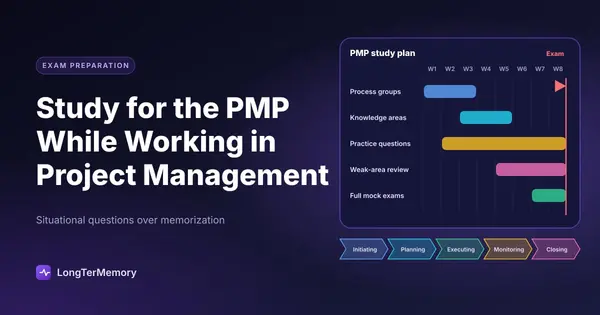
Phase 1: Diagnostic exposure (weeks 1 to 2) Answer 30 to 50 questions per major domain without worrying about your score. Your goal is to discover where your instincts align with PMI and where they conflict. Track every miss in a simple log.
Phase 2: Targeted, domain-by-domain practice (weeks 3 to 8) After you review a knowledge area, immediately do 40 to 60 questions on that topic. Read every explanation, even for correct answers. The explanations reveal PMI logic: why one answer is best, why another is tempting but premature, and why a third is out of scope.
Phase 3: Mixed, timed simulations (weeks 9 to 12) Stop domain-specific sets. Move to full 180-question simulations under realistic timing, about 1.3 minutes per question. This builds stamina and reduces the panic that hits candidates around question 120.
When reviewing situational questions, ask these four filters:
- What process group are we in?
- What is the next logical step according to PMI?
- Who is the key stakeholder the question is testing?
- Are there qualifiers like “first,” “best,” “most likely,” or “except” that change everything?
These filters train you to read the question before you read the answers, which prevents answer choices from anchoring your thinking.
Building your PMP study plan around process groups and knowledge areas
A strong PMP study plan is structured, not random. Start with the exam blueprint and work backward.
The current PMP exam is organized around three domains:
| Domain | Exam weight | What it tests |
|---|---|---|
| People | 42% | Leadership, team performance, conflict, stakeholder engagement |
| Process | 50% | Technical project management across process groups and knowledge areas |
| Business Environment | 8% | Strategy, compliance, organizational change, benefits management |
The Process domain carries the most weight, but the People domain often determines whether experienced project managers pass. Real-world leaders sometimes over-rely on authority or informal influence, while the exam rewards servant leadership, emotional intelligence, and planned engagement.
For each domain, follow this loop:
- Read the relevant section of the PMBOK Guide or a trusted prep book.
- Watch one concise video summary if you are a visual learner.
- Answer 30 to 50 practice questions on that domain.
- Log your mistakes and the reasoning behind them.
- Use flashcards or a spaced repetition app to revisit weak concepts at expanding intervals.
This loop turns passive reading into active recall, which is the single most effective way to move information into long-term memory.
The best study resources for busy project managers
You do not need every book on the market. You need a small, reliable stack that matches your schedule.
Core resources:
- PMBOK Guide, Seventh Edition plus the PMI Process Groups: A Practice Guide. These define the language of the exam.
- Rita Mulcahy’s PMP Exam Prep or another well-reviewed prep manual. These translate dry standards into practical explanations.
- A high-quality question bank. Look for at least 1,000 practice questions with detailed explanations. Full-length simulations are essential.
- A flashcard or spaced repetition system. Use it for process sequences, formulas, and definitions you keep missing.
Optional but helpful:
- PMI study hall or an official PMI practice exam for the closest experience to test day.
- Video courses for commute or gym time, as long as you pair them with active practice.
- A study group or accountability partner who checks in weekly. Peer pressure, used lightly, works.
Avoid the trap of collecting resources instead of using them. One prep book, one question bank, and one flashcard system used consistently will outperform a shelf of untouched materials.
Protecting your energy: sleep, boundaries, and momentum
Studying while working full time is a stamina game. The material is manageable, but the sustained effort can wear you down if you ignore recovery.
Memory consolidation happens during sleep. Cutting sleep to squeeze in extra study hours usually backfires. Aim for seven to eight hours, especially in the final week. A rested brain answers situational questions faster and with fewer careless errors.
Set realistic weekly targets. If you plan 15 hours but only complete 10, that is not failure. It is data. Adjust your timeline rather than abandoning the plan. Most working project managers benefit from a 12-week runway rather than an 8-week sprint.
Celebrate small wins. Finishing a domain, hitting 75 percent on a practice set, or completing a full simulation are all worth acknowledging. Momentum is easier to maintain when you can see progress.
A technology boost: turning PMBOK and study PDFs into spaced repetition flashcards
Reviewing dense certification material does not have to mean copying every definition by hand. Modern study tools can extract the key concepts from your PMBOK sections, prep notes, or PDF handouts and turn them into active recall flashcards.
LongTerMemory is built for exactly this. Upload your PMBOK excerpts, study PDFs, or class notes, and it generates AI flashcards and Q&A pairs from them. More importantly, it schedules your review using spaced repetition, so you revisit each concept right before you are about to forget it. That is especially useful for PMP candidates who need to keep process sequences, formulas, and situational patterns fresh across a 10 to 14 week study plan.
If you are studying while working, efficiency matters. A tool that automates flashcard creation and review scheduling gives you back hours every week without sacrificing retention.
The bottom line
Passing the PMP exam while working in project management is absolutely doable. In fact, your real-world project experience is one of the strongest predictors of success, as long as you translate that experience into PMI’s framework.
The candidates who pass follow a simple pattern. They protect consistent study blocks. They prioritize situational practice questions over passive reading. They use their mistakes as a map of what to review. And they lean on spaced repetition to keep the details accessible under exam pressure.
You do not need to quit your job, disappear from your family, or memorize every page of the PMBOK Guide. You need a realistic plan, a reliable question bank, and the discipline to show up week after week. Start this week with a diagnostic quiz and a calendar block. By exam day, you will be glad you did.